
TL;DR – in the newest Namecheap Domain Insights & Trends Report included registrations comparison of 2024 vs 2025, with trends and signals for 2026. The dataset is based on Namecheap’s proprietary registration data and reflects activity across more than 22 million domains under management.
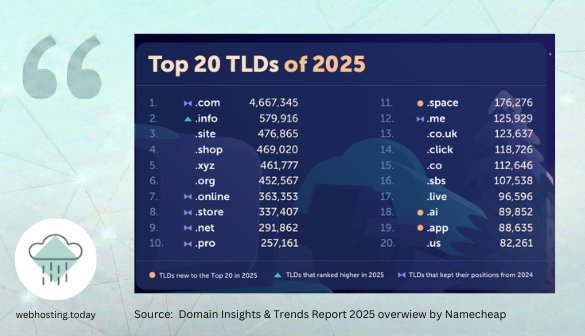
.com is still the largest TLD, but keeps shrinking YoY
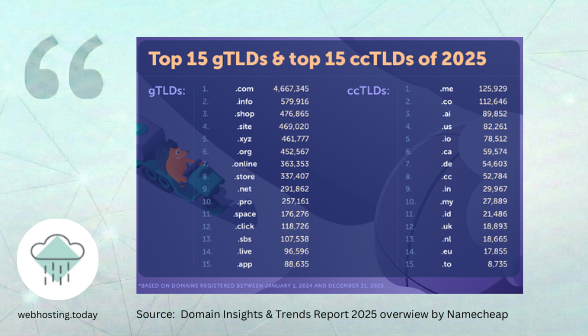
In absolute numbers, .com remains the single largest TLD at Namecheap.
According to the 2025 report:
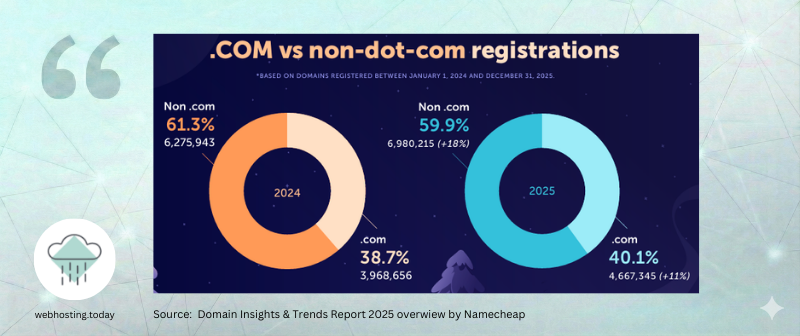
- new .com registrations in 2025: 4.67 million,
- year-over-year growth (2025 vs 2024): +11%,
- share of new registrations in 2025 – .com: 40.1% and non-.com: 59.9%.
2024 Namecheap’s report, which we also covered on webhosting.today, showed the same direction – .com domains were losing year over year to alternative TLDs.
Five years ago, .com accounted for more than 50% of new registrations at large registrars. The 2024 and 2025 data shows that this is no longer the case.
For registrars and shared hosting providers, this reduces the strategic value of positioning .com as the primary upsell anchor. It still matters for volume and renewals, but it no longer defines the market baseline as it did in the past.
Alternative TLDs are no longer a niche
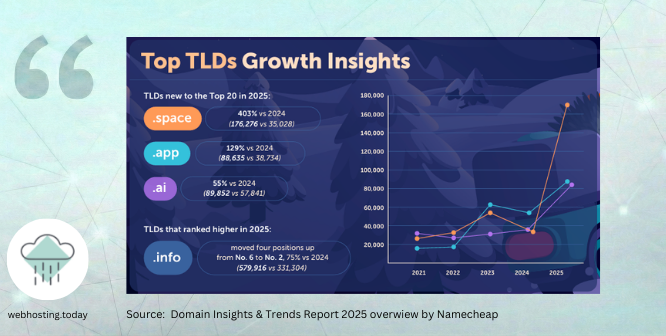
The 2025 data shows that alternative TLDs, are not growing evenly. Growth concentrates around clear-use, function-oriented extensions.
Notable movements:
- .space: +403% year over year
- .app: +129%
- .ai: +55%
At the same time, .info moved from position #6 to #2 in the Top 20 TLDs, with 75% growth year over year.
This matters because it contradicts the idea that only “trendy” TLDs grow. Some growth is driven by price, availability, and clarity, not branding experiments
Country-code TLDsare still important
Among ccTLDs, the strongest performers were:
- .me
- .co
- .ai
- .us
- .io
The report explicitly shows that ccTLDs are increasingly used as semantic tools, not just geographic markers. For hosting companies operating in multiple regions, this reinforces a known pattern – customers increasingly expect localized domain options without localized infrastructure commitments.
Most customers still own one domain
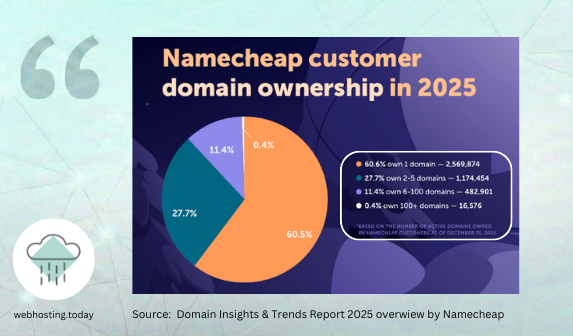
Despite expanding TLD choice, 60.5% of Namecheap customers own one domain and 27.7% own 2–5 domains.
Only 0.4% own more than 100 domains
This confirms that the majority of the market is still driven by individuals and very small businesses, not domain investors or portfolio operators.
For hosting, this limits the upside of strategies built purely around bulk domain ownership or advanced portfolio tooling
New TLD launches show mixed results
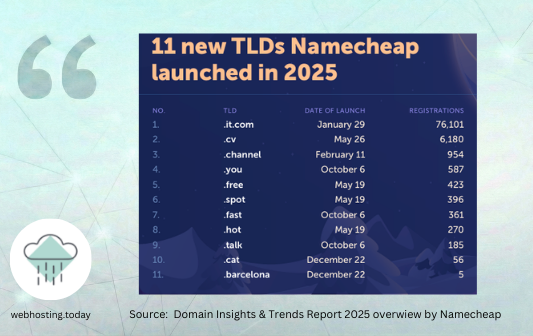
Namecheap launched 11 new TLDs in 2025. Only one showed meaningful adoption:
- .it.com: 76,101 registrations
Most others remained below four-digit registration counts.
This reinforces a pattern seen repeatedly over the past decade:
launching a new TLD does not create demand by itself. Distribution, pricing, and existing semantic familiarity matter more than novelty
Bottom line
This report shows that domains are increasingly treated as functional components, not identity statements for companies and individuals. Customers optimize for price, clarity, and availability, not prestige.
Most customers remain small (with 1 domain), cautious, and cost-sensitive.
For hosting providers, this aligns with patterns already visible in consolidation, product bundling, and platform strategy across the industry.
Sources
- Namecheap Domain Insights & Trends Report 2025,
- Namecheap official announcement, January 29, 2026
- Namecheap 2024 report (historical comparison).
Name cheap 2024 report

Damian Andruszkiewicz
Author of this post.