

TL;DR – new WordPress connects websites through API with the Internet Archive. When an outbound link dies, instead of 404s, users are redirected to an archived copy of the resource. For public sites, this is frictionless resilience. For private environments, it’s a real privacy risk.
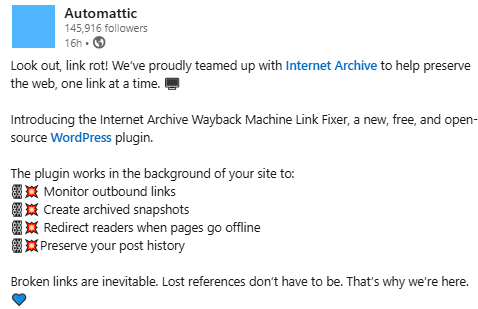
What new plugin does
1. Redirects broken links automatically
When a visitor clicks a link that returns a 404, the plugin intercepts the request.
Instead of an error page, the user is redirected to the last archived version of that page stored by the Wayback Machine.
If the original site comes back online, the redirect stops and the live link is used again.
2. Archives links at publish time
When an author publishes a post, the plugin checks whether outbound links already exist in the Internet Archive.
If not, it triggers an immediate snapshot.
At the same time, it also archives the author’s own post.
In practice, this turns every published WordPress article into a small preservation event.
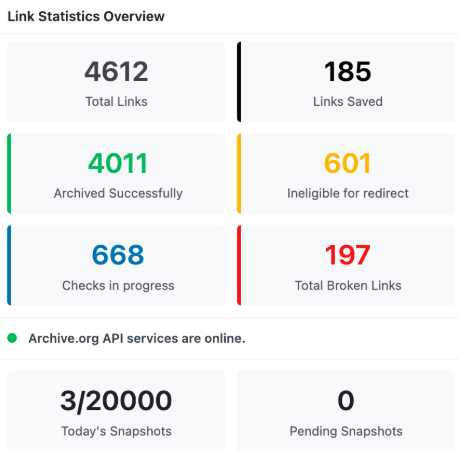
Pros and cons of new plugin
1. Less support overhead
Dead links will no longer need to be fixed via heavy scanning plugins or manually by the support team. Link Fixer offloads the work to the Internet Archive’s API ,Client sites stay intact and avoid SEO decay without ongoing maintenance.
2. Privacy concerns
This is the critical point to communicate clearly to customers. They should not use this plugin on:
- staging environments,
- intranets,
- membership or gated-content sites.
To function, the plugin sends URLs to the Internet Archive.
Once submitted, those URLs can become part of the public historical record.
If a customer installs this on a staging site with private content, that might end up publicly accessible via the Wayback Machine.
3. External dependency
All link recovery depends on the Internet Archive being reachable.
If its API is down, link fixing stops.
It’s an excellent fallback, but it introduces a hard third-party dependency into the content layer.
Internet Archive Wayback Machine Link Fixer is a smart, free tool that addresses a real structural problem of the web: content decay.
For public blogs, news sites, and long-lived content, it adds real value at almost zero cost.

Damian Andruszkiewicz
Author of this post.