
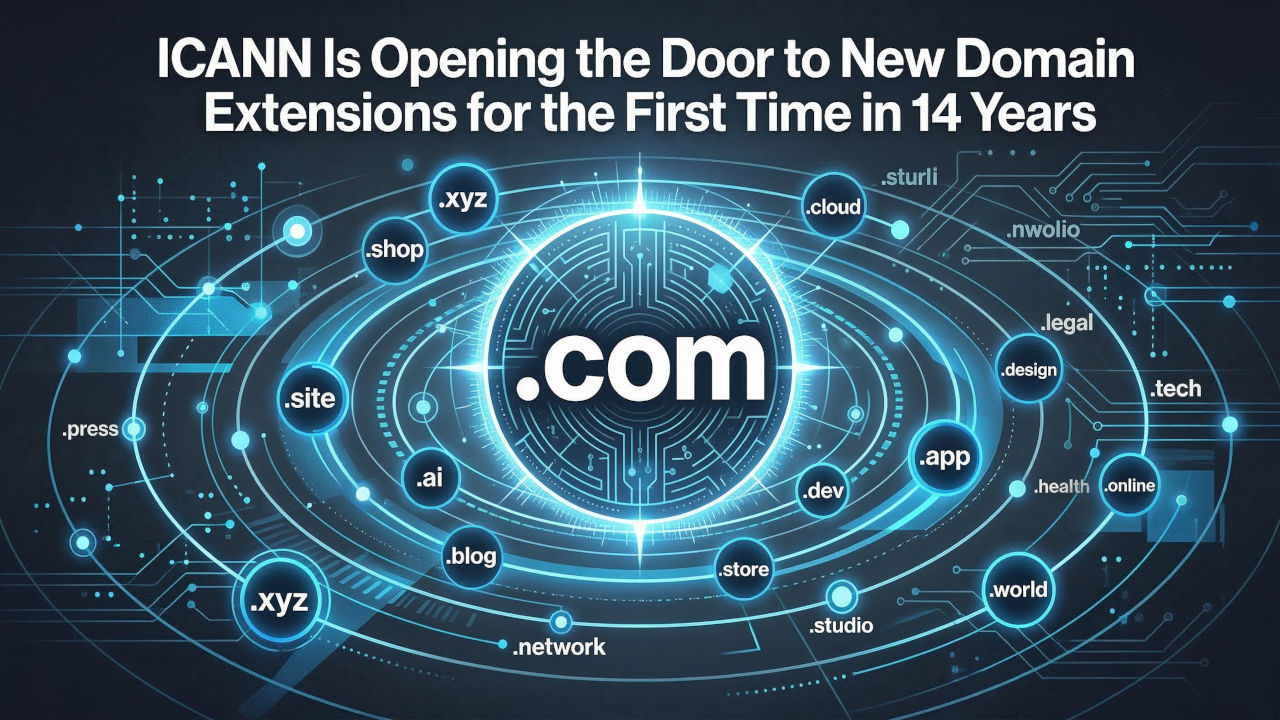
On April 30, 2026, ICANN will open the application window for new generic top-level domains (gTLDs) – the first such opportunity since the 2012 round that created extensions like .xyz, .shop, .online, and over 1,200 others. The window will remain open for 105 days, closing on August 12, 2026. For the hosting and domain industry, this is the most significant structural change to the domain name system in over a decade.
The 2012 round generated 1,930 applications. It resulted in 1,241 new gTLDs being delegated into the DNS root zone. It fundamentally reshaped the domain market – new gTLDs now account for approximately 11.3% of all domain registrations, with the most successful extensions (.top, .xyz, .shop) each carrying millions of registrations. And it created an entirely new category of registry operators, many of whom are now significant players in the domain ecosystem.
The 2026 round will be different in important ways. ICANN has spent the intervening years developing policy changes informed by the 2012 experience – and several of those changes directly affect the strategic calculus for hosting businesses considering participation.
What Has Changed Since 2012
The Applicant Guidebook, published December 16, 2025, introduces several significant policy shifts:
Closed generics are prohibited. In the 2012 round, an applicant could apply for a generic term – .book, .cloud, .shop – and operate it as a closed registry, restricting registrations to their own organization. That is no longer permitted. All generic TLDs must now be operated in an open and non-discriminatory manner. This prevents a single company from monopolizing a generic namespace and ensures that new extensions function as public resources.
Private contention resolution is banned. When multiple parties applied for the same string in 2012, they could resolve the conflict privately – through joint ventures, buyouts, or other negotiated settlements. In 2026, all unresolved contention sets must proceed to an ICANN-run auction. Applicants who attempt private deals face application cancellation and potential exclusion from future rounds. This change eliminates the behind-the-scenes deal-making that characterized the 2012 round and ensures that contested strings are allocated through a transparent process.
Pre-approved Registry Service Providers (RSPs) can fast-track applications. ICANN now allows technical providers to be vetted in advance through an RSP Pre-Evaluation Program. Applicants who select a pre-approved RSP skip the technical evaluation entirely, reducing both the timeline and the cost of the application process. For hosting companies that lack registry operations expertise, partnering with a pre-approved RSP is the most practical path to participation.
A replacement string option adds strategic flexibility. Applicants can now include an alternative string in their initial application. If their primary choice enters contention with another applicant, they can switch to the alternative at no additional cost – a safety valve that did not exist in 2012.
The Cost of Entry
The application fee is $227,000 – up from $185,000 in 2012, an approximately 23% increase. The fee is set on a cost-recovery basis to fund the program without drawing on ICANN’s operating budget.
But the application fee is only the beginning. Total costs including compliance deposits, annual ICANN registry fees, and the technical infrastructure required to operate a TLD can exceed $350,000. For .brand applicants, an additional $500 evaluation fee applies, along with a requirement to submit a valid trademark file from the Trademark Clearinghouse.
For most hosting businesses, the direct cost of applying for and operating a gTLD is prohibitive unless the extension serves a clear strategic purpose – such as a vertical-specific domain (.hosting, .cloud) that aligns with the company’s market position and can generate registration revenue at scale.
The Applicant Support Program
ICANN’s Applicant Support Program (ASP) offers a 75-85% reduction in the evaluation fee for eligible entities from underserved or developing regions, or those pursuing non-commercial public interest goals – bringing the cost down to approximately $34,000-$57,000.
The program has seen dramatically greater interest than in 2012. ICANN received 75 ASP applications from 27 countries, compared to just 3 applications in the 2012 round. The Asia-Pacific region accounts for the largest share (38 applications), followed by North America (20) and Africa (10). ICANN has indicated capacity to support approximately 40 qualified applicants.
The .com Pricing Context
The new gTLD round arrives against a backdrop of rising .com prices. Verisign has raised .com wholesale prices by 7% annually from 2021 through 2024, bringing the current wholesale rate to $10.26 per domain. The next increase – likely to approximately $10.98 – is expected no earlier than September 2026, with the Verisign-ICANN contract permitting 7% annual increases through 2030.
For hosting providers that bundle domain registration with hosting plans, this is a margin issue. Each .com price increase either compresses the hosting provider’s margin on bundled domains or forces a retail price adjustment that makes the bundle less attractive. New gTLDs – particularly those with lower wholesale pricing – offer an alternative for providers looking to maintain competitive bundle pricing.
However, the economics of new gTLD registrations come with a caveat. Data from the 2012 round shows that many new gTLD registrations are speculative or short-term. The quarterly renewal rate for .xyz, for instance, was just 22.2% in Q2 2025 – far below the renewal rates for legacy extensions. For hosting providers, bundling a new gTLD domain with a hosting plan only makes business sense if the customer retains both the domain and the hosting account.
The Abuse Problem
One factor that hosting providers should weigh carefully: new gTLDs have a disproportionate association with abuse. According to industry data, new gTLDs accounted for approximately 11% of domain registrations in 2023-2024 but were linked to 37% of reported cybercrime cases in the same period. Several hosting providers have already banned certain new gTLDs from their platforms due to widespread misuse.
For hosting businesses, this creates a practical tension. New gTLD registrations represent revenue, but domains on abuse-prone extensions also generate support overhead, reputational risk, and potential blacklisting of shared infrastructure. Any strategy around new gTLD promotion should include abuse mitigation planning.
What This Means for Hosting Businesses
Most hosting companies will not apply for a gTLD – and should not. The cost, complexity, and ongoing operational burden of running a registry are not justified for businesses whose core competency is hosting, not domain management. The exceptions are large hosting groups with integrated registrar operations and a strategic reason to own a specific namespace.
The indirect impact is more significant than the direct one. A new wave of gTLDs will create new domain registration revenue for hosting providers that also operate as registrars or resellers. It will require DNS infrastructure updates to support new extensions. And it will introduce new options for domain bundling that may help offset rising .com costs.
Watch the timeline. Applications open April 30, 2026, but the first new TLDs from this round are unlikely to be delegated before late 2027 or 2028, based on the 2012 precedent where the first delegations took approximately 17 months from application close. Hosting providers have time to prepare – but preparation should start now, particularly for registrar integration and customer communication planning.

Łukasz Nowak
Nearly two decades in IT. A decade in web hosting - and still in the trenches. Writing about the infrastructure that runs the internet from the inside.
Sources
- ICANN — New gTLD Program: 2026 Round
- ICANN — 2026 Round Applicant Guidebook (PDF, December 2025)
- ICANN — How Much Will It Cost to Apply for a New gTLD?
- ICANN Blog — A Year of Progress on the Path to Opening the 2026 Round (December 2025)
- ICANN — New gTLD Program Statistics
- Domain Name Wire — Verisign Can Increase .com Prices in 2026
- FairWinds — What's New in the 2026 gTLD Application Round
- CircleID — Deadline Announced for 2026 New Top-Level Domain Applications