
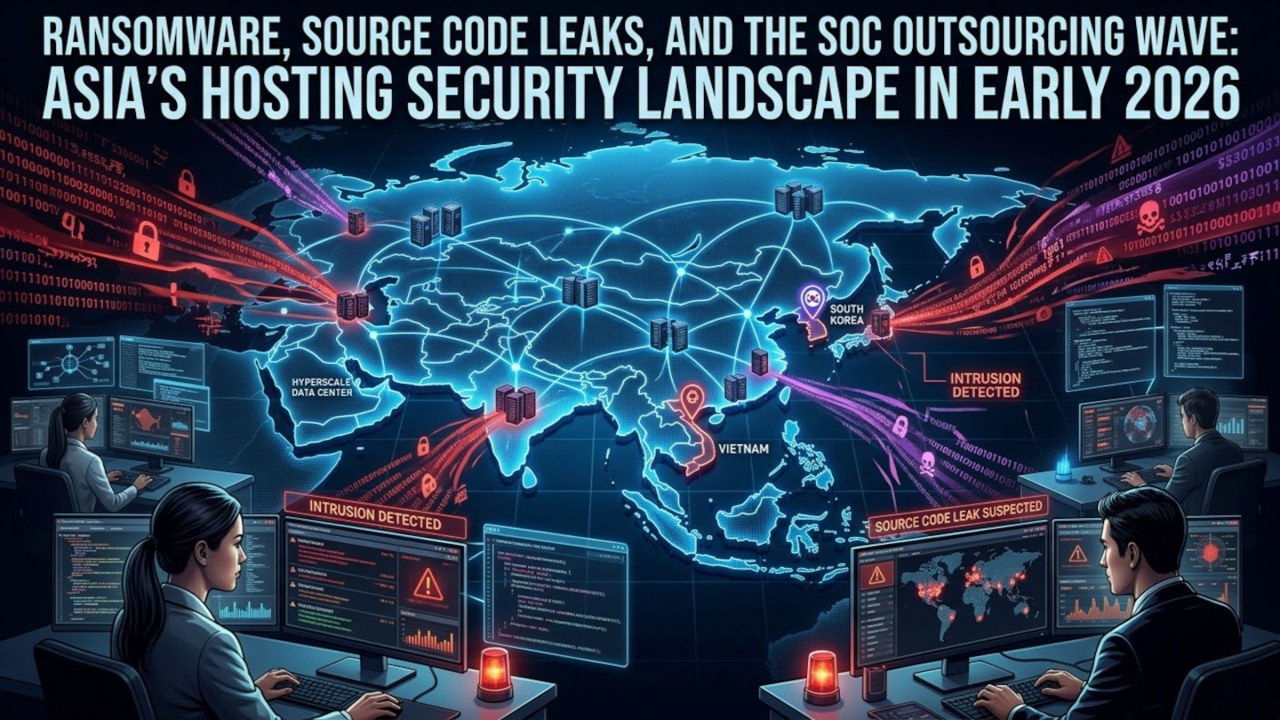
While the Asian hosting industry’s attention in early 2026 has been dominated by data center investments and regulatory changes, the security threat landscape has been evolving just as rapidly – and with more immediate operational consequences. The incidents and trends from February and March 2026 paint a picture of a region where cyber threats are increasing in sophistication, where the attack surface is expanding faster than defensive capabilities, and where the economics of security are pushing the industry toward a fundamental restructuring of how protection is delivered.
South Korea: A Quarter of High-Profile Breaches
South Korea experienced a cluster of significant security incidents in February 2026 that collectively illustrate the breadth of the current threat landscape.
According to AhnLab’s ASEC threat intelligence unit, the source code of a Korean accounting automation software company was listed for sale on BreachForums during the fourth week of February. Source code theft represents one of the most damaging categories of breach for software companies – it exposes intellectual property, reveals potential vulnerabilities that can be exploited in future attacks, and undermines customer trust in the integrity of the product.
In the same reporting period, ransomware attacks targeted Korean pharmaceutical companies and secondary battery component manufacturers. These are not random targets. Pharmaceutical and advanced manufacturing companies hold high-value intellectual property and operate under time pressure that makes them more likely to pay ransoms – a calculus that ransomware operators understand and exploit.
For hosting providers, the South Korean incidents carry a specific warning. The accounting software breach likely originated through a supply chain or infrastructure compromise – exactly the kind of attack vector that hosting environments can either enable or prevent. When a customer’s source code is exfiltrated from hosted infrastructure, the hosting provider’s security posture is invariably scrutinized, regardless of where the actual vulnerability lay. In a regulatory environment where – as Singapore’s updated Cybersecurity Act makes explicit – outsourcing does not transfer responsibility, customers will increasingly demand that their hosting providers can demonstrate they were not the weak link.
Vietnam: The SOC Outsourcing Tsunami
Perhaps the most striking data point from the quarter comes from Vietnam, where a survey of IT security leaders found that 96% of Vietnamese enterprises plan to outsource some or all of their Security Operations Center (SOC) functions, with 37% intending to fully delegate SOC operations to third-party providers via SOC-as-a-Service models.
A note on methodology: the 96% figure comes from a survey of IT security decision-makers at Vietnamese enterprises, not a census of all businesses. It reflects the views of companies that have dedicated IT security functions – a population that skews toward larger, more digitally mature organizations. The actual percentage across all Vietnamese businesses, including SMEs without formal IT security roles, would be lower. That said, among the companies that matter most to hosting providers – those with meaningful IT budgets and security requirements – the trend is overwhelming.
The drivers behind this shift are structural, not cyclical:
- Talent scarcity. Vietnam’s cybersecurity workforce cannot keep pace with the demand created by the country’s rapid digital transformation. Building an in-house SOC requires specialized analysts, threat intelligence capabilities, and 24/7 staffing – resources that most Vietnamese enterprises cannot recruit or retain at competitive cost.
- Sophistication gap. The threat landscape has evolved beyond what basic in-house security teams can monitor and respond to. Advanced persistent threats, ransomware-as-a-service operations, and AI-augmented attack techniques require tooling and expertise that are impractical for individual companies to develop independently.
- Regulatory pressure. As cybersecurity regulations tighten across the region, enterprises face compliance obligations that require documented security monitoring, incident response capabilities, and audit trails – capabilities that are more cost-effectively delivered through specialized providers than built in-house.
The Revenue Opportunity for Hosting Providers
The convergence of rising threats and outsourcing demand creates a significant revenue opportunity for hosting companies that can integrate managed security services into their offerings.
The logic is straightforward. Hosting providers already operate the infrastructure that needs to be protected. They have visibility into network traffic, system logs, and application behavior that external security vendors must reconstruct through integrations. And they have existing customer relationships and billing relationships that make adding security services a natural extension of the commercial model.
The specific services with the strongest demand signal in early 2026 include:
- Managed Detection and Response (MDR) – continuous monitoring and threat response integrated directly into the hosting platform, eliminating the integration overhead that customers face when using standalone security providers.
- Compliance-as-a-Service – automated compliance monitoring, audit trail generation, and regulatory reporting tailored to the specific frameworks applicable in each market (China’s CSL, Hong Kong’s Critical Infrastructure Ordinance, Singapore’s Cybersecurity Act).
- Incident Response Retainers – pre-negotiated incident response agreements that give customers access to forensics and remediation expertise within guaranteed response times, addressing the regulatory requirement for timely breach reporting.
- Backup and Ransomware Recovery – immutable backup solutions and tested recovery procedures that reduce customers’ exposure to ransomware and their incentive to pay ransoms.
Hosting providers that successfully execute on managed security can expect two benefits beyond direct revenue. First, security services create deep customer lock-in – switching hosting providers is inconvenient, but switching hosting and security providers simultaneously is operationally daunting. Second, security-capable providers can command pricing premiums in a market where commodity hosting margins are under severe pressure.
The Risk of Inaction
The flip side of the opportunity is equally clear. Hosting providers that do not invest in security capabilities face a compounding set of risks:
- Customer attrition as enterprise buyers consolidate their hosting and security spend with providers that can deliver both.
- Regulatory exposure as new laws across the region hold infrastructure providers to higher standards of security governance.
- Reputational damage when – not if – a customer breach is traced to inadequate infrastructure-level protections.
The security landscape in Asia is not improving on its own. Threats are escalating, attack surfaces are expanding, and regulatory expectations are rising. For hosting providers, the question is no longer whether to invest in security capabilities, but how quickly they can bring those capabilities to market.

Łukasz Nowak
Nearly two decades in IT. A decade in web hosting - and still in the trenches. Writing about the infrastructure that runs the internet from the inside.
Sources
- ASEC AhnLab - Ransom & Dark Web Issues, February 2026 Week 4 (Korean)
- Pages.kr - 2026 Security News and Business Announcements (Korean)
- GQS Singapore - Singapore Cybersecurity Regulations in 2026
- IAPP - China's Cybersecurity Law Amendments Introduce AI Provisions
- DPS Media - Vietnam Hosting & VPS Industry Report 2026