
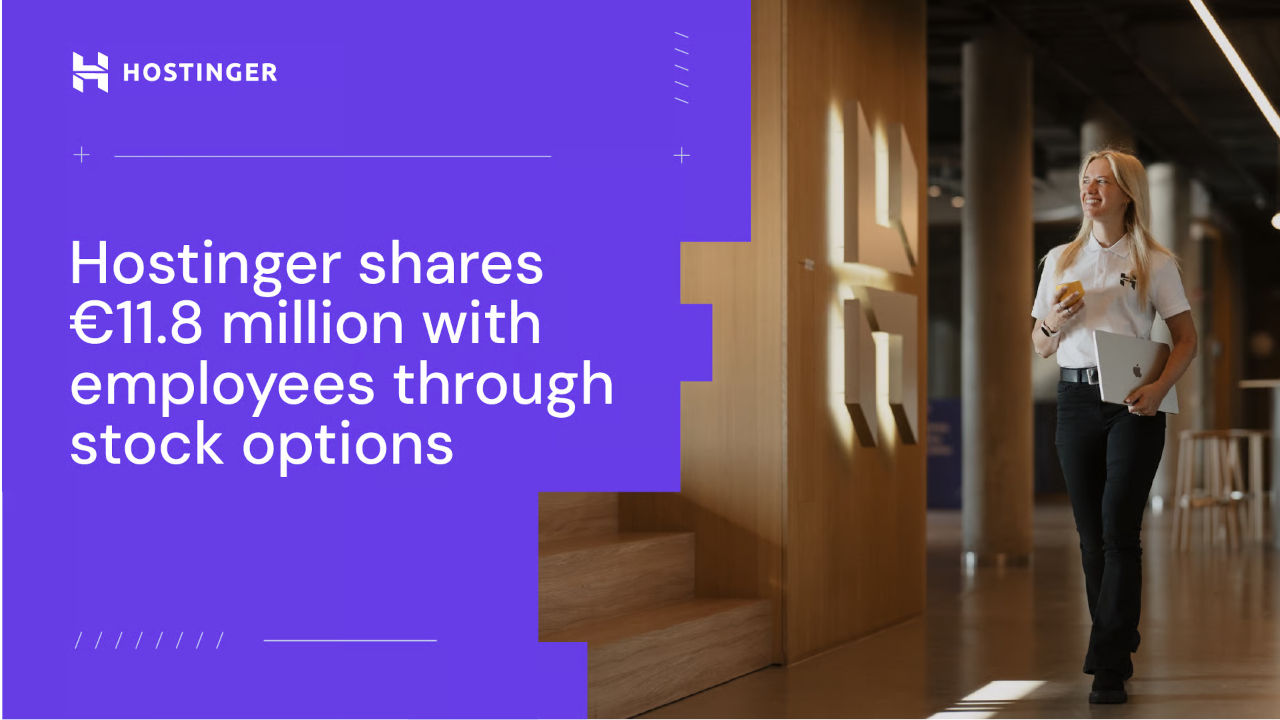
Hostinger, the Lithuanian-born hosting company that has quietly become one of Europe’s fastest-growing tech firms, distributed €11.8 million to employees through its stock option program on March 18, 2026. The payout is notable not because of the amount itself, but because of what it reveals about Hostinger’s financial trajectory and the growing divergence between hosting companies that share equity with employees and those that do not.
Hostinger reported €275.4 million in revenue for 2025, a 51% year-over-year increase. The company serves 4.6 million customers across 150+ countries, grew its client base by 35% in the past year, and has maintained 50%+ annual revenue growth for four consecutive years. It remains private, profitable, and – unlike most hosting companies of its scale – has never raised traditional venture capital. The €11.8 million stock option payout is a signal that Hostinger’s ownership structure is designed for sustained growth, not a quick exit.
The Stock Option Program
Hostinger launched its employee stock option program in 2017, when the company was a fraction of its current size. At that point, Hostinger had roughly 100,000 customers and revenue that was a small fraction of today’s €275 million. The decision to offer equity compensation at that stage – before growth was guaranteed – is the kind of bet that only pays off if the company actually grows. It did.
CEO Daugirdas Jankus framed the payout in those terms: “We launched our stock option program nearly a decade ago, when we were still far from today’s results. Now, we are able to share the financial returns with colleagues who have contributed to the company’s growth over many years.”
The program covers approximately 10% of Hostinger’s workforce – roughly 90–100 employees out of approximately 1,000. Hostinger has not disclosed the specific mechanics of the program (vesting schedules, exercise prices, or the valuation methodology used for the payout), which is typical for private companies. What is clear is that the €11.8 million represents real liquidity for employees who otherwise hold equity in a company with no public market for its shares.
For a private hosting company, creating liquidity events for employee shareholders is non-trivial. Public companies like GoDaddy offer Employee Stock Purchase Plans (ESPPs) and RSU grants that employees can sell on the open market. Private companies must either find buyers for employee shares, conduct tender offers, or – as Hostinger appears to have done – fund payouts from operating cash flow or balance sheet capacity. Hostinger completed a refinancing and dividend recapitalization in November 2025, which may have provided the financial flexibility for this payout.
The Revenue Trajectory
The stock option payout is newsworthy in part because of the revenue curve that underpins it. Hostinger’s growth over the past four years is exceptional by any standard in the hosting industry:
- 2022: €69.6 million
- 2023: €110.2 million (+57% YoY)
- 2024: €182.4 million (+65% YoY)
- 2025: €275.4 million (+51% YoY)
That is a compound annual growth rate of approximately 58% over three years. For context, GoDaddy – the largest hosting company globally with approximately $4.3 billion in revenue – grows in the single digits. Newfold Digital (Bluehost, HostGator) is private and does not disclose figures, but industry estimates suggest flat to low-single-digit growth. Namecheap, recently acquired by CVC Capital Partners for $1.5 billion, generated approximately $398 million in 2024 revenue with 18% growth.
Hostinger is growing faster than all of them, from a base that is now large enough to matter. At €275 million and 51% growth, Hostinger is on track to exceed €415 million in 2026 revenue if the trajectory holds. The customer base – 4.6 million, up from 100,000 in 2015 – provides the volume to sustain this growth, and the company’s aggressive pricing strategy (Hostinger is consistently among the cheapest major hosting providers) continues to drive acquisition.
How Hostinger Makes Money While Being Cheap
Hostinger’s business model inverts the traditional hosting margin structure. Where most hosting companies charge higher prices and employ large support teams, Hostinger charges less and automates aggressively. The company’s AI assistant Kodee now handles 83% of customer support interactions – up from 50% at the start of 2025 – performing over 350 technical tasks including migrations, backups, and server health checks. In August 2025 alone, Kodee processed 750,000 conversations, fully resolving 75% without human intervention.
The financial impact is concrete: Kodee saved Hostinger approximately €9 million in 2025. For a company with €275 million in revenue, that is a meaningful margin contribution – roughly 3.3 percentage points of revenue that would otherwise go to support staffing costs. The WebPros/CloudLinux 2026 Hosting Trends Report identifies this kind of automation as the dividing line between hosting operators whose margins are improving and those whose margins are shrinking.
Hostinger’s product expansion reinforces this model. Hostinger Horizons, launched in March 2025, is a no-code platform that generates functional websites and web applications from plain-language descriptions, running on Google’s Gemini and Anthropic’s Claude. Horizons represents Hostinger’s bet that the next generation of hosting customers will not know or care about cPanel, FTP, or PHP versions – they will describe what they want and expect the platform to build it. Hostinger Reach, an AI email marketing tool, extends the platform further into SaaS territory.
The strategic direction is clear: Hostinger is evolving from a hosting company into a web platform company where AI does most of the work. The stock option payout rewards employees who joined during the hosting phase; the next wave of equity value will likely come from the platform phase.
Private, Profitable, and Not Going Public
Hostinger has never raised traditional venture capital. The company grew organically from its founding, with strategic investment from Tesonet – the Lithuanian tech accelerator also behind NordVPN and Oxylabs. In 2021, ConHostinger GmbH – a Cologne-based acquisition vehicle backed by Equivia Partners, led by German hosting veterans Jochen Berger and Thomas Strohe – acquired an approximately 31% stake in a PE-style transaction.
The November 2025 dividend recapitalization – a financial engineering move where a company takes on debt to pay dividends to shareholders – suggests that Hostinger’s investors are extracting returns through leverage rather than pursuing an IPO. This is a common PE playbook: if the company generates enough cash flow to service debt while continuing to grow, there is no urgency to go public.
Compare this to the neocloud companies racing toward IPOs in H2 2026. CoreWeave went public in March 2025 and has seen 200%+ stock gains. Nscale ($14.6 billion valuation) and Lambda ($5.9 billion) are both targeting public listings. These companies need public market capital to fund massive GPU hardware purchases. Hostinger does not have the same capital intensity – web hosting infrastructure is expensive but not GPU-expensive – and its profitability means it can fund growth internally.
The €11.8 million stock option payout is, in this context, a substitute for the liquidity that a public listing would provide. Employees get cash; the company stays private; the growth story continues without the scrutiny and quarterly earnings pressure of public markets.
Employee Equity in the Hosting Industry: A Comparison
Hostinger’s stock option program is unusual in the hosting industry, where employee equity is the exception rather than the rule:
- GoDaddy (NYSE: GDDY) – As a public company, GoDaddy offers an Employee Stock Purchase Plan allowing discounted share purchases, plus RSU and performance-based RSU grants tied to tenure and targets. Employees can sell shares on the open market at any time.
- Newfold Digital (Bluehost, HostGator, Web.com) – Owned by Clearlake Capital and Siris Capital. Employee reviews consistently rate compensation below average, and there is no public information about broad-based equity programs. PE-owned hosting companies typically reserve equity for senior management.
- Namecheap – Now majority-owned by CVC Capital Partners ($1.5 billion deal). No public information on employee equity programs.
- team.blue – Owned by Hg Capital, valued at €4.8 billion, operating across 22 countries. No disclosed employee equity program for the broader workforce.
The pattern is clear: PE-owned hosting companies – which now represent the majority of mid-to-large hosting operators in Europe and North America – generally do not share equity broadly with employees. The economics of leveraged buyouts prioritize debt service and investor returns over employee ownership. Hostinger, despite having PE-style investors, has maintained its stock option program through the ownership changes – a decision that costs the existing shareholders dilution but builds employee retention and alignment.
For an industry with notoriously high support staff turnover and intense competition for engineering talent, equity compensation matters. Hostinger plans to hire 200–300 additional employees in 2026, and the public announcement of an €11.8 million payout is, among other things, a recruiting tool.
Lithuania’s Quiet Tech Power
Hostinger’s growth is also a story about Lithuania’s tech ecosystem, which has reached a valuation exceeding €16 billion – a 39x increase in a decade. The country now hosts three unicorns and over 1,000 startups. Hostinger, headquartered in Kaunas with a flagship “Cyber City” campus in Vilnius, is among the country’s most prominent tech exports alongside NordVPN (also a Tesonet portfolio company).
With nearly 500 of its approximately 1,000 employees based in Lithuania, Hostinger is one of the country’s largest tech employers. The company has ranked on the Financial Times FT 1000 list of Europe’s fastest-growing companies for six consecutive years and placed second in the “Long-term Growth Champions: Europe 2026” ranking – a recognition that measures sustained growth over multiple years rather than a single spike.
For the hosting industry, Lithuania’s emergence as a tech hub is worth noting. The country’s cost structure (lower than Western Europe but with strong technical education), EU membership (data protection compliance), and digital infrastructure make it a competitive location for hosting operations. Hostinger has leveraged this advantage more effectively than any other hosting company.
What This Means for the Hosting Industry
Hostinger’s €11.8 million stock option payout, taken in isolation, is a human-interest story about employees benefiting from company growth. Taken in context, it reveals several dynamics that matter for the broader hosting industry:
- The growth gap is widening – Hostinger at 51% growth versus GoDaddy in single digits is not a temporary divergence. It reflects fundamentally different strategies: heavy automation and aggressive pricing versus large support teams and incremental optimization. The hosting companies that automated early are growing faster than those that did not.
- Private beats public for some models – Hostinger’s ability to stay private, profitable, and growing at 50%+ demonstrates that not every successful hosting company needs to go public or sell to PE. The dividend recapitalization model lets investors take returns without the constraints of public markets.
- Talent competition is real – An €11.8 million payout to 90–100 employees averages roughly €120,000 per participant. For Lithuanian tech workers, that is a substantial payout by Lithuanian standards. Competing hosting companies – especially PE-owned operators that do not offer equity – will find it increasingly difficult to attract and retain top talent against employers who share the upside.
- AI is the margin story – Kodee saving €9 million annually is not a marketing claim; it is a real cost advantage. As Hostinger scales, the AI cost savings scale with it while support costs for non-automated competitors scale linearly with customer growth. This gap compounds over time.
Hostinger is not the largest hosting company. GoDaddy’s revenue is roughly 15 times higher. But Hostinger is growing faster, automating more aggressively, and – with this stock option payout – demonstrating that it can share that growth with the people who build the product. In an industry increasingly dominated by PE consolidators who prioritize investor returns over employee ownership, that distinction matters.

Łukasz Nowak
Nearly two decades in IT. A decade in web hosting - and still in the trenches. Writing about the infrastructure that runs the internet from the inside.