
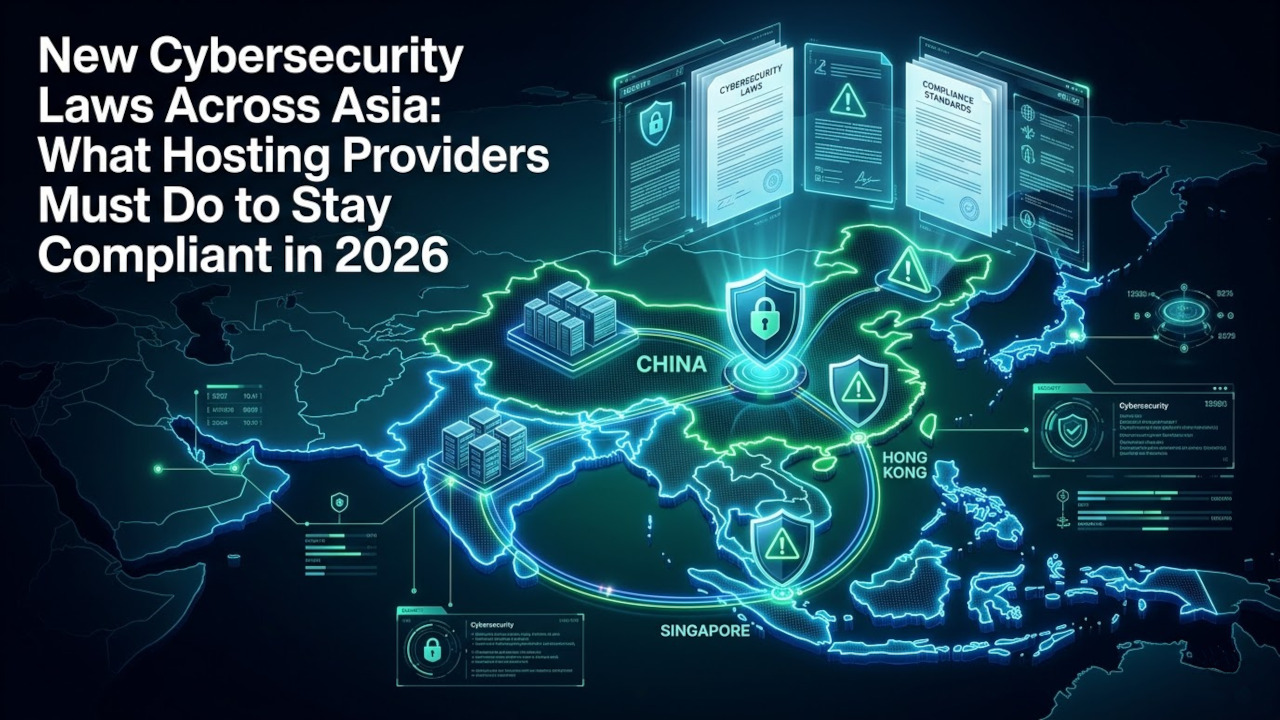
In the span of just three months – from October 2025 through January 2026 – three of Asia’s most important markets enacted or expanded cybersecurity laws that directly affect how hosting companies store data, report incidents, manage supply chains, and govern AI systems. The timing is not coincidental, and the combined regulatory weight is unlike anything the region’s hosting industry has previously faced.
These are not upcoming proposals. These laws are in effect now. And the penalties for non-compliance are severe – not just for large enterprises, but for the hosting providers that serve them.
China: The Amended Cybersecurity Law
What Changed
China’s revised Cybersecurity Law (CSL) took effect on January 1, 2026. The amendments represent the most substantial overhaul since the law’s original passage in 2017, introducing four major changes relevant to hosting providers:
- AI governance brought under the CSL. For the first time, artificial intelligence is explicitly within scope. The government will regulate AI ethics, require risk assessments for AI systems, and mandate documented oversight processes for AI deployed on hosted infrastructure.
- Supply-chain cybersecurity requirements tightened. Hosting providers are now responsible for the security of the products and services they procure – including third-party software, hardware components, and managed services integrated into their platforms.
- Critical Information Infrastructure Operators (CIIOs) face enhanced obligations. Most data center and cloud service companies serving key industries – finance, energy, transport, healthcare, communications – now fall under CIIO classification, triggering mandatory security reviews for procurement, annual risk assessments, and real-time threat reporting to the Cyberspace Administration of China (CAC).
- Penalties dramatically increased under a new tiered structure. For Critical Information Infrastructure Operators whose violations cause “especially grave consequences,” the maximum corporate fine has been raised to CNY 10 million (~$1.4 million), with individual liability for directly responsible personnel reaching CNY 1 million (~$138,000). For other network operators, the ceiling is CNY 2 million for violations with grave consequences. These are significant increases from the original CSL’s penalty caps, and the CAC has been actively enforcing – the higher ceilings give regulators substantially more leverage.
What Hosting Providers Must Do
Any hosting company operating in mainland China – whether headquartered there or serving Chinese customers from offshore infrastructure – needs to take three immediate steps:
- Determine your CIIO status. If your infrastructure serves customers in any of the designated critical sectors, you are likely classified as a CIIO. This classification triggers the full suite of enhanced obligations, including mandatory security reviews for all network product and service procurement.
- Establish CAC reporting channels. CIIOs must maintain real-time threat reporting capabilities to their local CAC office. This is not a “best effort” requirement – it is a documented obligation with specific response time deadlines.
- Complete minors’ data compliance audits. Organizations that collect personal information from minors were required to complete compliance audits and submit filings to their local CAC offices by January 31, 2026. If your platform hosts services that interact with users under 18 – including educational platforms, gaming services, and social applications – verify that your customers have met this deadline, and that your infrastructure supports the required audit trail.
For foreign-headquartered providers, the exposure is particularly acute. The amended CSL now has explicit extraterritorial reach – covering overseas organizations and individuals whose activities harm China’s cybersecurity – and enforcement actions can include suspension of operations, effectively forcing a market exit. Getting compliant now is expensive. Getting caught later is worse – enforcement actions can include suspension of operations.
Hong Kong: Critical Infrastructure Law and Mandatory Breach Reporting
What Changed
Hong Kong enacted two major regulatory changes in the first quarter of 2026:
The Protection of Critical Infrastructure (Computer Systems) Ordinance came into force on January 1, 2026. This is Hong Kong’s first comprehensive cybersecurity statute, applying to critical infrastructure operators across eight essential service sectors: energy, information technology, banking and financial services, air transport, land transport, maritime transport, healthcare services, and telecommunications and broadcasting. A second category – potentially covering venues such as major sports and performance facilities, and research and development parks – may be designated at a later stage. Hosting providers whose infrastructure supports operators in any of these sectors are directly in scope.
On February 7, 2026, Hong Kong’s privacy regulator – the Office of the Privacy Commissioner for Personal Data (PCPD) – announced plans to consult lawmakers on reviving amendments to the Personal Data Privacy Ordinance (PDPO). The proposed changes would make data breach reporting mandatory for the first time and introduce administrative fines for non-compliance.
What Hosting Providers Must Do
Hong Kong’s new critical infrastructure law requires covered operators to implement specific cybersecurity measures, conduct regular assessments, and report incidents within defined timeframes. For hosting providers, the operational impact centers on three areas:
- Audit your customer base against the eight sectors. If you host infrastructure for financial institutions, healthcare providers, telecoms, or any of the other designated sectors, you are subject to the ordinance’s requirements – regardless of whether the end customer has notified you of their classification.
- Implement incident response protocols that meet statutory timelines. The ordinance specifies reporting windows for security incidents. Your existing incident response plan must be updated to meet these requirements, including the ability to notify both the affected customer and the relevant regulatory authority within the prescribed period.
- Prepare for mandatory breach reporting under the amended PDPO. While the PDPO amendments are still in consultation, the intent is clear. Hosting providers that process personal data on behalf of Hong Kong customers should begin building breach detection and notification capabilities now, rather than scrambling to comply when the amendments pass.
- Assess your exposure regardless of where you are headquartered. The Critical Infrastructure Ordinance applies to operators delivering essential services in Hong Kong. If your infrastructure supports those services – even from a data center in Singapore or Tokyo – you may fall within the ordinance’s scope.
Singapore: Outsourcing Does Not Transfer Responsibility
What Changed
The Cybersecurity (Amendment) Act 2024, passed by Parliament on May 7, 2024, came into force on October 31, 2025. Its provisions are now fully operational. The amendment significantly expands the scope of Singapore’s cybersecurity regime in four ways directly relevant to hosting providers:
- Third-party-owned Critical Information Infrastructure (CII). The Commissioner of Cybersecurity can now designate virtual machines and systems owned by third parties – including hosting providers – as CII if they are necessary for the continuous delivery of an essential service.
- Overseas infrastructure brought into scope. Systems located entirely outside Singapore can now be designated as CII if they are essential to keeping an important service running in Singapore. Hosting providers with offshore infrastructure serving Singaporean customers are directly affected.
- Foundational Digital Infrastructure (FDI) providers regulated. A new Part 3D of the Act covers Major FDI service providers, with the initial schedule explicitly including cloud computing services and data centre facility services.
- Systems of Temporary Cybersecurity Concern (STCCs). The Commissioner can now designate systems facing heightened temporary cybersecurity risk – such as those supporting elections or emergency response – for up to one year, imposing incident reporting duties and issuing binding directions.
But the most important point for hosting providers is a principle the amended law makes explicit: outsourcing does not transfer cybersecurity responsibility. Organizations that rely on third-party hosting, managed services, or cloud infrastructure remain fully accountable for breaches – even when the breach originates in the provider’s infrastructure. As with the China and Hong Kong regimes, any provider serving Singaporean customers is in scope, regardless of where the company is headquartered.
What Hosting Providers Must Do
The practical impact is significant – and it favors hosting providers who can prove their security is solid:
- Compliance documentation becomes a selling point. When your customers know that they remain liable for breaches on your infrastructure, they will demand evidence that your security practices meet regulatory requirements. SOC 2 reports, penetration test results, and incident response documentation now belong in the sales conversation, not just in an internal folder.
- Contracts must spell out who is responsible for what. Vague “we take security seriously” language in hosting agreements is no longer enough. Contracts must clearly state which security controls are the provider’s responsibility and which belong to the customer. Ambiguity creates regulatory risk for both sides.
- Managed security services become easier to sell. If customers bear full regulatory responsibility for breaches regardless of where they occur, many will conclude that managing their own security on hosted infrastructure is not realistic. Hosting providers that offer security monitoring, incident response, and compliance reporting as part of their managed services will find willing buyers – because the alternative is the customer doing it alone under regulatory pressure.
What This Means for Hosting Businesses
Taken together, the regulatory changes across China, Hong Kong, and Singapore in early 2026 represent a fundamental change in the rules of operating a hosting business in Asia. Meeting these requirements is no longer optional – and providers that do it well will have an easier time winning and keeping customers.
Hosting providers that invest in regulatory expertise, audit processes, incident response systems, and clear reporting will find that these investments pay for themselves – through fewer lost customers, lower regulatory risk, and the ability to charge more in a market where buyers are actively looking for providers they can trust.
Providers that ignore these requirements will find that the fines, operational disruptions, and damage to their reputation from enforcement actions cost far more than getting compliant would have.

Łukasz Nowak
Nearly two decades in IT. A decade in web hosting - and still in the trenches. Writing about the infrastructure that runs the internet from the inside.
Sources
- IAPP - China's Cybersecurity Law Amendments Introduce AI Provisions
- Mayer Brown - China Finalises Amendments to the Cybersecurity Law
- A&O Shearman - China Cybersecurity Law Amendments 2026: Key AI & Compliance Changes
- Law.Asia - Revised Cybersecurity Law: New Penalties, Extends Enforcement
- IAPP - Strong Start to 2026 for China's Data, AI Governance Landscape (incl. Hong Kong PDPO)
- Herbert Smith Freehills - China's Revised Cybersecurity Law: Key Changes Enterprises Need to Know
- Cyber Security Agency of Singapore - Provisions in the Cybersecurity (Amendment) Act to Come Into Force on 31 October 2025
- DLA Piper - Singapore: Key Amendments to the Cybersecurity Act Now in Force
- Hogan Lovells - Provisions in Singapore's Cybersecurity (Amendment) Act Came Into Force
- GQS Singapore - Singapore Cybersecurity Regulations in 2026: What Companies Should Expect