
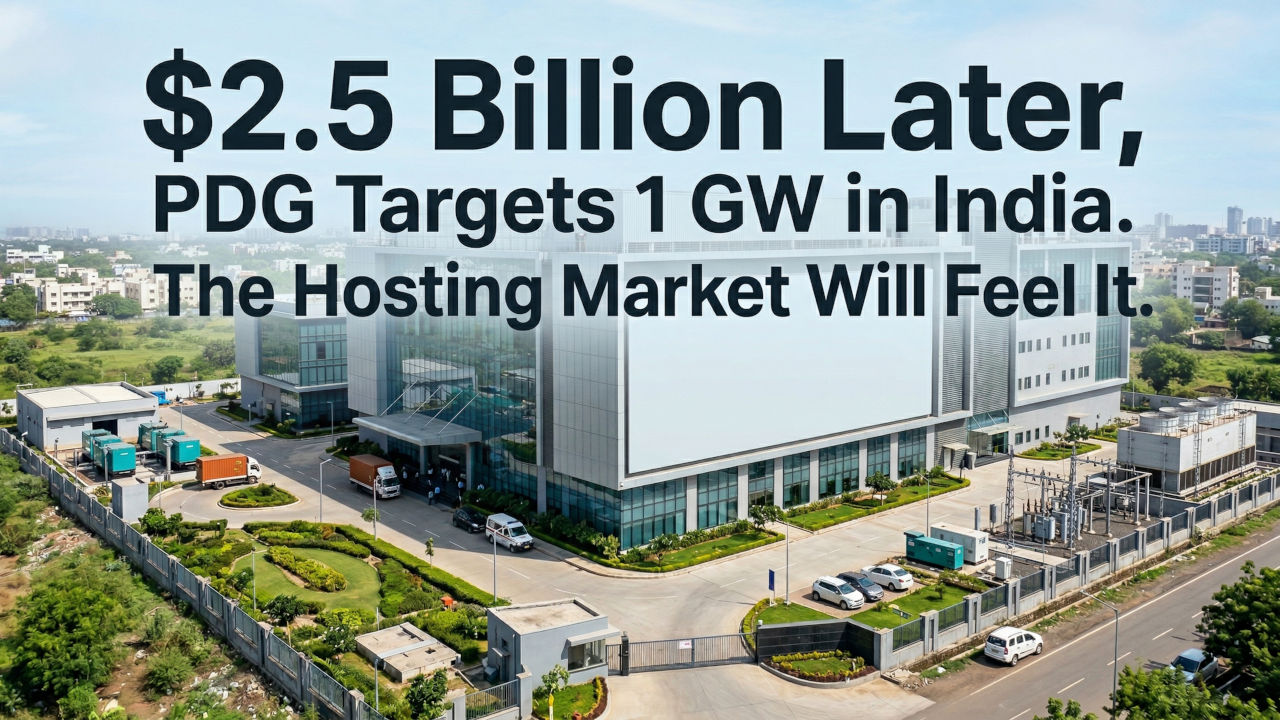
Princeton Digital Group acquired 210 MW of data center capacity in Mumbai and Hyderabad on March 24. The deal nearly doubles PDG’s planned capacity in India and brings its total India portfolio to 1 GW. The company has committed $2.5 billion to India since entering the market in 2022.
PDG is not a hosting company. It is a wholesale infrastructure operator whose customers are global hyperscalers. Understanding what $2.5 billion of wholesale capacity in India means requires understanding who fills it and what happens to the market when they do.
Who Is Princeton Digital Group
PDG is not a name that registers in most North American hosting conversations, despite operating at a scale that would place it alongside the largest US-based wholesale operators. The company is privately held, Asia-focused, and largely invisible outside the markets where it builds.
It was founded in 2017 in Singapore by Rangu Salgame and Varoon Raghavan, with Warburg Pincus, the New York-based private equity firm, as the founding institutional backer. The name has no connection to Princeton University. It comes from Princeton, New Jersey, Salgame’s hometown. Salgame holds an MBA from Wharton and built his career across Tata Communications, Cisco, and Verizon before founding PDG on the thesis that hyperscalers needed a single regional operator capable of delivering consistent, global-grade data center capacity across multiple Asian markets simultaneously.
The investor base has expanded considerably since 2017. Ontario Teachers’ Pension Plan led a $360 million equity round in October 2020. Mubadala Investment Company, Abu Dhabi’s sovereign wealth fund, led a round exceeding $500 million in February 2022. In July 2025, Stonepeak, a New York-based infrastructure-focused investment firm, committed $1.3 billion in preferred equity. Combined with $1.2 billion in debt financing closed in the same year, PDG raised $2.5 billion in capital in 2025 alone.
For a North American reader unfamiliar with the name: PDG has built a 1.8 GW data center portfolio across Asia in eight years, backed by Warburg Pincus, Mubadala, Ontario Teachers’, and Stonepeak. It operates at a scale comparable to the largest US wholesale operators. It has virtually no profile in the North American market. India is now its single largest country position.
The Business Model Behind the Numbers
PDG builds large-scale, AI-ready data center capacity and leases it to hyperscalers: the cloud platforms that then sell compute, storage, and AI services to enterprises and developers. PDG’s CEO Rangu Salgame described India as a “long-term growth engine for global hyperscalers” and the new sites as serving “cloud adoption and AI-led digital transformation.” That is not marketing language. It is a description of the customer.
The business case for PDG’s India bet rests on a single assumption: that hyperscaler demand in India will continue to grow fast enough to absorb 1 GW of capacity at returns that justify $2.5 billion of capital deployed over four years. PDG has returned to the market repeatedly since 2022, each acquisition adding to a position that is now among the largest in the country.
Both new sites have power secured and key land approvals in place. PDG builds to IGBC Platinum certification with renewable energy procurement, which is increasingly a requirement rather than a preference for hyperscaler tenants with their own sustainability commitments to fulfill.
Why Hosting Companies Should Care
PDG’s customers are the global hyperscalers. When those platforms get more capacity in a market, they expand their regional cloud regions. When they expand, compute prices for local buyers fall and availability improves. Mumbai and Hyderabad are next in that sequence.
For Indian developers and enterprises, the practical effect is that running AI workloads on infrastructure physically located in India, rather than routing through Singapore or a US region, becomes cheaper and faster. That removes the cost and latency penalty that has historically made local AI development less competitive. As that penalty falls, demand for locally-hosted AI applications grows, and the infrastructure expectations of Indian hosting customers shift with it.
The question for hosting executives serving the Indian market is not whether this shift happens. It is where their product sits when it does. A hosting company selling managed cloud services, application hosting, or migration support to Indian enterprises is positioned on the right side of this transition. A hosting company whose primary offer is cheap shared hosting in a market where cloud compute is getting structurally cheaper is not.
The 1 GW Number in Context
India’s total installed data center capacity across all operators reached approximately 1.5 GW at the end of 2025, according to India’s Ministry of Electronics and IT. PDG’s target of 1 GW in India represents a single operator building toward two-thirds of the entire national installed base, starting from zero in 2022. Both figures measure total capacity across all operators and all facility types, which makes the comparison direct.
PDG’s total global portfolio across seven Asian markets stands at 1.8 GW of operating and planned capacity. Its India target of 1 GW represents more than half of everything the company has built globally. India is not a regional position for PDG. It is the center of the portfolio.
To put the ambition in perspective: India added 387 MW of new data center capacity in 2025, a 103% year-on-year increase that made it one of the fastest-growing markets in the world. PDG’s India target is nearly three times that record annual addition, from a single operator.
Once fully built, PDG’s India portfolio would exceed the current operating capacity of London, which Cushman & Wakefield measured at 1,189 MW in H1 2025, making it the largest data center market in Europe. For further reference on what these numbers mean in industry terms: Digital Realty reported 3 GW of in-place operating capacity in its Q4 2025 earnings, making it one of the world’s largest wholesale operators. STT GDC, currently being acquired by KKR and Singtel for $5.1 billion, has 2.3 GW of design capacity across 12 markets. PDG is building an India-only position that sits in the same order of magnitude as those global platforms.
Whether that position fills on schedule will be visible in occupancy rates over the next two to three years. The $2.5 billion is already deployed. The question now is whether the hyperscaler tenants PDG is building for expand their Indian cloud regions on the timeline the investment assumes. If they do, PDG’s India portfolio becomes a reference point for every operator evaluating the market. If the timeline slips, $2.5 billion is a lot of committed capital waiting for demand to catch up.

Łukasz Nowak
Nearly two decades in IT. A decade in web hosting - and still in the trenches. Writing about the infrastructure that runs the internet from the inside.
Sources
- PDG Acquires 210 MW in India, Advancing Toward a 1 GW Portfolio - Princeton Digital Group
- PDG Acquires 210 MW of India Data Centre Capacity - MingTiandi
- Stonepeak to Invest USD 1.3 Billion in Princeton Digital Group - Stonepeak
- Princeton Digital Group - Warburg Pincus
- Ontario Teachers Leads US$360M Investment Round into Princeton Digital Group - Ontario Teachers' Pension Plan
- Mubadala Leads $500M+ Equity Round into Princeton Digital Group - Princeton Digital Group
- One-on-One with Rangu Salgame, Chairman, CEO and Co-Founder - InterGlobix Magazine
- India's DC Capacity Almost Touched 1.5 GW in 2025, IT Ministry - W.media
- India Data Centre Capacity More Than Doubled to 387 MW in 2025 - Tribune India
- EMEA Data Centre H1 2025 - Cushman & Wakefield
- Digital Realty Q4 2025 Earnings Call Transcript - The Motley Fool
- KKR-Led Consortium to Fully Acquire STT GDC - ST Telemedia Global Data Centres