

Cloudflare published a blog post on April 1 announcing EmDash, an open-source CMS built on Cloudflare Workers, D1, R2, and the Astro framework. The GitHub repository is live. The demo site is live. The announcement was real. Cloudflare launched a WordPress competitor on April Fools’ Day, which is either very good timing or very poor timing depending on whether you want people to take it seriously.
For what it is worth, this is not unprecedented. Gmail launched on April 1, 2004, and was widely assumed to be a joke partly because of the date and partly because offering 1 GB of free email storage seemed implausible. Cloudflare itself has used April 1 as a real product launch date before: its 1.1.1.1 DNS resolver launched on April 1, 2018. The date, in Cloudflare’s case, appears to be a deliberate choice rather than an accident. Whether that framing helps or hurts initial adoption of EmDash is a reasonable question.
The current release is v0.1.0, a developer preview built over approximately two months using AI coding agents. It is MIT-licensed, requires TypeScript familiarity, and is not production-ready. None of that changes what EmDash signals about where Cloudflare sees its platform going, or what the managed WordPress hosting market needs to understand about it.
The Plugin Security Pitch
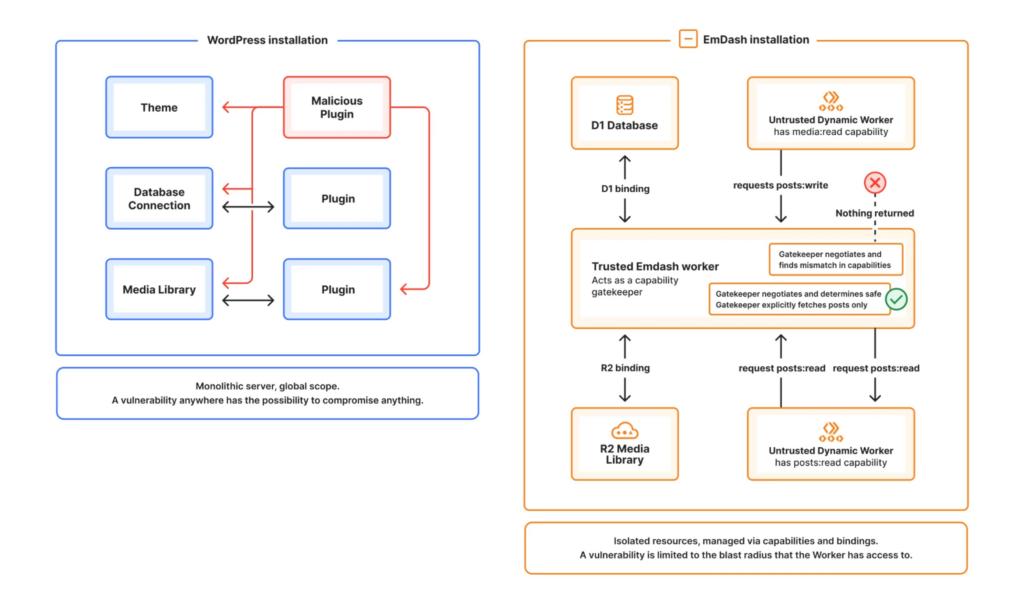
Cloudflare’s positioning for EmDash is direct: “96% of security issues for WordPress sites originate in plugins.” That number is the product’s entire thesis. WordPress plugins run in the same PHP process as the core application, sharing database access, filesystem access, and execution context. A compromised or malicious plugin can reach everything. This is not a WordPress-specific failure; it is the consequence of an architectural model designed before modern isolation primitives existed.
EmDash’s answer is plugin sandboxing through Cloudflare’s Dynamic Workers feature. Each plugin runs inside its own v8 isolate, separated from the core application and from every other plugin. A plugin manifest declares the specific capabilities it needs: read content, send email, make outbound HTTP calls. The EmDash core provides those capabilities as bindings. A plugin cannot access anything it did not declare in its manifest, regardless of what the plugin code attempts to do.
This is conceptually close to how mobile operating systems handle app permissions. A phone app that requests camera access does not automatically get microphone access. EmDash applies the same model to CMS plugins. Whether that model holds under adversarial conditions at scale is something a v0.1.0 preview cannot demonstrate, but the architecture is sound and the problem it addresses is real.
What EmDash Actually Is
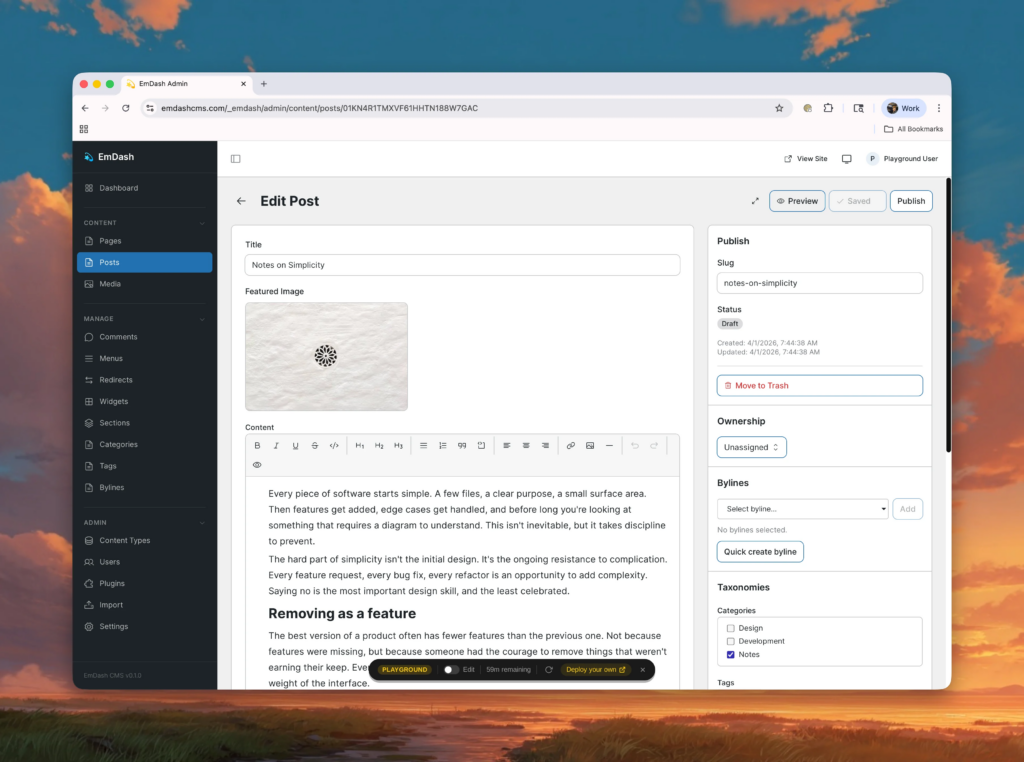
The technical stack: TypeScript end-to-end, Astro 6.0 as the frontend framework, Cloudflare D1 (SQLite at the edge) as the primary database, R2 for media storage, and Workers as the runtime. Authentication defaults to WebAuthn passkeys. Content is stored as Portable Text, a structured JSON format rather than serialized HTML, which makes content portable across web, mobile, email, and API surfaces without DOM parsing.
Two features in the architecture are worth noting for their implications beyond the CMS itself.
First: EmDash ships with a built-in MCP server, the Model Context Protocol that Anthropic developed for AI agent integration. Any Claude-compatible or MCP-compatible AI agent can connect to an EmDash site and read, write, or modify content through a structured interface. This is not a plugin or an add-on. It is built into the core. The CMS was designed from the start to be legible to AI agents, not just human editors.
Second: EmDash includes native support for x402, an open payment protocol maintained by Coinbase Developer Platform and adopted by Cloudflare among others. Site operators can designate specific content as paid, set a price, provide a wallet address, and the system handles the transaction. This applies to human visitors but also, explicitly, to AI scrapers. A site running EmDash can charge the AI systems crawling it for access to its content, per request, without any subscription infrastructure.
The Cloudflare Platform Angle
EmDash is not a standalone product. It is an application that runs on Cloudflare Workers, stores data in D1, stores media in R2, and uses Dynamic Workers for plugin isolation. Self-hosting on any Node.js server is supported and costs nothing beyond compute. But running EmDash on Cloudflare’s infrastructure with full plugin sandboxing requires at minimum a paid Cloudflare account, starting at $5 per month, because Dynamic Workers is not available on the free tier.
Cloudflare has positioned its developer platform, Workers plus D1 plus R2, as a stack for building production applications at the edge. The adoption problem for any infrastructure platform is that developers need a reason to build on it. EmDash is a reason. A CMS that showcases D1 as a production database, R2 as a media store, and Workers as a runtime is also a demonstration that all three products are ready for real application workloads. The CMS and the platform market each other.
What This Means for Managed WordPress Hosts
Managed WordPress hosting is a large and well-established market segment. Its value proposition rests on the idea that WordPress is the platform, and that managing it well for customers is a defensible specialty. A technically credible alternative from a company with Cloudflare’s infrastructure scale and developer reach is worth paying attention to, even at v0.1.0.
EmDash is not a direct threat to managed WordPress hosting today. At v0.1.0, with no plugin ecosystem, no theme marketplace, and performance issues already noted by early testers, it is not a product most customers would migrate to. WordPress has 60,000-plus plugins, a decade of documentation, and runs over 40% of the web. EmDash has a GitHub repository and a demo site.
The threat is directional, not immediate. Cloudflare is a company with the infrastructure, the developer audience, and the financial capacity to invest in a product like this over several years. The plugin sandbox model addresses a problem WordPress’s architecture has never solved. The AI-native design reflects where content workflows are heading. If Cloudflare treats EmDash as a strategic priority rather than a side project, the plugin ecosystem will grow, the performance issues will be addressed, and the barrier to migration will fall.
The question for managed WordPress hosting executives is not whether EmDash replaces WordPress in 2026. It is whether the managed WordPress market in 2028 or 2030 looks different if Cloudflare is actively invested in an alternative. The answer to that question depends on choices Cloudflare has not yet made public.
What Is Missing
The current release has real gaps. The plugin ecosystem is empty: there are no community plugins, no theme marketplace, and the first-party plugins cover only basic functionality (forms, SEO, audit log). Early hands-on testing reported that v0.1.0 was noticeably slow, which matters for a product positioned partly on Cloudflare’s edge performance advantage. The product was built in two months with AI coding agents and has not been battle-tested in production environments.
The governance question is also open. EmDash is MIT-licensed, maintained under the emdash-cms GitHub organization, and positioned as independent of Cloudflare’s commercial products. Whether Cloudflare’s long-term commitment to the project matches that positioning is something the roadmap and investment levels over the next 12 months will answer, not the v0.1.0 launch.
Joost de Valk, founder of Yoast SEO and a longtime WordPress ecosystem figure who has been publicly critical of Automattic’s direction, published a substantive analysis of EmDash the day of the announcement. His engagement is a signal that the product is being taken seriously by people who understand the WordPress ecosystem from the inside.

Łukasz Nowak
Nearly two decades in IT. A decade in web hosting - and still in the trenches. Writing about the infrastructure that runs the internet from the inside.
Sources
- Introducing EmDash: The Spiritual Successor to WordPress - Cloudflare Blog
- EmDash CMS - GitHub
- Cloudflare Launches EmDash, the Spiritual Successor That Wants to Take on WordPress - TechRadar
- EmDash CMS Analysis - Joost de Valk
- Cloudflare Unveils WordPress Competitor EmDash CMS - Cybernews
- Cloudflare EmDash - Phoronix