
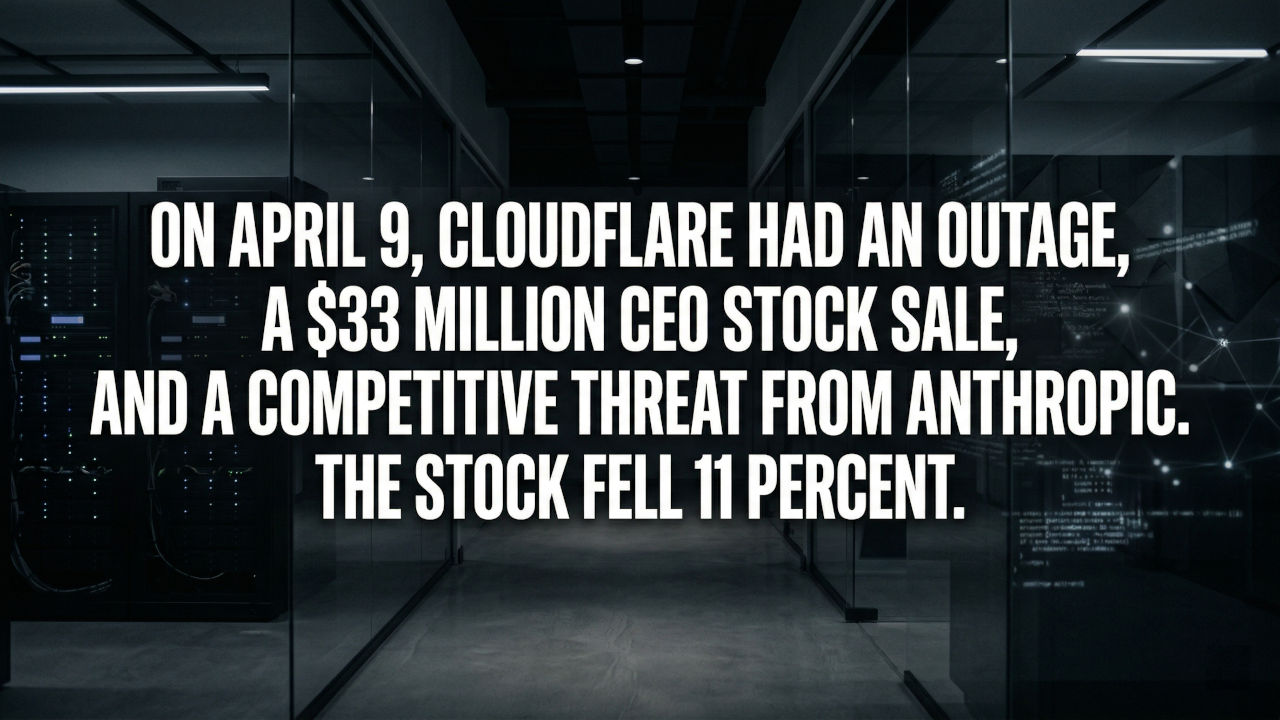
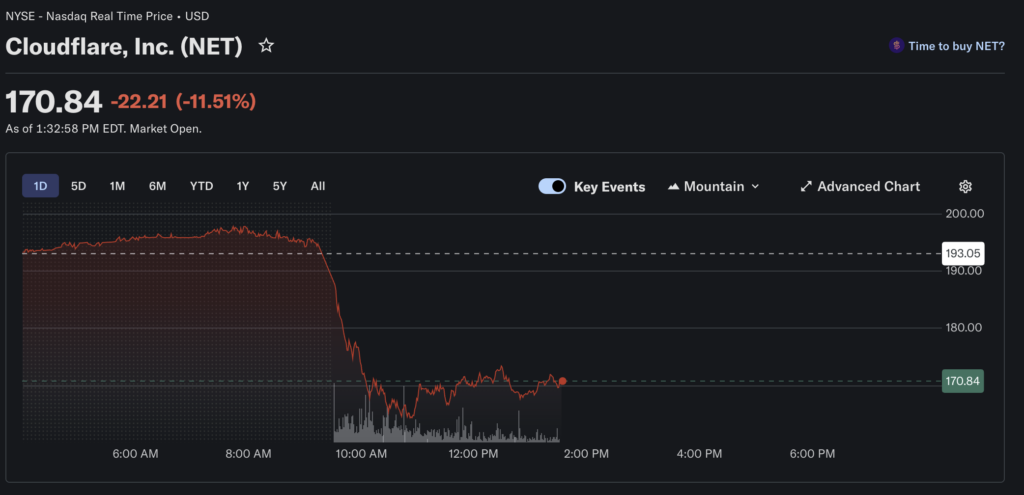
Three events landed on Cloudflare on April 9, 2026. A real infrastructure failure knocked LinkedIn, Zoom, and Shopify offline for nearly two hours. A pre-scheduled executive stock sale generated headlines about insider activity. And a product announcement from Anthropic, published the day before, gave analysts a concrete reason to reprice Cloudflare’s competitive position in AI infrastructure. The stock fell approximately 11 percent. Analysts at 24/7 Wall St. and Yahoo Finance published the same assessment: the Anthropic launch, not the outage and not the insider sale, was the driver.
The Outage
Between 14:41 and 16:34 UTC on April 9, Cloudflare’s Philadelphia (PHL) data center generated elevated HTTP 5xx error rates affecting services routed through that node. The disruption lasted approximately one hour and 53 minutes. Cloudflare stated it had implemented a fix; a technical post-mortem had not been published at the time of this article. A separate incident at Cloudflare’s Amsterdam node was also reported on the same date.
The outage illustrates the structural reality of Cloudflare’s architecture. A failure at a single data center simultaneously affects dozens of major platforms that use Cloudflare for traffic routing, DDoS protection, and CDN delivery. This concentration is both the value proposition and the failure mode.
The Stock Sale
On April 6 and 8, Cloudflare CEO Matthew Prince sold shares of Class A stock under a Rule 10b5-1 trading plan adopted in February 2025, generating approximately $33 million at prices ranging from approximately $208 to $224 per share. Prince retains approximately 7.7 percent of Cloudflare through combined Class A and B shareholdings, representing over 26 million shares. The 10b5-1 structure means the timing of the sales was set in February 2025 and Prince had no discretion over when the transactions executed. The insider-selling headlines were factually accurate and causally irrelevant.
Anthropic Claude Managed Agents
On April 8, 2026, Anthropic launched Claude Managed Agents in public beta. The product is a hosted runtime environment for AI agents built on Claude. Developers specify the model, system prompt, tools, MCP server connections, and permission boundaries; Anthropic’s infrastructure handles session management, state checkpointing, crash recovery, and multi-agent coordination. Each agent session runs in a disposable, isolated Linux container. Pricing is $0.08 per agent runtime hour on top of standard Claude API token costs, putting a continuously running agent at approximately $58 per month in runtime fees before tokens. Early adopters named in the launch materials include Notion, Rakuten, Asana, Sentry, and Vibecode. The product runs on Anthropic’s own infrastructure and is not available through Amazon Bedrock or Google Vertex AI.
Why This Repriced Cloudflare
Cloudflare has spent two years building what it positioned as the infrastructure layer for AI agents. Workers AI runs inference across 300-plus edge locations. The Agents SDK and Dynamic Workers product, announced specifically for agent workloads, offered lightweight disposable isolates for running agents close to users at global scale. The pitch was: bring your model, use Cloudflare infrastructure.
Claude Managed Agents inverts that model. Anthropic is now saying: use Claude, use Anthropic infrastructure. The runtime layer Cloudflare was building is now available directly from the model provider, for Claude-based deployments. For enterprises where Claude is the preferred model and Anthropic’s compliance and audit capabilities matter, there is no longer a reason to add a third-party infrastructure layer between the application and the agent.
Cloudflare’s structural defense is real. It is model-agnostic, running Llama, Mistral, Stable Diffusion, and dozens of others, where Anthropic only runs Claude. Its network is embedded inside approximately 20 percent of global web traffic, giving it latency and security advantages that centralized cloud infrastructure cannot replicate. Dynamic Workers uses lightweight ephemeral isolates rather than persistent containers, which is a different architectural choice for certain workload profiles. Cloudflare did not issue a public response to the Anthropic announcement. Whether enterprises building on Claude will choose the model provider’s managed runtime or a third-party infrastructure layer is the question the market answered with an 11 percent discount before Cloudflare had a chance to argue its case.
What This Means for Infrastructure Providers
The Cloudflare CDN and DDoS protection services that hosting companies buy or resell are not affected by this development. The displacement argument is specific to the AI agent runtime layer, which is where hosting companies that have been planning AI service offerings using Cloudflare Workers as the compute base should pay attention.
The broader pattern is that AI model providers are moving up the infrastructure stack. OpenAI added hosted shell containers and a server-side execution loop to its Responses API in February 2026, running agent workloads on OpenAI-provisioned Debian containers with full terminal access and session management. Anthropic’s Claude Managed Agents, launched two months later, does the same for Claude-based workloads. Two of the largest model providers now operate hosted agent execution environments. The question for infrastructure companies is whether this continues: if model providers keep building down the stack, the next layer they reach is the compute, storage, and networking that managed hosting and colocation providers currently own.

Łukasz Nowak
Nearly two decades in IT. A decade in web hosting - and still in the trenches. Writing about the infrastructure that runs the internet from the inside.
Sources
- Cloudflare Status - Incident History - Cloudflare
- The Real Reason Cloudflare Is Down 11% Today Has Nothing to Do With Insider Selling - 24/7 Wall St.
- Anthropic launches Claude Managed Agents - SiliconANGLE
- With Claude Managed Agents, Anthropic wants to run your AI agents for you - The New Stack
- Anthropic will let your agents sleep on its couch - The Register
- Claude Managed Agents: Features, Pricing and Early Adopters - Thesys
- Cloudflare CEO sells $11 million in stock - MarketBeat
- Cloudflare launches Dynamic Workers for AI agent execution - InfoWorld
- From model to agent: Equipping the Responses API with a computer environment - OpenAI
- OpenAI Extends the Responses API to Serve as a Foundation for Autonomous Agents - InfoQ