
A recent discussion on WebHostingTalk – “I need feedback on Webuzo” – triggered an interesting exchange among hosting operators testing Webuzo as a potential alternative to cPanel.
Reading through the thread and comparing it with direct conversations we’ve had with shared hosting providers in recent weeks, one pattern emerges. Interest is real, but confidence is conditional.
First impression – installation and early friction
Several operators described similar experiences during initial deployment on fresh AlmaLinux 9 servers.
Reported issues included:
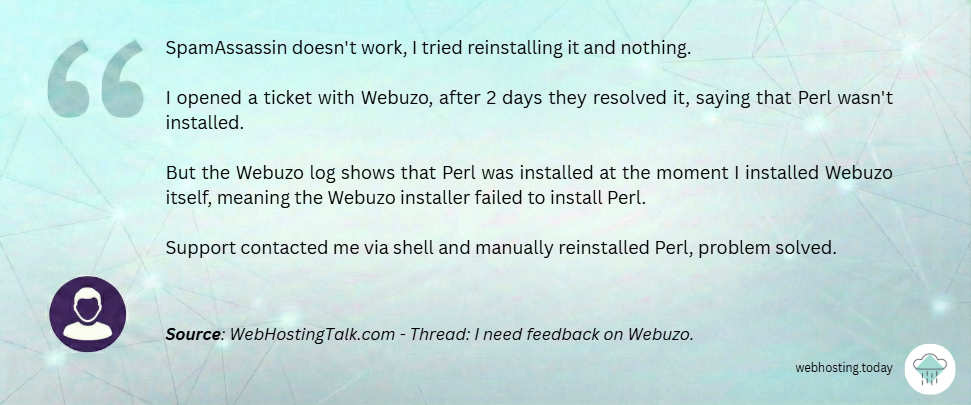
- SpamAssassin not functioning due to missing or incorrectly handled dependencies,
- CloudLinux plugin errors related to kernel detection,
- limitations in reseller account behavior,
- support response times measured in days rather than hours.
None of these issues were described as catastrophic. However, for shared hosting providers, installation-stage friction is interpreted as a maturity signal.
The recurring comment is – “It works, but it doesn’t feel fully polished.” In shared hosting, first-layer stability matters disproportionately because every inconsistency multiplies across accounts.
CloudLinux integration – maturity under pressure
CloudLinux compatibility is not optional for many shared environments.
One concrete issue discussed involved Webuzo’s CloudLinux plugin not aligning cleanly with AlmaLinux 9 kernel behavior.
What matters to operators is predictability and when panel logic does not fully align with OS-level assumptions, trust decreases.
For VPS or single-site deployments, this may be manageable, but for dense shared hosting nodes, this becomes a strategic risk.
Support responsiveness – capable but uneven
Feedback about the Webuzo team is generally positive, but hosting operators report uneven escalation flow:
- level 1 support is sometimes slow to escalate complex cases,
- third-party integration issues take longer to resolve,
- senior-level intervention often resolves problems – but not always quickly.
One operator described the experience as “Good once it reaches the right person.”
For smaller providers, this may be acceptable, but for larger ones predictability of resolution time becomes a serious risk.

Alternatives context – part of diversification, not replacement
Webuzo appears most often in conversations about reducing dependency on cPanel licensing, as we mentioned in our recent article:
Replacing a control panel requires:
- reliable third-party plugin integration,
- fast and predictable support,
- stable reseller account architecture.
Cost reduction alone is not sufficient.
Several providers are testing Webuzo in controlled environments:
- Internal nodes,
- VPS-only segments,
- Limited rollout before broader evaluation.
There is experimentation, not migration waves.
The dominant theme – cautious evaluation
The dominant theme in early 2026 discussions around Webuzo is measured interest.
It is seen as promising and usable in constrained environments. It is not yet universally trusted in high-density shared or reseller hosting models.
The mindset mirrors what we see in broader control panel discussions:
- less emotional positioning,
- more risk modeling,
- staged deployment strategies,
- careful validation before scale.
Among shared hosting operators in 2026, Webuzo is not yet a default choice.
It is tested seriously, not being dismissed, yet also not broadly adopted.
The desire to diversify away from cPanel dependency is visible but risk of operational instability of Webuzo makes its adoption limited for now.

Damian Andruszkiewicz
Author of this post.