
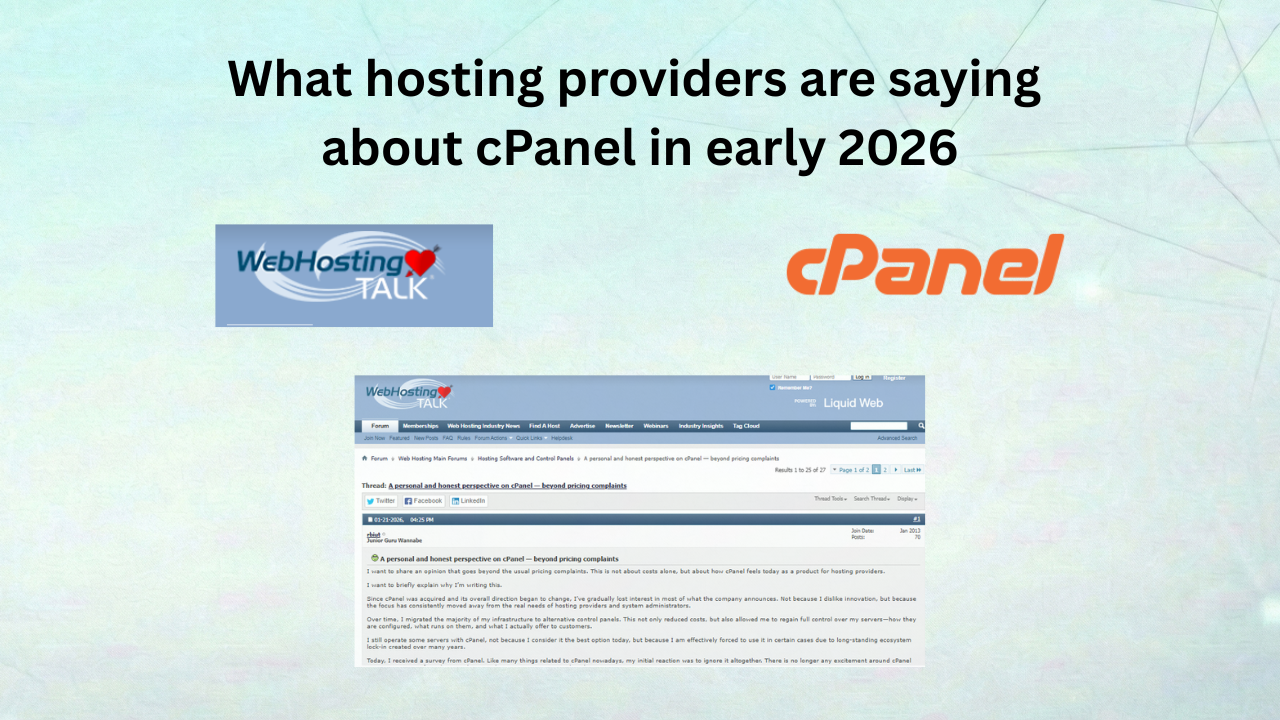
A recent thread on WebHostingTalk – “A personal and honest perspective on cPanel – beyond pricing complaints” – triggered a long discussion among hosting operators about cPanel’s direction in 2026.
Reading through the discussion, and comparing it with direct conversations we’ve had with shared hosting operators in recent weeks, one pattern is clear.
No one is surprised anymore, no one is emotional. But no one is fully comfortable either.
1. Pricing – no longer shocking, but structurally heavy
The 2026 pricing levels are not dramatically different in structure from previous years:
- tiered licenses based on number of accounts,
- additional per-account fees above 100 accounts,
- annual increases that are incremental, not radical.
The shock happened years ago when per-account licensing replaced per-server licensing. What providers are dealing with now is cumulative impact.
What we hear most often:
- “We’ve already adjusted pricing. It’s baked in.”
- “The problem is not this year. It’s predictable.”
- “You can’t build long-term margin planning if you assume another increase every cycle.”
For high-density shared nodes, the per-account model permanently changes capacity economics. Packing 500–800 accounts on a server is no longer just an operational decision. It is a licensing multiplier.
For lower-density, higher-margin setups, the pain is less visible.
The key theme is not price shock. It is margin compression in competitive segments.
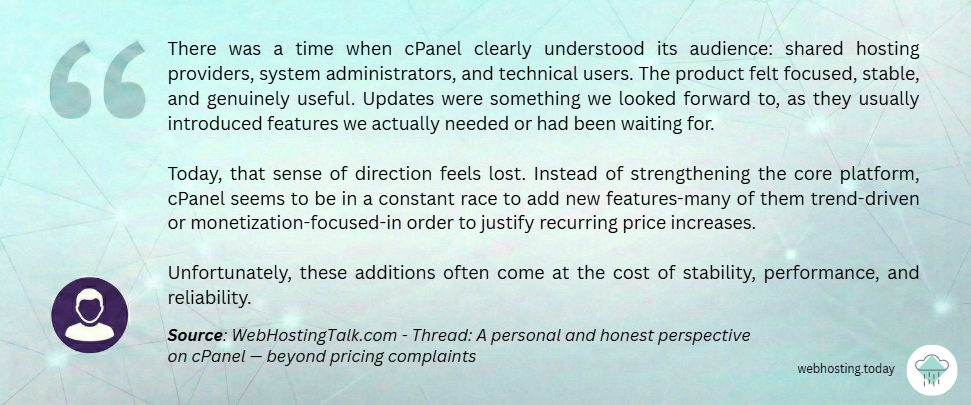
2. Feature direction – AI, bundling, and monetization layers
In 2026, cPanel continues adding automation and AI-assisted tooling inside the panel.
AI-powered support and contextual help features are being integrated directly into the interface. Site building and onboarding tools continue to expand.
There is also a recurring impression that the platform is increasingly designed around upsell and bundled components. Some providers describe it as “platformization” – moving from a control panel to a commercial ecosystem.
No one denies that cPanel still works well technically. The discussion is about direction.
The underlying question providers are asking:
Is this a server management tool first, or a monetization platform first?
3. Ecosystem gravity – why most still stay
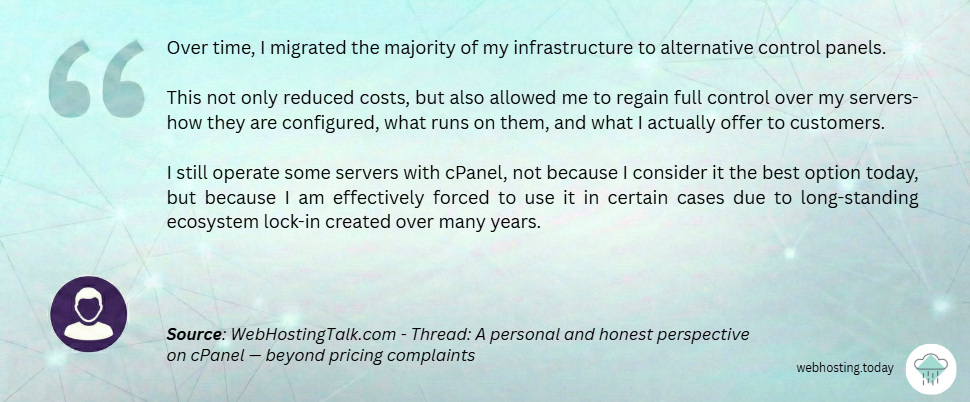
Despite dissatisfaction, most operators are not migrating.
Reasons are consistent:
- customers know cPanel,
- support teams know cPanel,
- documentation and integrations are mature,
- migration risk is real,
- third-party tooling assumes cPanel.
We could sum most comments into one – “We don’t love it. But replacing it is not free.”
Time cost, support load during migration, retraining, unexpected edge cases – these are real expenses. For many, the total cost of switching exceeds annual license deltas.
4. Alternatives – interest without mass movement
DirectAdmin, Webuzo, Enhance, and others are all part of the conversation.
But here is the honest assessment we hear:
- DirectAdmin is stable, but not identical in ecosystem depth,
- Webuzo is promising, but not fully trusted at scale,
- Enhance is interesting for VPS-based or modernized stacks,
- none fully replicate cPanel’s integration maturity.
Several providers are running hybrid strategies:
- cPanel for legacy and shared,
- alternatives for new segments,
- gradual diversification instead of full replacement.
No one we spoke to is making ideological moves – these are purely operational decisions.
5. The dominant theme – controlled dependency
The dominant theme in 2026 is this:
cPanel is not loved. It is also not abandoned – only managed. Many providers describe it as a strategic dependency. Not ideal, not catastrophic, but requiring planning.
The mindset shift compared to previous years:
- less emotional reaction,
- more financial modeling,
- more scenario planning,
- quiet exploration of fallback options.
Mass caution shapes how shared hosting companies design pricing, density, support automation, and long-term platform strategy in 2026.
Bottom line
Among hosting operators in 2026, the conversation about cPanel is pragmatic – it remains the default in many environments and its pricing trajectory forces margin discipline.
The relationship is no longer enthusiastic, as it was many years ago. Alternatives are evaluated, but rarely deployed wholesale. At least for now.

Damian Andruszkiewicz
Author of this post.