
On February 2, 2026, GoDaddy published a revised Universal Terms of Service Agreement (UTOS) that fundamentally changed the legal relationship between the company and its more than 21 million customers. The update – which took effect immediately, with no email notification – reclassifies every user as a “business customer,” rewrites dispute resolution from the ground up, expands GoDaddy’s indemnification rights, introduces sanctions screening, and adds new content and compliance provisions.
The B2B reclassification
The most widely discussed change is GoDaddy’s reclassification of all users as business customers.
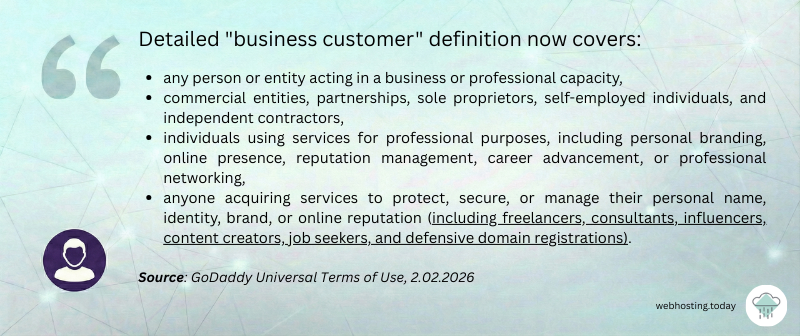
The previous UTOS addressed users as “any individual or entity” without distinguishing between consumer and business use. The new version introduces a new definition of “business customer” that is very broad.
Under the new terms, anyone who registers a domain for any of the following purposes qualifies as a business customer:
- freelancing, consulting, or providing professional services,
- content creation, blogging, or social media influence,
- job seeking or career advancement,
- personal branding or reputation management,
- defensive domain registration (protecting a name or brand),
- any activity that “directly or indirectly supports or facilitates economic activity”.
A new warranty disclaimer reinforces the classification: “You acknowledge that you are acquiring the Services for business, trade, or professional purposes and not for private, personal or household use.”
What consumer protections are affected
Consumer protection frameworks in most jurisdictions apply specifically to B2C transactions.
By declaring all relationships B2B, GoDaddy reduces its exposure under several regulatory frameworks:
- Right of withdrawal.
Consumers in the EU normally have 14 days to cancel an online purchase and get their money back. This right does not apply to business customers. If GoDaddy treats some EU customers as businesses instead of consumers, they may lose this 14-day cancellation right. - Unfair contract terms.
Courts usually protect consumers more than businesses. In the EU, a contract term that is clearly unfair to a consumer can be cancelled by a court. Between two businesses, it is much harder to challenge contract terms, even if they seem one-sided. - Regulatory complaints.
Consumer complaints can be filed with public authorities such as consumer protection agencies. These cases often follow special procedures. Business disputes usually do not go through consumer authorities. They are handled in commercial court or through arbitration. - Class actions.
In the US, consumer class actions have been one of GoDaddy’s main legal risks. If customers are treated as businesses and must use individual arbitration, class actions become much harder to bring. In its 2024 annual filing, GoDaddy reported around $30 million in legal contingencies. Lower exposure to class actions could reduce future legal costs.
Complete rewrite of dispute rules
The biggest operational change is in how disputes are handled.
The old terms used consumer arbitration rules. The new version uses commercial rules. Filing fees under commercial rules start at $2,325 for claims up to $75,000. Under consumer rules, the fee was about $200. The higher cost alone may discourage individual claims.
Other impactful changes include:
- jury trial waiver – new terms include a separate clause where customers waive the right to a jury trial. This did not appear in the previous version,
- fixed arbitration location – previously, arbitration could take place in a reasonably accessible location. Now, any in-person proceeding must take place in Maricopa County, Arizona. For non-US customers, this creates a practical barrier,
- mandatory 60-day pre-arbitration process – before starting arbitration, customers must send a signed dispute notice themselves, not through a lawyer. They must also take part in a phone call, and any formal action against GoDaddy can begin after 60 days,
- settlement cost risk – if GoDaddy makes a settlement offer and the customer rejects it, and later wins less than the offer, the customer must pay GoDaddy’s post-offer costs. This adds financial risk for anyone proceeding to a hearing,
- arbitration opt-out limited – previously, customers could opt out of arbitration within 30 days. Now they can only opt out of applying the new rules to old disputes and arbitration itself is mandatory,
- retroactive application – the new dispute rules apply even to disputes that started before the customer accepted the updated terms. Customers with older complaints may now be subject to the new commercial rules,
- strict limits on evidence – each side may request up to five documents and five written questions. No depositions are possible unless both parties agree and proceedings are written by default – oral hearings must be requested within 10 days.
Sanctions screening and liability changes
The new terms allow GoDaddy to screen accounts against government sanctions lists. Company may request identity documents and suspend or terminate services for compliance reasons. The previous version only referred generally to export laws. The section title has also been broadened from “U.S. Export Laws” to “International Trade Laws”.
Moreover, previously customers agreed to cover GoDaddy’s costs in claims brought by third parties. Now this also covers GoDaddy’s own claims against the customer.
The old terms excluded liability for direct and indirect damages. The word “direct” has been removed and the exclusion list now includes “indirect, exemplary, fixed, and enhanced damages”, with the overall liability cap remaining $10,000. Also the new version excludes any loss of profits.
Content and compliance updates in new version of UTOS include:
- stricter spam definition, with unsolicited communication now requiring prior written consent from the recipient,
- new sections addressing compliance with the UK Online Safety Act 2023 and the EU Digital Services Act, that include content moderation and reporting obligations,
- “ethical values” termination clause, which allows GoDaddy to terminate services for conduct inconsistent with its “ethical values or standards” – without defining these standards,
- full authorization to call recording, without any limitations (in older version call recording was “subject to applicable laws”).
Will new terms of use be enforceable in the EU
Reclassifying all customers as business users raises questions under EU law.
Under EU rules, consumer protection does not disappear simply because a contract labels someone as a business. According to the European Court of Justice consumer status depends on the nature of the transaction, not the wording of the contract.
A person registering a domain for personal use would most likely still qualify as a consumer under Directive 2011/83/EU.
Industry reaction
The changes have drawn attention across the domain and hosting market.
DomainNameWire reported on February 19 that GoDaddy likely made the move to limit the application of consumer protection laws.
Discussion also appeared on NamePros, where users questioned how broadly “business customer” is defined.
MonstaDomains described the reclassification as one of the most significant policy shifts in registrar history.
A review of major providers shows no similar move as of February 20 and all continue to address customers as individuals or entities, without limiting services to business users.
Implications for hosting providers
This is not a minor legal update – it changes how customer relationships are structured. GoDaddy manages domains for more than 21 million customers. If regulators do not intervene, other providers may follow, especially in the US where class action risk is high.
With GoDaddy reducing consumer protections, competitors may choose to emphasize them. Clear withdrawal rights, transparent dispute handling, and no mandatory arbitration could appeal to EU customers.
If EU authorities or US regulators challenge GoDaddy’s approach, the outcome will influence the entire sector.
Sources
- GoDaddy Universal Terms of Service Agreement (February 2, 2026) – godaddy.com/legal/agreements/universal-terms-of-service-agreement
- GoDaddy Universal Terms of Service Agreement (November 12, 2025, archived) – web.archive.org
- DomainNameWire: “GoDaddy Calls All Customers Business Customers” (February 19, 2026)
- MonstaDomains: “GoDaddy Reclassifies Users’ Domains as Business Assets” (February 19, 2026) – dev.to/monstadomains
- NamePros forum discussion threads (February 19–20, 2026)
- GoDaddy Inc. 10-K Annual Report (2024) – SEC filing
- EU Consumer Rights Directive 2011/83/EU
- EU Unfair Contract Terms Directive 93/13/EEC
- AAA Commercial Arbitration Rules and Fee Schedule

Damian Andruszkiewicz
Author of this post.