
Search has changed. AI-generated answers now sit at the top of Google results, and platforms like ChatGPT, Perplexity, and Google’s AI Overviews are fundamentally reshaping how people find information. Businesses still running yesterday’s SEO playbook aren’t just missing out; they’re actively losing ground.
But this isn’t about starting over. Keyword research, technical health, backlinks, and authority are still the foundation. What’s changed is what you need to build on top of them. The businesses pulling ahead right now are the ones layering AI-optimized search strategies on top of their existing SEO, protecting their current traffic while opening entirely new channels for growth.
In this article, I explain how to build that integrated approach, rooted in proven SEO basics, layered with AI visibility strategies becoming essential, and tied to the business metrics that truly matter.
Key Takeaways: SEO and AI-Enhanced Search
- Search is shifting from website authority toward entity and brand authority.
- Traditional SEO fundamentals (technical health, backlinks, topical authority) remain essential.
- AI visibility requires a clear answer-first content structure.
- Content clusters strengthen domain authority for both Google and AI models.
- Cross-platform mentions (Reddit, LinkedIn, YouTube, and industry publications) increase the probability of AI citations.
- Structured data, such as FAQ, Article, and Person schema, improves AI extraction.
Understanding the New Search Landscape
Before you can optimize for AI Search, you need to understand what’s actually changed. Three shifts are reshaping search as we know it.
1. AI is Answering Queries Before Users Click
Google’s AI Overviews now provide synthesized answers to a growing share of queries. For informational searches, this can significantly reduce click-through rates, but it also creates a new opportunity: to be the source of Google’s AI Overview mentions. Businesses whose content is authoritative, well-structured, and clearly attributed are the ones feeding these AI answers.
2. Search Intent Has Become More Conversational
People increasingly retrieve information in chats, type and speak in full questions rather than short keyword strings. “Best WordPress hosting for agencies” has given way to “What is the best WordPress hosting for a growing agency with 50 clients?” or even “What is the best WordPress hosting for an agency like mine?” that AI answers based on the user’s personalized context from previous conversations. Traditional keyword optimization doesn’t fully capture this shift, so you need content that addresses the complete context of a user’s intent.
3. Authority Signals Are Being Re-Weighted
Google’s E-E-A-T framework (Experience, Expertise, Authoritativeness, Trustworthiness) is more important than ever. AI models trained on the web also tend to favor content from sources with demonstrated credibility. This means building a recognizable brand, publishing under real author profiles, and earning references from trusted domains is now both an SEO and an AI-optimization strategy.
The Foundation: What Traditional SEO Still Gets Right
Before adding AI-specific tactics, make sure your traditional SEO fundamentals are solid. These are not optional. It’s the infrastructure on which Search and AI visibility rely:
- Technical SEO: Fast load times, clean site architecture, proper crawlability, and mobile responsiveness remain table stakes. Google’s crawlers and AI models both favor content they can reliably access and parse.
- Keyword strategy: Long-tail keywords and topic clusters still drive significant organic traffic. The goal is no longer to target isolated keywords but to build topical authority, which is a comprehensive coverage of a subject area that signals deep expertise.
- On-page optimization: Well-structured content with clear headings, logical flow, and accurate metadata helps both traditional ranking algorithms and AI systems extract the right signals from your pages.
- Link acquisition: Backlinks from authoritative domains remain among the strongest signals of credibility. If you are into hosting, you should prioritize editorial links from industry publications like WebHosting.Today, over volume-based link schemes.
The Upgrade: AI Visibility Optimization
With your fundamentals in place, here’s how to layer AI-specific optimization strategies that extend your reach into the new search environment.
Structure Your Content for Easy AI Extraction
The most effective change most sites can make is surprisingly simple: answer the main question directly in the first paragraph before adding details. AI systems that use retrieval-augmented generation, which involves fetching real-time content to base their answers on, prioritize sources that offer clear, concise, and immediately useful information.
This means reorganizing your content so that the most important answer appears first, rather than being buried after an introduction. Use numbered steps for processes, define concepts clearly in paragraphs, and include FAQ sections at the end of long content. Also, implement FAQ schema markup so AI systems can directly extract question-answer pairs from your page structure.
Build Content Clusters That Signal Domain Authority
A single well-performing article on a specific topic is far less powerful than a coordinated cluster of content covering that specific topic from every relevant angle. AI models develop topic associations based on the cumulative signal from everything published in a domain, not from individual pages in isolation.
For a site targeting “affiliate marketing for SaaS,” a complete cluster might include: a pillar guide on affiliate programme structures, separate articles on commission models, tracking tool comparisons, recruitment strategies, legal considerations, and case studies with outcome data, all interlinked.
Each piece functions as a standalone answer to a specific query while reinforcing the domain’s authority on the broader topic. This shows both Google and AI systems that your domain is the authoritative destination for this kind of information.
Increase Fact-Density and Cite Your Sources
A 2024 academic paper from Princeton University in the USA reports on testing specific content-optimization tactics for generative AI engines. The researchers built a benchmark of 10,000 queries and tested what actually moves the needle.
The researchers identified three content characteristics that consistently improve AI citation rates:
- citing authoritative sources
- including specific statistics, and
- incorporating expert attribution.
These are not soft signals; they are the markers AI systems use to evaluate whether content is reliable enough to reference. Practically, this means including specific numbers wherever possible, linking to original research and industry data, and attributing claims to named sources or studies.
Content that reads like a well-sourced article rather than a general overview is significantly more likely to be selected as a citation source.
Earn Cross-Platform Mentions and Earned Media
AI systems develop brand associations based on where and how a business is mentioned across the broader internet, not just on its own site. Based on a Semrush study of 230K prompts conducted in October 2025, Reddit, LinkedIn, Medium, and YouTube were among the top-cited sources across major LLMs in late 2025.
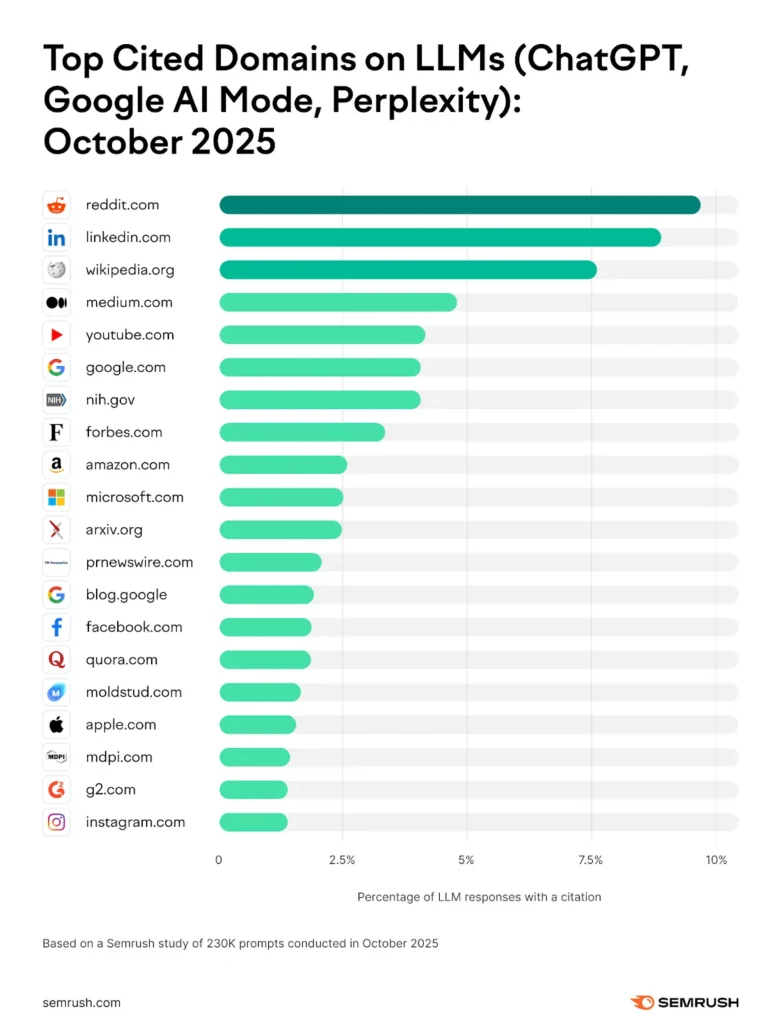
Customer reviews on platforms like G2 and Capterra, mentions in industry journalism, and community recommendations in relevant forums all feed the credibility signals that AI systems use to evaluate sources.
For SaaS and digital businesses, this means treating digital PR and community presence as components of your search strategy rather than separate initiatives. Earned mentions from independent, credible sources are among the hardest signals to manufacture and among the most durable when built authentically.
Build E-E-A-T Into Your Brand Identity, Not Just Your Website
Most E-E-A-T advice stays at the surface: maintain an About page, write author bios, and get testimonials. These are necessary but insufficient. The deeper opportunity is entity-level optimisation, ensuring that Google’s Knowledge Graph and models trained on web data associate your name, brand, and domain with specific, credible expertise.
Below is a screenshot of the Knowledge Person Panel for Matt Mullenweg, the creator of WordPress, when you search for his name. This is powered by Google Knowledge Graph.
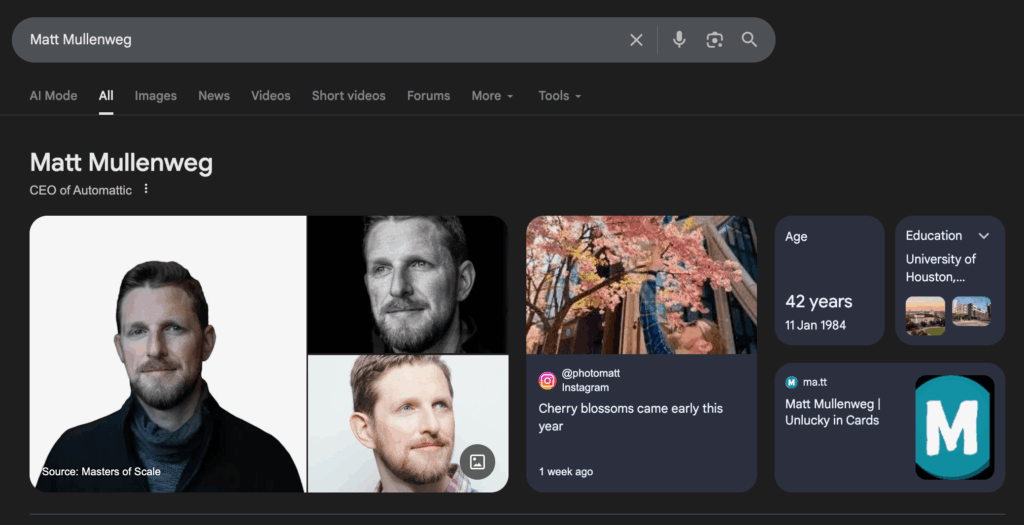
In practice, this means you should publish under consistent author profiles linked to your LinkedIn, industry publications, and social presence, thereby earning coverage in media outlets that Google considers authoritative.
Also, it helps to speak at conferences, ensuring coverage is indexed and linkable, and building a presence on platforms that AI systems frequently cite. The goal is to become a recognisable entity in your space, as this goes beyond the website.
Technical GEO: AI Crawler Access
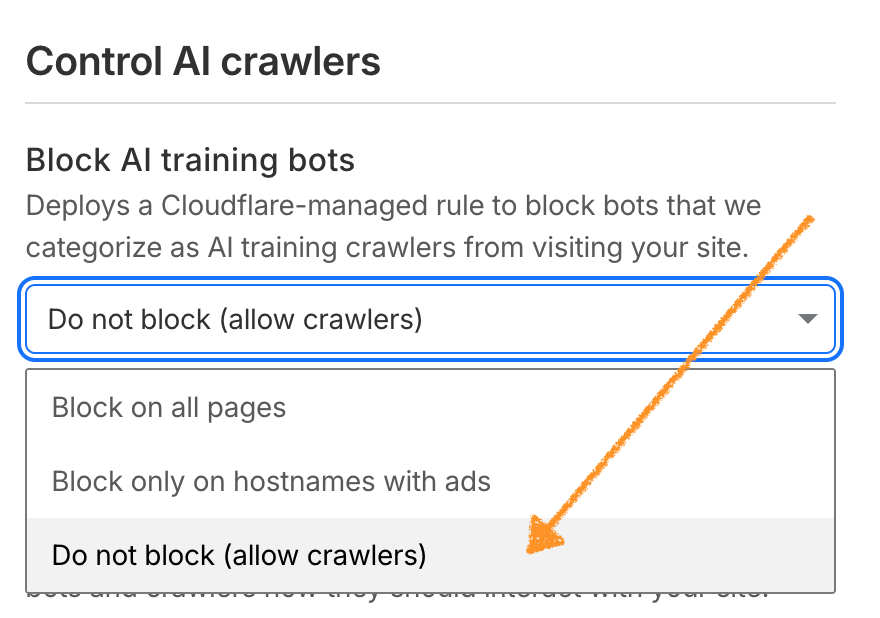
Before AI systems can extract any signal from your site, they need to be able to crawl it. This means explicitly permitting known AI crawlers (GPTBot, ClaudeBot, Google-Extended, PerplexityBot, etc) in your robots.txt file. Blocking these bots, even unintentionally through overly broad rules or third-party security configurations, will prevent your content from being used for AI training data and real-time retrieval pipelines.
Firewall and bot management tools like Cloudflare can inadvertently block AI crawlers if configured too aggressively. If you use Cloudflare, then it’s worth auditing your settings to confirm that AI crawlers are set to Allow rather than Block or Challenge, as shown in the screenshot below.
Once crawl access is confirmed, you should ensure your site’s structured data is complete and accurate. JSON-LD schema markup for the Article, FAQ, Person, and Organization types helps AI systems extract structured facts about your content, authors, and business, in addition to the parsing they perform on page text.
Use AI Tools to Scale Content Research and Draft Not Full Production
AI tools like ChatGPT, Claude, and Gemini can dramatically accelerate content generation, but businesses that achieve the best results treat AI as a research and drafting assistant, not a content factory.
Use AI tools to:
- Identify content gaps by analyzing SERP results at scale,
- Generate outline options that you can refine and enhance manually,
- Repurpose long-form content into multiple formats, and
- Produce first drafts that subject-matter experts then enrich with real experience and original data.
It’s still difficult for AI systems to generate original data, real-world experience, and first-person insight, and these are precisely the elements that differentiate your content in a landscape increasingly flooded with basic AI-generated text.
Connecting Visibility to Conversions
Traffic growth is only valuable if it converts into leads and further clients. Many SEO strategies generate impressions and visits but fail to close the loop with business outcomes.
Here’s how to ensure your AI-enhanced search strategy drives not just visibility, but revenue.
Map Content to Conversion Stages
Every page on your site should have a clear role in the buyer’s journey:
- Top-of-funnel content builds awareness and earns AI citations.
- Middle-funnel content compares options and builds trust.
- Bottom-funnel content, such as pricing pages, case studies, and demo-request CTAs, closes the deal.
The mistake most sites make is over-indexing on awareness content and under-investing in the middle. AI-enhanced search systems have made this worse by absorbing informational queries. Your competitive edge lives in the middle and bottom of the funnel, where personalization, proof, and specificity matter most.
Identify High-Intent Opportunities in Search Console
Google Search Console remains one of the most underused SEO tools. The highest-leverage action is to filter for queries where you rank in positions 5–30 with meaningful impression volume. These are commercial or informational searches where you have demonstrated relevance but are not yet capturing clicks.
Optimizing these pages with a more direct introduction, a stronger title tag, a clearer match to the query’s specific intent, and several backlinks can significantly improve them and generate meaningful traffic gains without creating new content.
Track AI Referral Traffic as a Distinct Channel
According to McKinsey’s CMO survey, fielded with Fortune 500 consumer-brand CMOs in September 2025, only 16% of brands systematically track AI search performance. You gain a competitive advantage for companies that start early.
In GA4, you can segment referral traffic by source to identify visits arriving from ChatGPT, Perplexity, and other AI platforms. Set up these segments now, before AI traffic becomes a significant enough share of your visits to matter, so you have baseline data when it does.
Beyond traffic, the metrics that matter for digital businesses are:
- Organic-driven trial signups and lead generation;
- Revenue attributed to organic channels (requiring CRM integration and proper UTM setup); and
- Customer acquisition cost: organic vs. paid.
Building this attribution model is unsexy, but it lets you make the case for continued SEO and AI SEO investment when budgets come under pressure.
Practical Implementation: A Prioritised Sequence
Based on working with digital businesses at different stages of organic maturity, here is the implementation sequence I recommend, ordering the actions by impact relative to effort:
- Run a full crawl audit with tools like Screaming Frog and SiteBulb, and resolve critical issues first. Broken crawlability undermines every investment made above it.
- Choose the intersections of your deepest expertise and your audience’s highest-value search intent. These are the topic areas where you will build authority. Don’t aim for individual keywords; aim for subject domains. Identify your three to five core topic clusters.
- Review and refresh each page, but also rewrite the content to lead with a direct answer to the primary query. Add FAQ sections where appropriate. This is the highest-leverage AI visibility change most sites can make for a quick win. Restructure your top 20 pages for AI extraction.
- Create or update detailed author profiles linked to verifiable external credentials. Ensure your About page clearly describes your expertise, experience, and the evidence for both. This is the foundation of E-E-A-T at the entity level. Strengthen your entity and author presence.
- Plan pillar pages and supporting content before writing a single new article. Each piece should answer a specific query while reinforcing the cluster’s overall topical authority. Build content clusters around your core topics.
- Identify the publications, forums, and platforms where your target audience researches decisions. Build a systematic presence in those places through contributed articles, community participation, and digital PR. These cross-platform mentions are the credibility signals AI systems weigh most heavily. Activate your earned media and community presence.
- Set up GA4 segments for AI referral traffic, implement UTM tracking across all channels, and connect your CRM to organic conversion data. Do this before you need it. Build your measurement infrastructure.
The Integrated Approach Is a Competitive Moat
The businesses that will win in search over the next three to five years are not the ones chasing the latest AI tool or algorithm update. They’re the ones building deep topical authority, genuine credibility, and well-structured content that serves both human readers and the AI systems increasingly mediating between people and information.
Combining traditional SEO and AI Visibility optimization is a durable competitive moat. Start with what you already know. Then add the layers that the new search landscape demands.
