
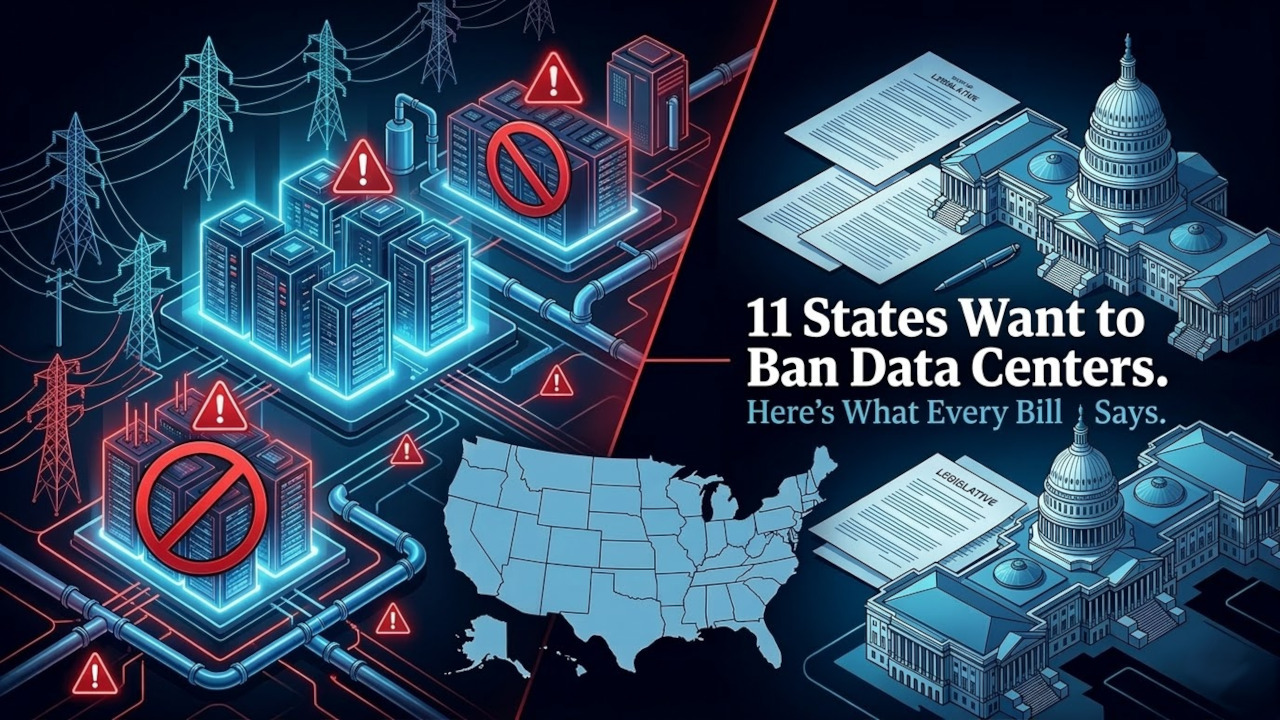
In the first ten weeks of 2026, lawmakers across more than 30 U.S. states have introduced over 300 pieces of legislation targeting data center construction, energy consumption, water usage, and tax incentives. At least 11 states have filed bills that would temporarily ban new data center development outright. Meanwhile, a parallel movement is dismantling the generous tax incentive programs that once defined site-selection strategy for the hosting industry.
The triggers are well documented. U.S. data centers consumed approximately 176 terawatt-hours of electricity in 2023 – 4.4% of national demand, according to the Department of Energy and Lawrence Berkeley National Laboratory – and the DOE projects that figure could reach 6.7% to 12% by 2028. A single AI query has been estimated to use roughly ten times the electricity of a standard web search, though more recent analyses suggest the multiplier varies significantly depending on the model and hardware used. In Virginia, home to the world’s densest cluster of data centers, these facilities already consume 26% of the state’s total electricity output. Dominion Energy reports that data centers have requested 70,000 megawatts of future capacity – nearly triple the utility’s all-time peak demand.
Water tells a similar story. A large data center can consume 5 million gallons per day – equivalent to a town of 50,000 residents. Researchers at the University of California, Riverside estimate that building the water infrastructure to meet projected data center cooling demand by 2030 would cost $10 billion to $58 billion nationwide.
Communities that initially welcomed data centers for jobs and tax revenue are now confronting rising electricity bills, strained water supplies, and infrastructure costs that often exceed the promised economic benefits. The political response has been swift and bipartisan.
The Moratorium Wave: State by State
As of March 2026, lawmakers in at least 11 states have introduced bills imposing temporary bans on new data center development. While no state has enacted a moratorium into law yet, several cities and counties have already implemented local bans, and the state-level movement is accelerating. Here is what each state is proposing.
Oklahoma: SB 1488
Oklahoma’s Senate Bill 1488 proposes a moratorium on the construction of data centers with an electrical load exceeding 100 megawatts, effective until November 1, 2029 – more than three years. The moratorium would give the state’s Public Utility Commission time to study data center impacts on water supply, utility rates, and property values. A companion bill, HB 4424, would end state tax incentives for any data center not operational by January 1, 2027.
New York: A 10141 / S 9144
New York’s bill is among the most aggressive in scope. It would halt all data center construction statewide for up to three years while the Department of Environmental Conservation and the Public Service Commission develop comprehensive regulatory frameworks. The legislation also mandates a state study of data center impacts on local economies, the environment, and community infrastructure.
Vermont: Moratorium Through July 2030
Vermont’s proposal would ban new data center projects through July 2030 – one of the longest moratorium periods proposed by any state. During this time, the Public Utility Commission would investigate how data centers could affect the state’s natural resources, communities, and economy, and develop mitigation strategies.
Georgia: HB 1012
Georgia’s House Bill 1012 would bar counties and cities from issuing any permit, license, or certificate authorizing the construction of a new data center until March 1, 2027, with an exception for approvals issued before July 1, 2026.
South Carolina: H. 5286
This joint resolution would prohibit state and local governments from granting permits, approvals, or incentives for new data centers until January 1, 2028.
Michigan: Bipartisan Three-Bill Package
On February 26, 2026, a bipartisan group of Michigan lawmakers introduced three bills that would pause new enterprise data center approvals statewide until April 1, 2027. The effort was spearheaded by Rep. Jennifer Wortz (R-Quincy), with co-sponsors Rep. Dylan Wegela (D-Garden City) and Rep. Joseph Fox (R-Fremont). One of the three bills targets approvals by the Michigan Public Service Commission specifically. Notably, Governor Gretchen Whitmer has publicly opposed any effort to block data center development, signaling a likely executive-legislative standoff.
New Hampshire: HB 1265
This bill would prohibit anyone from beginning construction of a new data center anywhere in the state for one year from the act’s effective date. The legislation also creates a legislative committee to study the environmental impacts of data centers.
South Dakota: SB 232
South Dakota’s Senate Bill 232 proposed a one-year moratorium on the construction or expansion of hyperscale data centers, while allowing smaller facilities to proceed. The bill was tabled in the Senate State Affairs Committee by a vote of 5–3 in what observers described as a “tense” session exposing deep fault lines among lawmakers. Despite its failure, the debate catalyzed a broader public conversation. As of early March, local officials across the state have expressed growing interest in implementing their own restrictions.
Wisconsin
Wisconsin lawmakers circulated draft legislation (LRB-6377/1) that would create a statewide moratorium on data centers. Details remain limited as the bill moves through early legislative stages.
Maryland: HB 120
Maryland takes a conditional approach rather than a blanket ban. HB 120 would prohibit new data center construction unless the General Assembly first enacts legislation governing co-location with power generation facilities, including natural gas, nuclear, and small modular reactors (SMRs). A separate bill (SB 596 / HB 940) would encourage data centers to participate in demand response energy programs.
Virginia: HB 1515
Virginia’s bill would block localities from granting final zoning, special permit, or site plan approvals for new data centers until specified grid-interconnection conditions are satisfied. Given that Virginia hosts the world’s densest concentration of data centers, this bill carries outsized significance for the global hosting industry.
The Tax Incentive Rollback
Running parallel to the moratorium movement, a growing number of states are reconsidering the generous tax breaks that were once used to attract data center investment. The shift is striking: states that spent years competing to offer the richest incentive packages are now racing to claw them back.
Virginia: The $1.6 Billion Annual Question
Virginia’s data center tax incentive program, which costs the state an estimated $1.6 billion per year, is under intense scrutiny. The state Senate introduced a proposal in its biennial budget to eliminate data center tax breaks in 2027 – eight years ahead of their scheduled 2035 expiration. Additional bills would restrict incentives to replacement equipment and repairs only (HB 961) and require data centers to use emission-free backup generators as a condition for continued tax benefits.
As of early March 2026, the question of whether to end data center incentives early is one of the key issues holding up budget passage.
The impact on Virginia residents is already tangible. The State Corporation Commission approved rate increases of $565.7 million in 2026 and $209.9 million in 2027, translating to monthly bill increases of $11.24 for a typical household in 2026. Dominion Energy projects summer peak load will increase by 70% between 2022 and 2045, driven almost entirely by data center growth, with peak data center demand alone potentially reaching 13.3 gigawatts by 2038.
Illinois: Governor’s Executive Action
Governor J.B. Pritzker announced during his budget address a two-year suspension of all state tax incentives for new data center developments, effective July 1, 2026. This executive action is separate from – and complementary to – the legislative POWER Act (SB 4016 / HB 5513), which would impose comprehensive energy, water, and community-benefit obligations on data center operators.
Pennsylvania: $2 Billion Revenue Impact
The Shapiro administration’s budget estimates show that Pennsylvania could lose approximately $2 billion in revenue by mid-2031 due to existing data center tax breaks. Lawmakers have introduced legislation to repeal the exemption.
Other States
Similar bills to repeal or restrict data center tax incentives have been filed in Arizona, Georgia, Maine, and Oklahoma. Maine lawmakers are considering excluding new data center projects from two existing tax incentive programs. Oklahoma’s HB 4424 would end incentives for data centers not in operation by January 1, 2027.
What This Means for the Hosting Industry
For hosting companies evaluating expansion plans, the calculus has fundamentally changed. The traditional site-selection model – optimizing for power availability, fiber connectivity, land cost, and tax incentives – must now incorporate detailed legislative risk assessment.
States that were once considered ideal locations due to cheap power and generous tax breaks – Virginia, Illinois, Oklahoma – are now among the most aggressive in imposing restrictions. A site that looks attractive today could become unbuildable in six months if a moratorium bill advances. And the geographic concentration that the industry has historically favored (Northern Virginia alone hosts approximately 300 data centers across Loudoun, Fairfax, and Prince William counties) creates compounding risk: the states with the most data centers are precisely the states most likely to restrict them.
No state has enacted a moratorium yet. But the sheer volume of legislative activity – 300+ bills across 30+ states in ten weeks – signals a durable political shift, not a passing trend. The era of frictionless data center expansion, subsidized by tax incentives and largely invisible to regulators, is coming to a close.

Łukasz Nowak
Nearly two decades in IT. A decade in web hosting - and still in the trenches. Writing about the infrastructure that runs the internet from the inside.
Sources
- State Data Center Legislation in 2026 Tackles Energy and Tax Issues - MultiState
- Data Center Moratorium Bills Are Spreading in 2026 - Good Jobs First
- Data Center Compliance in 2026: What Changed, What's Next - Data Center Knowledge
- DOE Report: Evaluating Increase in Electricity Demand from Data Centers - U.S. Department of Energy
- Dominion Long-Range Projections Show Major Energy Growth - Virginia Mercury
- SCC Issues Order on DEV Biennial Review 2025 - Virginia State Corporation Commission
- Virginia Regulators Approve New Dominion Rates, Assign More Costs to Data Centers - Inside Climate News
- Data Center Water Spikes Could Cost Billions - UC Riverside
- AI Datacenters May Gulp NYC's Daily Water Supply at Peak - The Register
- Data Center Tax Breaks on the Chopping Block - Stateline
- States Rethink Data Center Tax Incentives as Costs Soar - MultiState
- To End Data Center Tax Incentives Early or Not - Cardinal News
- Pritzker Announces Two-Year Suspension of Tax Incentives - NRDC
- PA Data Center Tax Break Expected to Cost $2B - Spotlight PA
- Michigan Data Center Tracker - WKAR Public Media
- South Dakota's Data Center Debate - SDPB
- Temporarily Banning Data Centers Draws More Interest - Stateline
- Oklahoma Among 12 States Considering Data Center Bans - Oklahoma Energy Today
- State Regulation of Data Centers: Emerging Trends - WilmerHale