
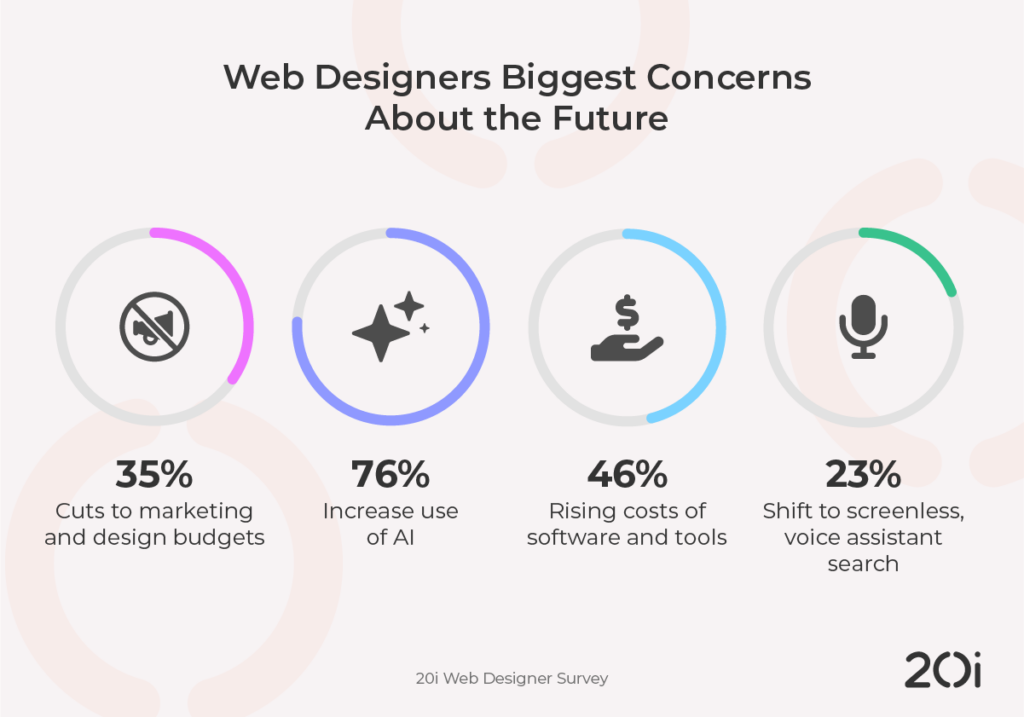
Three quarters of US web designers say AI-driven competition has already impacted their business, according to the 2026 Web Designer Survey published by managed hosting provider 20i. The survey of 500 professionals found that 76% cite increasing AI use as their biggest concern for the future of web design – ahead of rising tool costs (45.6%) and shrinking client budgets (34.8%). When asked to look ten years ahead, designers ranked AI-powered self-design tools and AI agent-led website creation as the two forces most likely to transform their industry.
For the hosting industry, this survey matters less for what it says about designers and more for what it reveals about the channel that feeds hosting sales. Web designers and agencies have historically been one of the largest sources of new hosting accounts. They build sites, choose hosting providers, manage accounts, and often resell hosting under their own brands. If AI tools reduce demand for professional web design – even at the lower end – that pipeline contracts. The question is not whether AI will change web design. It already is. The question is what happens to hosting revenue when the people who used to buy hosting on behalf of their clients are no longer in the loop.
What the 20i Survey Actually Shows
The full survey data paints a more complicated picture than the headline suggests. Yes, 75.4% of designers report AI-driven competition pressure. But 78.6% also say they feel properly compensated for their work, and 37% earn over $100,000 per year. These numbers do not describe an industry in collapse – they describe an industry in transition, where the lower end of the market is being automated while specialist expertise retains its value.
The breakdown by work type is telling. Only 4.2% of respondents primarily use CMS block editors (like WordPress’s Gutenberg) as their main tool. The majority – 42% – use design-to-development handoff tools like Figma, Adobe XD, and Sketch. Another 26.6% use visual builders like Webflow and Framer. These are designers doing custom, high-value work that AI tools cannot yet replicate. The ones losing ground are those building straightforward business websites – the five-page brochure sites that AI can now generate in minutes.
The client side confirms this shift. Designers report that 32% of clients prioritize delivery speed above all else, and 27% prioritize price. Only 18% prioritize visual appeal. When speed and price are the primary buying criteria, AI tools win. When the job requires UX research, custom integrations, accessibility compliance, or performance optimization, designers win. The market is splitting, and the split runs directly through the hosting industry’s customer base.
One statistic stands out: 89% of designers believe clients underestimate the true cost of web design. That gap between perceived and actual cost is exactly where AI website builders are inserting themselves – not by matching designer quality, but by matching what many clients think they need.
The Tools That Are Doing the Replacing
The AI website building market is no longer theoretical. Multiple products are in production, generating real sites for real businesses, and several of them are deeply integrated into the hosting industry’s infrastructure:
Hostinger Horizons, launched in March 2025, generates functional websites and web applications from plain-language descriptions. Running on Google’s Gemini and Anthropic’s Claude, it represents Hostinger’s bet that hosting customers will skip designers entirely – describing what they want and letting AI build it. Hostinger’s AI assistant Kodee already handles 83% of customer support interactions. The company reported €275.4 million in 2025 revenue, growing 51% year-over-year. Horizons is central to that growth strategy.
Extendify, founded by Artur Grabowski and Chris Lubkert, both formerly of Automattic’s corporate development team, takes a different approach. Rather than building a competing platform, Extendify provides white-label AI site building tools that hosting companies pre-install for their WordPress customers. Its Launch AI generates complete, personalized WordPress sites from a few questions. Its AI Agent – embedded directly in the WordPress dashboard – can edit content, swap images, install plugins, generate pages, and create custom color palettes, all from conversational prompts. Critically, everything Extendify builds uses core WordPress blocks and patterns, not a proprietary builder – there is no lock-in beyond WordPress itself.
Extendify’s partner list reads like a map of the hosting industry: WebPros (cPanel and Plesk), Namecheap, hosting.com, Spaceship, HOSTAFRICA, 34SP.com, and mijndomein.nl. Its AutoLaunch feature lets hosting providers gather customer information during signup and pass it to Extendify, which creates a finished site before the customer even logs into WordPress for the first time. The model is explicitly B2B – Extendify sells to hosting companies starting at $1,000/month, not to end users.
DreamHost joined the race on March 10 with Remixer, a conversational AI website builder bundled at no extra cost with hosting plans starting at $1.99/month. Users describe their business in plain English, and Remixer generates a complete multi-page site in two to three minutes – layout, copy, images, and navigation included. Editing works the same way: instead of dragging blocks or writing CSS, users type instructions like “add a pricing table with three tiers” or “make the hero image darker.” The output is static HTML with no database or CMS overhead, which DreamHost frames as a performance and security advantage over WordPress-based alternatives. The key differentiator is portability – Remixer produces standard source files the customer owns outright and can move to another host, unlike Wix or Squarespace where the site is locked to the platform. For users who do need WordPress, DreamHost offers a separate AI builder called Liftoff. Ralph Castro, VP of Product at DreamHost, put it simply: “Small business owners shouldn’t have to choose between getting online quickly and actually owning what they build.”
Other platforms are moving in the same direction. Wix and Squarespace have added AI site generation to their platforms, but these are closed ecosystems that pull customers away from traditional hosting entirely. Durable and 10Web offer AI-generated sites with varying degrees of quality. WordPress 7.0 (releasing April 9, 2026) continues to expand the native editing experience, and WordPress.com introduced its own AI Assistant in February 2026.
The Hosting Channel Problem
The 20i survey reveals that web designers find clients through a mix of channels: social media (18%), SEO (17%), freelance marketplaces (17%), referrals (15%), and – notably – AI chatbot referrals (10%). That last number, while still small, signals a shift: clients are already asking AI tools for help finding designers, and the next step is asking those same tools to build the site directly.
For hosting companies, the designer channel has worked as follows for two decades: a business needs a website, hires a designer, the designer selects a hosting provider, sets up the account, builds the site, and often manages the hosting relationship going forward. The designer is both the sales channel and the ongoing customer. When that designer is removed from the equation – replaced by AI tools that the business uses directly – the hosting company needs a new acquisition path.
This is why Extendify’s model is strategically important for the hosting industry. Instead of losing customers to AI-powered platforms like Wix or Squarespace, hosting companies can offer their own AI site building tools – keeping the customer on WordPress, on their hosting, and in their billing system. The designer is gone, but the hosting revenue stays.
Hostinger Horizons serves the same function but as a proprietary platform. Extendify does it as a white-label layer that any hosting company can integrate. Both represent the hosting industry’s answer to the same problem: if AI replaces the web designer, make sure the AI runs on your platform.
What Designers Get Right About the Future
When asked to rank the forces most likely to transform web design over the next decade, survey respondents identified AI-agent dominance as the top force, followed by AI-powered self-design tools. Generative content saturation ranked third. These assessments align with what the hosting industry is already seeing.
What designers ranked lower is equally interesting. Spatial web and AR integration came last. Privacy-first design ranked fifth. Voice and no-screen navigation ranked sixth. The consensus among practitioners is that AI is the transformative force, not extended reality or alternative interfaces. This is consistent with where hosting infrastructure investment is going – toward AI compute, not toward AR rendering or voice processing.
The designers who feel secure – the 78.6% who say they are properly compensated – are overwhelmingly those doing work that AI cannot yet do: complex UX research, custom application design, accessibility audits, performance optimization, and strategic consulting. The 20i survey does not break down compensation by service type, but the implication is clear. Designers who execute (build pages, write copy, choose layouts) are competing with AI. Designers who advise (define strategy, solve business problems, integrate systems) are not – at least not yet.
What This Means for Hosting Companies
The 20i survey quantifies a transition that hosting companies need to plan for, not react to:
- The designer channel is shrinking, not dying – High-end design work will continue, and the designers doing it will continue buying hosting. But the volume of simple business sites built by designers is declining as AI tools make those projects uneconomical. Hosting companies that depend on designer-driven account growth need alternative acquisition channels.
- AI site builders are now a competitive requirement – Hosting companies without an integrated AI site building option – whether Extendify, a proprietary tool, or a third-party integration – will lose customers to platforms that offer one. The expectation is shifting from “give me hosting and I’ll figure out the site” to “give me a site and hosting together.”
- WordPress remains the anchor – The advantage of Extendify’s model is that everything stays on WordPress. Customers who outgrow AI-generated sites can hire designers to customize them, without migrating platforms. Hosting companies that keep customers on WordPress retain optionality that closed platforms like Wix and Squarespace do not offer.
- Reseller hosting needs repositioning – Reseller hosting has traditionally been sold to web designers and agencies. If the designer population contracts at the lower end, the reseller hosting product needs to evolve – targeting marketing agencies, IT consultants, and managed service providers rather than freelance web designers.
- Support costs may actually decrease – AI-built sites are typically simpler and more standardized than custom-designed sites. They use default themes, standard plugins, and predictable configurations. For hosting support teams, this means fewer edge cases and fewer “my designer did something unusual” tickets. Hostinger’s experience with Kodee – resolving 83% of support interactions via AI – suggests this is already happening at scale.
The 20i survey captures a moment of anxiety in the web design profession. But for the hosting industry, the signal is not about anxiety – it is about infrastructure. The designers who remain will continue to be valuable hosting customers. The ones who leave will be replaced by AI tools that, if properly integrated, generate hosting revenue without the intermediary. The hosting companies that have already built or integrated those tools – Hostinger with Horizons, Extendify’s partners with Launch AI, and others following the same path – are the ones positioned to grow regardless of which direction the web design market goes.

Łukasz Nowak
Nearly two decades in IT. A decade in web hosting - and still in the trenches. Writing about the infrastructure that runs the internet from the inside.