
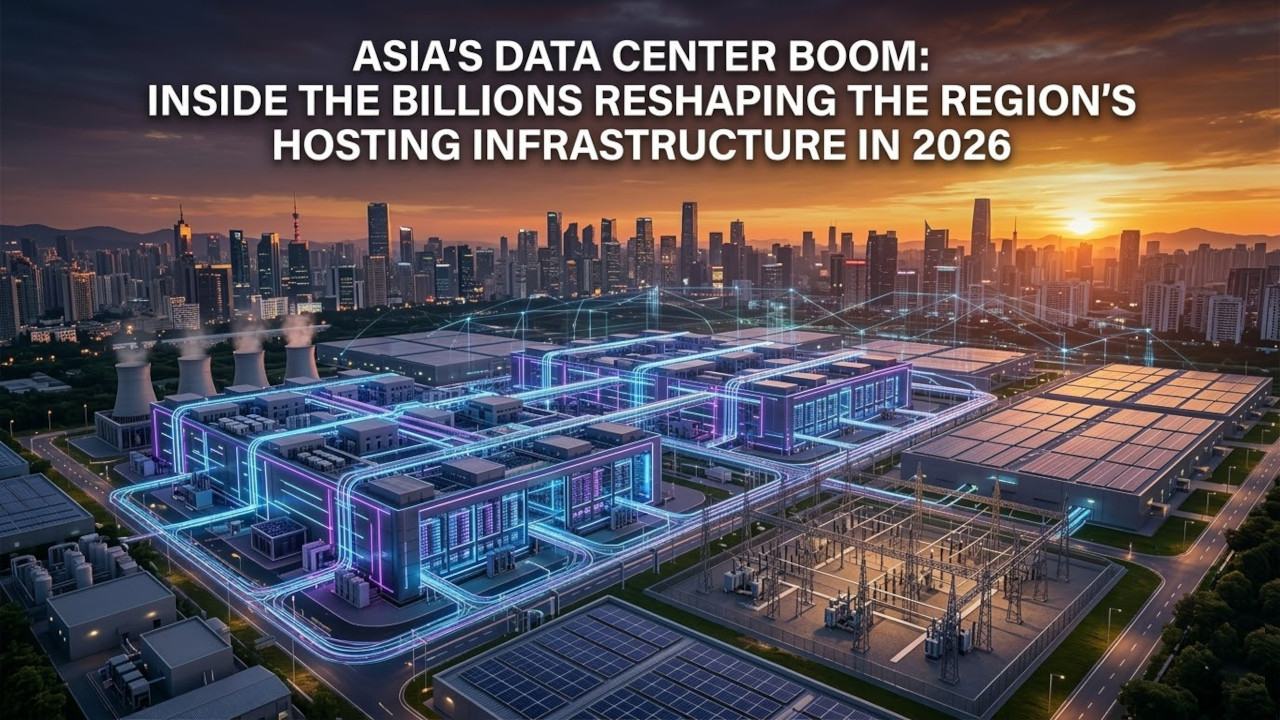
The first quarter of 2026 has been among the most active on record for data center investment announcements across Asia. With Wall Street consensus estimates placing aggregate hyperscaler capital expenditure at roughly $527 billion globally this year – up from $465 billion just one quarter earlier, according to Goldman Sachs – Asia-Pacific has emerged as the primary destination for new capacity, and the pace of deployment is accelerating.
What makes this moment different is the convergence of three forces: explosive demand for AI compute, aggressive government incentive programs across Southeast Asia, and a fundamental shift in how global enterprises think about data sovereignty.
The Deals That Defined the Quarter
Digital Edge committed $4.5 billion to develop the CGK Campus in Bekasi, east of Jakarta – one of Indonesia’s largest AI-ready hyperscale data center projects, designed to deliver up to 500 MW of IT capacity at full build-out, with the first building scheduled for service by Q4 2026 (Data Center Dynamics, Bloomberg). The campus features direct-to-chip liquid cooling and targets a PUE of 1.25 – a clear bet that Indonesia, with its 280-million-strong population, is no longer a secondary compute market.
Google Cloud launched a new three-zone cloud region in Bangkok on January 21, backed by a $1 billion infrastructure investment in Thailand. The region is projected to contribute THB 1.4 trillion (~$41 billion) in economic value over five years (Google Cloud Blog, Fintech Singapore).
Microsoft announced new Azure regions in India and Taiwan for 2026. The India expansion is part of a broader $17.5 billion, four-year commitment (2026–2029) to Indian cloud and AI infrastructure – Microsoft’s largest investment in Asia to date. The new India South Central region in Hyderabad is expected to come online by mid-2026. The Taiwan region is a separate initiative, bringing Azure services and Microsoft 365 data residency to one of Asia’s key semiconductor and AI research hubs (Microsoft Source Asia, Azure Blog).
Managed hosting providers are following the hyperscalers’ lead. 20i opened its first Singapore data center on February 3 within an Equinix Tier 3 facility (CRN Asia), while Cloudways added 17 new locations to reach over 150 data center points across 50+ countries, including Bangkok, Kuala Lumpur, and Taipei (Cloudways Blog). When mid-market providers start opening in the same cities as hyperscalers, it confirms the demand signal is broad-based – not limited to the largest enterprise buyers.
What Is Driving the Buildout
AI compute demand is the most immediate driver. Much of the new data center funding across Southeast Asia has been specifically earmarked for AI-ready facilities – purpose-built for the power density and cooling requirements of GPU-intensive workloads. Hosting providers that cannot offer GPU access or elastic scaling for AI workloads are already losing RFPs to competitors that can.
Government policy is the second accelerant. Countries across the region are competing aggressively for data center investment through tax incentives, streamlined permitting, and dedicated industrial zones. Indonesia’s designation of Bekasi as a data center corridor, Thailand’s Eastern Economic Corridor initiative, and Malaysia’s continued investment in Cyberjaya are all examples of state-level strategies designed to attract exactly this kind of capital.
Data sovereignty requirements are the third force. Regulatory frameworks across Asia increasingly mandate that financial, healthcare, and government data be stored and processed within national borders. A single Singapore hub is no longer sufficient. Country-level presence is becoming a compliance requirement, not just a latency optimization.
The Numbers Behind the Boom
Total data center supply in Asia-Pacific is projected to expand from approximately 13.3 GW today to around 30 GW over the next two to three years, according to CBRE’s latest market outlook. Even at that pace, supply may fall short of potential demand by 15 to 25 GW by 2028, creating a significant capacity gap driven by AI adoption and cloud migration.
The growth is distributed broadly across the region. The global data center market is projected to grow from $300.64 billion in 2026 to $699.13 billion by 2034 at an 11.1% CAGR, according to Fortune Business Insights. Within Asia, China and Japan remain the largest national markets by revenue, but the fastest growth is in emerging Southeast Asian economies. Indonesia’s data center market alone – valued at $1.83 billion in 2026 with a 13.71% CAGR – is projected to reach $3.48 billion by 2031, according to Mordor Intelligence. The global web hosting services market is forecast to expand from $78.23 billion in 2025 to $162.09 billion by 2031, with Asia-Pacific consistently identified as the fastest-growing region.
What This Means for Hosting Businesses
The window for differentiation is narrowing. As hyperscalers establish direct presence in Thailand, Indonesia, India, and Taiwan, the value proposition of “we have a data center in Singapore that serves all of APAC” is eroding. Customers want in-country infrastructure, and they are willing to switch providers to get it.
Partnerships are the pragmatic path for mid-size providers. Not every hosting company can build a 500 MW campus. But leveraging hyperscaler infrastructure through reseller and managed service models remains viable and profitable – provided the value-add is real: compliance support, local-language assistance, and vertical-specific managed services.
AI readiness is no longer optional. The fact that the largest single investment of the quarter was explicitly positioned as AI-ready infrastructure tells the market where demand is heading. Hosting providers that cannot accommodate GPU workloads or offer elastic scaling for inference will find themselves competing for a shrinking share of commodity compute.
Looking Ahead
The capital flowing into Asian data center infrastructure in early 2026 is not speculative – it is a direct response to measurable demand. AI workloads are consuming capacity faster than it can be built. Regulatory requirements are forcing localization. And the region’s digital economy shows no signs of decelerating. The companies that position themselves in-region now will define the competitive landscape for years to come.

Łukasz Nowak
Nearly two decades in IT. A decade in web hosting - and still in the trenches. Writing about the infrastructure that runs the internet from the inside.
Sources
- Goldman Sachs - Why AI Companies May Invest More Than $500 Billion in 2026
- Data Center Dynamics - Digital Edge to Develop $4.5B Data Center Outside Jakarta
- Bloomberg - Digital Edge to Build $4.5B Data Center Campus in Indonesia
- Google Cloud Blog - Launches New Region in Bangkok, Thailand
- Fintech Singapore - Google Cloud Opens Bangkok Data Centre Under $1B Investment
- Microsoft Source Asia - $17.5B India AI Investment
- Microsoft Azure Blog - Supporting Cloud Infrastructure Demand in Asia
- CRN Asia - 20i Opens Singapore Data Center
- Cloudways Blog - Expands to 150+ Data Centers in 50+ Countries
- CBRE - Asia Pacific Data Centre Boom to Continue in 2026
- GlobeNewsWire - $162.09B Web Hosting Services Market Forecast 2021–2031
- Fortune Business Insights - Global Data Center Market Size & Growth Report
- Mordor Intelligence - Indonesia Data Center Market