
The global web hosting services market is projected to expand from $78.23 billion in 2025 to $162.09 billion by 2031, achieving a compound annual growth rate of 12.91%. That is a doubling of the market in six years – and Asia-Pacific is contributing a disproportionate share of that expansion.
But “Asia-Pacific” is not a single market. It is a collection of economies at vastly different stages of digital maturity, with different regulatory environments, different customer profiles, and different competitive dynamics. Understanding where the growth actually is – at the country level – is essential for any hosting business making investment or expansion decisions in the region.
The Regional Landscape at a Glance
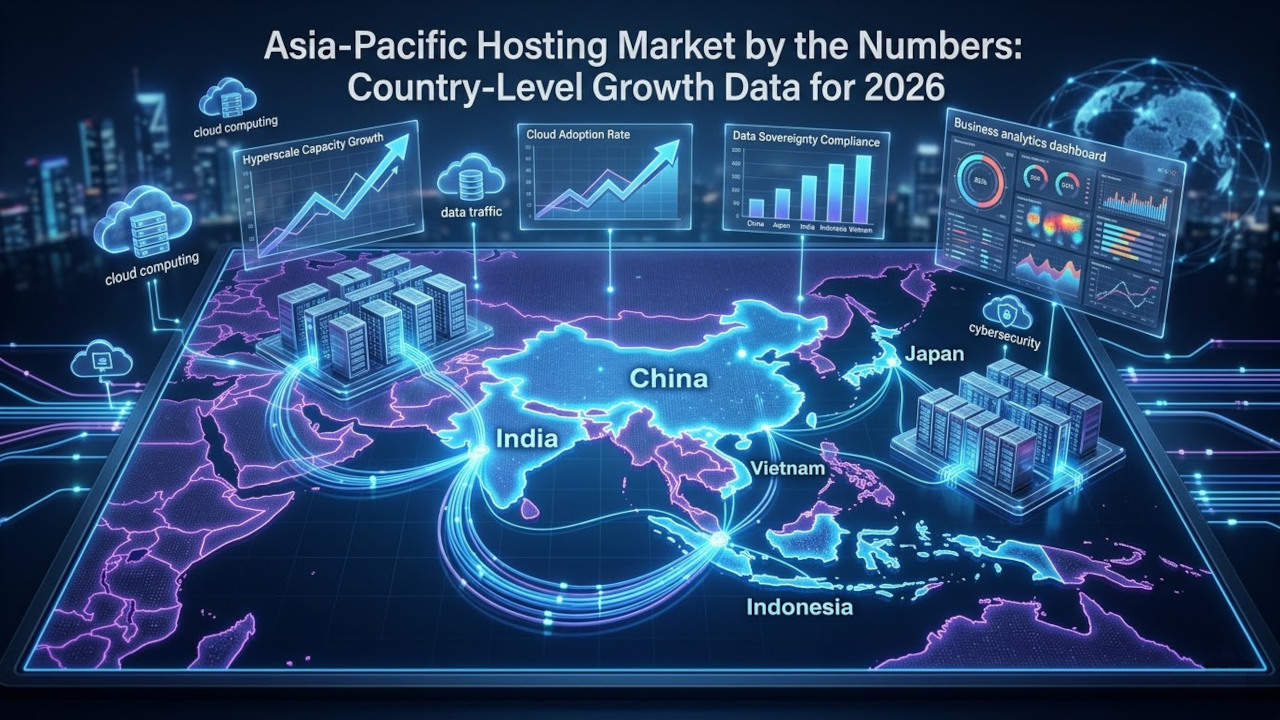
Asia-Pacific has been consistently identified as the fastest-growing hosting region globally, driven by three macro factors: rising internet penetration in emerging markets, accelerating enterprise digital transformation, and expanding e-commerce infrastructure. The key players – China, Japan, India, Indonesia, and increasingly Vietnam – each represent a distinct opportunity profile.
| Market | 2026 Estimated Value | CAGR | Primary Growth Driver |
| China | $15.50 billion | – | Cloud migration, AI infrastructure |
| Japan | $14.17 billion | – | Enterprise modernization, compliance |
| India | $11.49 billion | – | IT services boom, data localization |
| Indonesia | $1.83 billion | 13.71% | Digital economy expansion, SME adoption |
| Vietnam (hosting & VPS) | ~$190 million (VND 4,850B) | 24.5% | SME digital transformation, AI adoption |
China: The $15.5 Billion Giant With Compressed Margins
China remains the largest hosting market in Asia by a wide margin. At an estimated $15.50 billion in 2026, it represents roughly a third of the region’s total revenue. The market is dominated by domestic hyperscalers – Alibaba Cloud, Tencent Cloud, and Huawei Cloud – with Alibaba holding the top position as the leading IaaS provider in Asia-Pacific and ranking third globally.
However, size does not equal easy opportunity. The Chinese domestic market is characterized by intense price competition that has pushed commodity hosting to near-zero margins. Entry-level VPS offerings from providers like Ucloud start at CNY 65 per year (~$9), and Alibaba Cloud’s basic ECS instances are listed at CNY 38 annually. For foreign providers, regulatory barriers – including data localization requirements, cybersecurity licensing, and the amended Cybersecurity Law – make direct market entry complex and expensive.
The strategic takeaway: China is a market for scale players and specialists. Mid-size hosting companies are better served treating it as a demand signal for what Asian enterprise customers will expect globally – aggressive pricing, integrated AI tooling, and seamless compliance – rather than as a direct revenue target.
Japan: Mature, Stable, and Compliance-Driven
Japan’s $14.17 billion hosting market is the region’s second-largest and arguably its most stable. Growth is driven less by new user acquisition and more by enterprise modernization – legacy infrastructure migration, hybrid cloud adoption, and increasingly stringent compliance requirements.
The Japanese market rewards reliability and trust above all else. Customer churn rates are among the lowest in Asia, but so is the appetite for switching providers based on price alone. For hosting businesses, Japan represents a high-value, high-barrier market: winning customers requires localized support, Japanese-language interfaces, and alignment with domestic compliance frameworks. Once acquired, those customers tend to stay.
India: $11.5 Billion and Accelerating
India’s hosting and data center market, valued at an estimated $11.49 billion in 2026, is being propelled by the country’s massive IT services sector, the proliferation of digital payment platforms, and government mandates around data localization. Microsoft’s $17.5 billion, four-year commitment (2026–2029) to Indian cloud and AI infrastructure – including new Azure datacenter regions launching in 2026 – is both a response to existing demand and a catalyst for further growth.
What makes India distinct is the breadth of its demand profile. Unlike markets where growth is concentrated in enterprise or SMB segments, India generates hosting demand across the full spectrum – from individual developers and startups to government agencies and multinational corporations. This creates opportunities for providers at every price point, but it also means that competitive differentiation requires more than infrastructure alone. Support quality, billing flexibility, and integration with India’s unique digital infrastructure – particularly UPI (the country’s dominant real-time payment rail, processing over 10 billion transactions per month) and Aadhaar (the national biometric identity system used for KYC and government services) – are increasingly baseline requirements for competitive providers.
Indonesia: Small Base, Big Trajectory
At $1.83 billion, Indonesia’s data center market is a fraction of China’s or Japan’s in absolute terms. But its 13.71% CAGR – combined with Digital Edge’s $4.5 billion campus investment in Bekasi and Google Cloud’s regional expansion – signals that the market is approaching an inflection point.
Indonesia’s 280-million-strong population, rapidly growing e-commerce sector, and government-backed digital transformation initiatives make it the largest untapped hosting opportunity in Southeast Asia. The challenge for hosting providers is infrastructure readiness: power supply reliability, fiber connectivity outside of Java, and regulatory clarity around data sovereignty are all still works in progress. Companies that solve these operational challenges – or partner with those who have – will be positioned to capture a market that is projected to reach $3.48 billion by 2031.
Vietnam: The Fastest Growth Rate in the Region
Vietnam’s hosting and VPS market reached VND 4,850 billion (~$190 million) in early 2026, with a CAGR of 24.5% – the highest sustained growth rate of any hosting market in Asia-Pacific. At that pace, the market is roughly doubling every three years.
In absolute terms, Vietnam’s entire hosting sector is approximately 1.2% the size of China’s – a ratio that reflects a genuinely early-stage market rather than a mature one growing incrementally. That context matters: a 24.5% CAGR on a $190 million base produces very different revenue outcomes than the same rate on a $15 billion base. But for providers evaluating where to deploy capital, the question is not “how large is this market today?” – it is “how large will this market be in five years, and can I establish position before it gets crowded?” Vietnam’s expansion is being driven by a wave of SME digital transformation, a young and tech-literate population, and the early-stage adoption of AI tools by Vietnamese businesses. The market share landscape has shifted significantly as these trends have accelerated, creating openings for both domestic providers and regional players willing to invest in Vietnamese-language support and local infrastructure.
For hosting businesses evaluating Southeast Asian expansion, Vietnam represents the classic early-mover opportunity: the market is small enough that a well-capitalized entrant can establish meaningful share, and growing fast enough that that share will compound into significant revenue within a few years.
The Strategic Picture
Three patterns emerge from the country-level data.
Mature markets (China, Japan) reward specialization. Growth is incremental, competition is intense, and margins are under pressure. Winning in these markets requires deep local expertise, compliance fluency, and differentiated services – not commodity compute.
Scaling markets (India, Indonesia) reward infrastructure investment. Demand is broad-based and growing rapidly, but operational challenges around power, connectivity, and regulation create barriers that also serve as moats for providers who solve them early.
Emerging markets (Vietnam) reward speed. The window to establish market position is open now and will narrow as growth attracts more competitors. First-mover advantage is real, but only if backed by genuine local commitment – not just a remote PoP.
Taken together, the data confirms what the investment flows have been signaling all quarter: Asia-Pacific is not just the fastest-growing hosting region in the world. It is the region where strategic decisions made in 2026 will determine competitive positioning for the rest of the decade. The companies that read the country-level data correctly – and act on it before the market consensus catches up – will be the ones writing the next chapter of this industry’s growth story.

Łukasz Nowak
Nearly two decades in IT. A decade in web hosting - and still in the trenches. Writing about the infrastructure that runs the internet from the inside.
Sources
- GlobeNewsWire - $162.09B Web Hosting Services Market Forecast 2021–2031
- Fortune Business Insights - Global Data Center Market Size, Share & Growth Report
- Mordor Intelligence - Indonesia Data Center Market Share & Size 2031 Outlook
- DPS.MEDIA JSC - "Vietnam Hosting and VPS Industry Report 2026: Revenue – Operations – Marketing"
- Hostinger - Web Hosting Statistics 2026: Key Trends, Facts & Global Insights
- WiFi Talents - Hosting Industry: Data Reports 2026
- CBRE - Asia Pacific Data Centre Boom to Continue in 2026
- WPBeginner - Ultimate Web Hosting Statistics and Market Share Report 2026
- PR Times - PW Consulting SME Hosting Market Strategy Report (Japanese)