
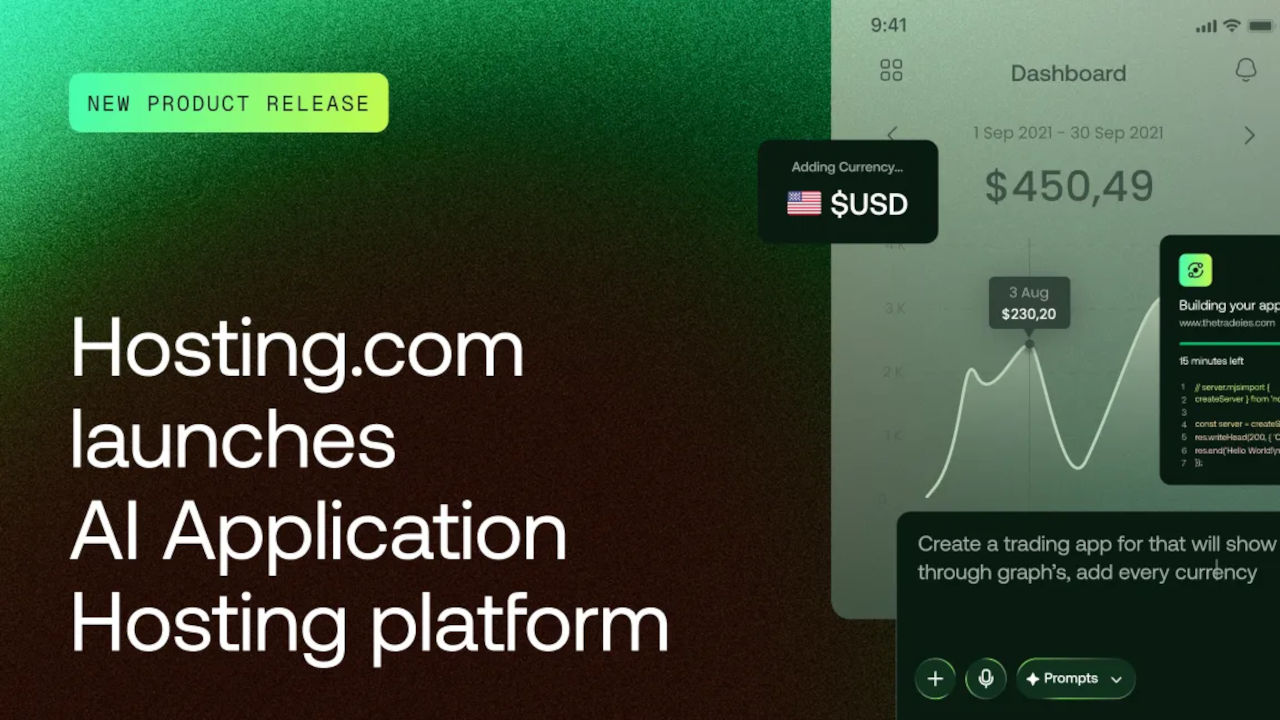
Hosting.com, the World Host Group brand that replaced A2 Hosting in 2025, launched an AI Application Studio and Hosting platform on March 24, 2026. The product targets two audiences: non-technical users who want to build applications through natural language prompts, and developers who generate code with AI tools and need somewhere to deploy the result.
Non-technical users get Nova, a natural language app builder that requires no coding knowledge. Developers who build applications in Cursor, Windsurf, or similar AI coding tools get one-click deployment with Git workflow integration. The infrastructure underneath is the same for both: Cloudflare Enterprise CDN, WAF, Monarx server security, and managed services.
Hostinger has Horizons. GoDaddy has Airo. Wix has ADI. DreamHost has Remixer, which generates pages, copy, images, and SEO from a text prompt starting at $1.99 per month. Those are AI website builders for non-technical users. Hosting.com’s product overlaps with that market through Nova, but it also targets a segment those tools do not reach: developers who use AI to generate full applications in Node.js, Python, PHP, or Rust, and who need production infrastructure with security, CDN, and managed services underneath.
The positioning matters because it addresses a real gap. AI coding tools have reached mass adoption, but the applications they produce still need to run somewhere. And the developers producing them are often less experienced than the code they generate would suggest.
What the Product Does
The platform combines a development studio with deployment infrastructure. Developers can build applications within the studio or import projects from external AI coding tools with one-click deployment.
The infrastructure layer runs on Cloudflare Enterprise across 330 or more points of presence. Security includes Cloudflare’s Web Application Firewall, Monarx server-level malware detection using behavioral analysis, bot detection, DDoS mitigation, and rate limiting for AI API abuse prevention. Built-in services cover transactional email, SSL certificates, daily automatic backups, and domain management. The platform advertises a 99.99% uptime SLA.
Pricing has three tiers: a Free plan with 5 AI build credits and one application, a Startup plan with 15 credits and 20 GB disk space, and a Business plan with 25 credits, five applications, and 50 GB disk space. Specific dollar amounts were not visible on the product page at launch. The launch covers the US, UK, and Germany, with Singapore, India, the UAE, Canada, and Australia planned for expansion.
The Market Context
The timing is not accidental. AI coding tool adoption has reached a point where the downstream hosting demand is becoming visible.
GitHub’s 2024 developer survey of 2,000 developers across four countries found that 92% reported using AI coding tools in some capacity. The Stack Overflow 2024 Developer Survey found approximately 76% of developers globally were using or planning to use AI tools. GitHub Copilot alone has over 1.8 million paid subscribers and 50,000 enterprise customers as of mid-2024.
Cursor, the AI-native code editor built by Anysphere, crossed $100 million in annualized revenue in early 2025 and was valued at $2.6 billion after a December 2024 funding round. Windsurf, formerly Codeium, was the subject of a $3 billion acquisition agreement with OpenAI in mid-2025, though the acquisition was not completed and Google later entered a separate licensing agreement with Codeium. These tools have become mainstream development environments that produce production code, regardless of which company owns them.
The question that Hosting.com is answering: where does all that AI-generated code go? A developer who builds an application in Cursor still needs a server, a domain, SSL, a CDN, email delivery, and security monitoring. The traditional answer is a VPS from DigitalOcean or Hetzner, or a PaaS like Railway or Render. Hosting.com is betting that a platform specifically designed for the AI-assisted developer workflow can capture a segment of that demand.
The Security Angle
The most substantive part of the announcement is the security positioning, and it addresses a documented problem.
A Stanford University study presented at ACM CCS 2023 found that developers using AI coding assistants produced code with more security vulnerabilities than those not using AI tools, and were more likely to believe their code was secure. AI coding tools are trained on public repositories that include both secure and insecure code patterns, meaning they can confidently reproduce SQL injection, XSS, hardcoded credentials, and other vulnerability types.
Hosting.com’s blog post cites that 75% of R&D leaders report concerns about security and data privacy risks associated with AI-generated code. Ben Gabler, the company’s Chief Product Officer, framed the product as moving “a step beyond AI website builders” to help developers transition from concept to production securely. CEO Seb de Lemos noted that modern software creators “often lack development experience or knowledge of best practices or security.”
Monarx, the server-level security component, works through behavioral analysis rather than signature-based detection, blocking threats before they execute. For AI-generated applications that may contain vulnerabilities the developer does not fully understand, automated security at the infrastructure level is a relevant safeguard.
Whether the security layer is sufficient to address the full range of AI-generated code vulnerabilities remains to be seen. WAF and server-level malware detection catch certain classes of attacks but do not replace code review, dependency auditing, or application-level security testing. The value is in providing a baseline that would otherwise not exist for developers deploying code they did not fully write.
How It Compares
The competitive landscape has several adjacent players but no direct equivalent.
Replit is the closest comparison. Replit combines an AI coding environment with one-click deployment, serving a similar “build with AI, deploy immediately” workflow. But Replit positions itself as a development platform, not a hosting company. The infrastructure and security stack is different.
Railway, Render, and Vercel are general-purpose developer platforms that support the same languages and frameworks. They do not specifically target AI-generated applications, but there is nothing preventing an AI-assisted developer from deploying to them. The deployment experience is already simple. Hosting.com’s differentiation would need to come from the bundled security, the Cloudflare Enterprise integration, or the workflow integration with tools like Cursor and Windsurf.
Cloudflare itself offers Workers, Pages, and Containers (in public beta since June 2025) that cover similar ground at the infrastructure level. Hosting.com is effectively building a managed layer on top of Cloudflare’s primitives, adding a simpler interface, bundled security, and managed services for developers who do not want to configure Cloudflare directly. This is a legitimate positioning if the target user is someone who can generate an application with Cursor but does not want to learn Cloudflare’s configuration model.
No other traditional hosting company has launched an explicitly branded “AI Application Hosting” product as a distinct category. DigitalOcean has App Platform. Hostinger has VPS and cloud hosting. IONOS has various deployment options. None have packaged a product specifically around the AI-assisted developer workflow. Hosting.com is first to market with this positioning in the traditional hosting space.
The World Host Group Context
Hosting.com is the flagship brand of World Host Group, which has acquired over 30 hosting brands through a consolidation strategy. A2 Hosting, founded in 2001, was rebranded to Hosting.com in spring 2025. The acquisition of Rocket.net, a managed WordPress host known for its tight Cloudflare Enterprise integration, provides the technical foundation for the Cloudflare-based infrastructure stack.
The AI Application Hosting launch signals a strategic direction for the group. Rather than competing on price in the commoditized shared hosting market, Hosting.com is targeting a new category of developer who did not exist three years ago: the AI-assisted builder who produces functional applications without traditional development training.
What Hosting Executives Should Watch
The question is not whether Hosting.com’s specific product succeeds. It is whether “AI application hosting” becomes a real category that other providers need to respond to.
The argument for: AI coding tools are producing a growing volume of applications that need hosting. The developers using these tools have different needs than traditional developers. They may not know how to configure a VPS, set up a reverse proxy, or audit dependencies. A hosting product that abstracts infrastructure and adds security guardrails serves this segment better than a raw server.
The argument against: existing PaaS platforms already offer simple deployment for the same languages and frameworks. Adding “AI” to the product name does not change what the platform actually does. A Node.js application needs the same hosting infrastructure regardless of whether a human or Cursor wrote it. The security concerns are real, but they apply to all code, not just AI-generated code.
The middle ground: AI coding tools are lowering the barrier to producing applications, which increases the total volume of applications that need hosting. Some percentage of those new applications will come from developers who would not have built them without AI assistance. Those developers are a new customer segment for hosting companies, and the first providers to serve them effectively will have an acquisition advantage.
Hosting.com is making a bet that this segment is large enough and distinct enough to justify a dedicated product. The bet is early. Whether it pays off depends on execution, competitive pricing (the free tier lowers the barrier to trial), and whether AI-assisted development continues its current growth trajectory.

Łukasz Nowak
Nearly two decades in IT. A decade in web hosting - and still in the trenches. Writing about the infrastructure that runs the internet from the inside.
Sources
- Hosting.com Launches AI Application Hosting Platform - Hosting.com Blog
- AI Application Hosting - Hosting.com Product Page
- GitHub 2024 Developer Survey: AI Coding Tool Adoption
- Stack Overflow 2024 Developer Survey
- Do Users Write More Insecure Code with AI Assistants? - Stanford/ACM CCS 2023
- Monarx Server Security