
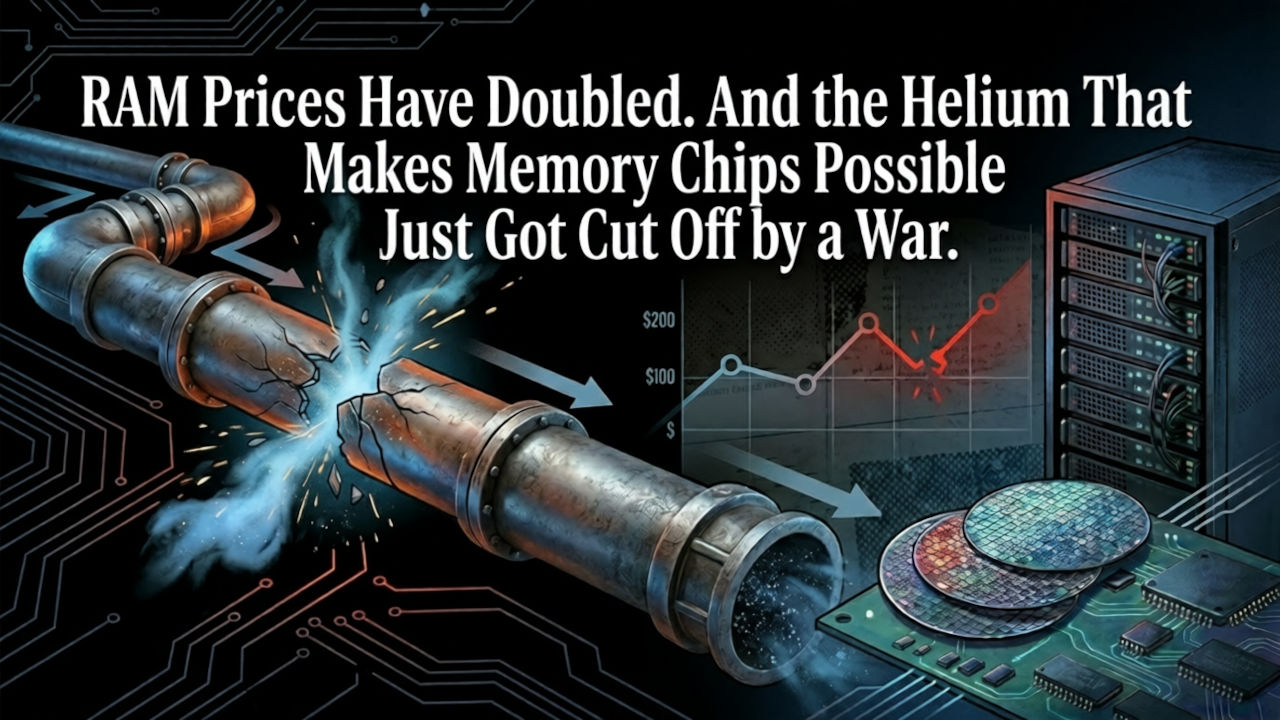
On February 24, Hetzner announced price increases of 30 to 50% across its cloud, dedicated server, storage, and load balancer products, effective April 1, 2026. The company cited “drastic price increases in various areas in the IT sector.” A week later, on March 2, Iranian drones hit Qatar’s Ras Laffan Industrial City – one of only two facilities on Earth that produces semiconductor-grade helium – and took 33% of the global helium supply offline.
These two events are connected. And the chain between them runs through every hosting company, every data center, and every VPS node on the planet.
The Problem Before the War
Server DRAM prices were already surging before a single drone was launched. The three companies that control 95% of global memory production – Samsung, SK Hynix, and Micron – have been redirecting their limited fabrication capacity toward High Bandwidth Memory (HBM) for AI infrastructure. HBM is more profitable, but it consumes approximately three to four times the silicon wafer capacity of standard server memory. The result: the total global output of conventional server RAM has physically decreased even as demand from every other sector continues to grow.
The numbers are severe. Distribution market prices for server DRAM across the most common capacities – 16 GB, 32 GB, 64 GB, and 128 GB modules – rose approximately 63% between September and December 2025 in European markets, according to analyst firm Context. TrendForce forecast an additional 60%+ increase in Q1 2026 alone. DDR5 64GB RDIMM modules – the standard in enterprise data centers – are on track to cost twice as much by the end of 2026 as they did at the start of 2025.
For many organizations, memory has become the single largest cost component of a new server build. That changes the economics of every hosting product that relies on memory density – which is all of them.
Then Ras Laffan Went Dark
On March 2, as part of broader retaliatory strikes following U.S. and Israeli attacks on Iran, IRGC drones struck Qatar’s Ras Laffan Industrial City. QatarEnergy halted production. Ras Laffan processes up to 17 metric tons of helium per day as a byproduct of LNG operations. Roughly 30 to 33% of the world’s helium supply vanished from the market overnight.
Helium is not optional in semiconductor manufacturing. It is used as a cooling medium during wafer etching – the process that carves circuit patterns into silicon. Modern lithography and etch tools rely on helium to maintain precise temperature and pressure conditions. Under current manufacturing processes, there is no viable substitute. Chip fabs operate on just-in-time helium delivery. There is no strategic stockpile. When Qatari shipments stopped, rationing started within days.
Then Ras Laffan was hit again. QatarGas reported “extensive” damage from follow-up strikes that will take years to repair and cut annual helium exports by 14%.
Bank of America estimated that spot helium prices surged 40 to 100% within the first week. The Defense News reported that 33% of global helium supply had been disrupted, impacting semiconductor manufacturing, healthcare (MRI machines use helium), and aerospace.
South Korea’s Exposure
The geographic concentration of the helium supply chain makes this crisis particularly acute for memory manufacturing. South Korea – home to Samsung and SK Hynix, which together produce roughly two-thirds of the world’s memory chips – sourced 64.7% of its helium from Qatar in 2025. Taiwan, home to TSMC, sourced 69% of its helium from Gulf Cooperation Council countries.
Over $200 billion was wiped off the combined market value of Samsung and SK Hynix on helium shortage concerns. SK Group Chairman Chey Tae-won told reporters at Nvidia’s GTC conference in San Jose that the crisis runs deeper than anyone expected: “The current shortage could continue until 2030, so we expect more than a 20% shortage of the wafers.” He estimated the industry needs four to five years to build sufficient new capacity.
Samsung has deployed an in-house Helium Reuse System (HeRS) on select production lines, capturing and purifying used helium for reuse. Early results show an annual reduction of roughly 4.7 tons. Expanding HeRS across all lines could cut Samsung’s total helium consumption by about 18.6% per year – meaningful, but nowhere near enough to offset a 33% supply disruption. SK Hynix is seeking alternative suppliers in the United States and has reportedly explored deals with Russian firms. Both companies maintain approximately six months of helium stock, but that clock is ticking.
The Strait of Hormuz Makes It Worse
The helium crisis does not exist in isolation. The Strait of Hormuz – through which roughly 20% of the world’s oil passes – has been effectively blockaded since February 28. The disruption compounds the helium shortage with additional supply chain shocks:
- Aluminum: The Middle East accounts for approximately 9% of global aluminum smelting capacity and supplies nearly 20% of U.S. aluminum imports. Aluminum is used in server chassis, heat sinks, and data center construction. Prices are already rising.
- LNG: The Middle East supplies 37% of the fuel that powers Taiwan’s electric grid, which runs the TSMC fabrication plants that produce chips for Apple, Nvidia, AMD, and Qualcomm. LNG prices jumped 60% following the blockade.
- Sulfur: Required to produce sulfuric acid, which is used as a cleaning agent during wafer fabrication. The Gulf region is a major supplier.
Tom’s Hardware summarized the situation: the ongoing Strait of Hormuz blockage will impact the semiconductor and AI industries with aluminum, helium, and LNG shortages, “and with no timeline for re-opening, supply chains face significant challenges.”
DRAM and HBM Prices After the Strikes
Counterpoint Research reported that DRAM and HBM chip prices surged 80-90% in Q1 2026 compared with the previous quarter. This reflects the combined effect of the pre-existing AI demand crunch and the helium supply disruption. Some server-grade memory modules saw spot-market price increases exceeding 400%.
The timeline for recovery is bleak. Helium consulting experts estimate a minimum two-to-three-month production shutdown even under optimistic scenarios, with four to six months before the helium supply chain returns to normal. Qatar’s energy minister indicated it would take weeks to months for helium deliveries to normalize, even if the conflict ended immediately. Given the follow-up strikes and “extensive” damage reported by QatarGas, the actual timeline is likely longer.
New memory fabrication facilities that could ease the wafer shortage are not expected to come online until 2028-2029. Until then, the structural deficit persists.
What Hosting Providers Are Paying
The cost pressure is hitting hosting companies from every direction simultaneously: DRAM, NAND/SSD, energy, and now the cascade effects of the Middle East conflict. The responses are already public.
Hetzner is raising cloud server prices in Germany and Finland by 30 to 37%, with some U.S. cloud tiers increasing 30 to 40%. The entry-level CX23 instance goes from EUR 2.99 to EUR 3.99 per month. Server Auction machines increase 3% across the board. The increases take effect April 1, 2026, for both new orders and existing products. Data Center Dynamics reported increases of up to 50% on certain configurations.
OVHcloud announced price increases of 9 to 11% for cloud services deployed between 2026 and 2028 (Public Cloud, Private Cloud, Bare Metal), effective April 1, 2026. For older infrastructure deployed before 2025, a moderate 2 to 6% increase applies. OVHcloud warned that depending on configurations, RAM and storage-related costs could increase 15 to 300% compared to 2025 prices. Octave Klaba had predicted 5-10% cloud price increases back in November 2025 – that estimate now looks conservative.
Cloud providers typically lag three to six months between procurement cost changes and retail pricing adjustments. That means the full impact of Q1 2026 DRAM prices – which nearly doubled – will show up in customer bills during Q2 and Q3 2026. What Hetzner and OVHcloud have announced so far reflects hardware purchased at earlier (lower) prices. The next round of increases will be steeper.
The Structural Problem
This is not a temporary spike. Three structural factors make the memory crisis different from previous supply fluctuations:
Market concentration. Samsung, SK Hynix, and Micron control 95% of global DRAM production. There is no fourth supplier large enough to matter. When these three companies prioritize HBM for AI over standard server RAM, there is no alternative source. Enterprise buyers have virtually no leverage to negotiate prices or secure guaranteed allocation during shortages.
AI demand is not cyclical. Previous DRAM shortages eventually resolved as demand softened. The current shortage is driven by structural investment in AI infrastructure by Microsoft, Google, Meta, Amazon, and others. These companies are contractually committed to GPU cluster deployments that require enormous quantities of HBM. They will not reduce orders when prices rise – they will outbid everyone else. Standard server RAM customers are the residual market.
Geopolitical risk is now permanent. Even if the Iran conflict resolves tomorrow, the concentration of helium production in Qatar (30-33% of global supply) and semiconductor manufacturing in South Korea and Taiwan (dependent on Gulf energy and helium) means that any future disruption in the Middle East will produce the same cascading effects. The supply chain has a structural vulnerability that cannot be resolved without years of diversification.
Broadcom’s VMware division described the situation as a “hardware super-cycle” and pitched VMware Cloud Foundation 9.0 as a response – using NVMe drives as a secondary memory tier to reduce DIMM dependency and achieve “up to 42% lower memory and server TCO.” Whether that number holds up in practice, the fact that VMware is marketing around the memory crisis tells you how fundamental the shift is.
What This Means for Hosting Companies
The immediate implications are straightforward: margins are compressed, and pricing must adjust. But the second-order effects matter more.
Shared hosting margins are getting squeezed hardest. Shared hosting depends on overprovisioning – selling more aggregate memory to customers than physically exists on the server, betting that not all of them will use their allocation simultaneously. When RAM costs double, the cost of each oversold gigabyte doubles too. Providers with thin margins on $3-5/month plans face a choice between raising prices (and losing price-sensitive customers) or absorbing costs (and eroding profitability).
VPS and cloud providers feel it next. VPS nodes are memory-bound – the amount of RAM in a server determines how many virtual machines it can host. When DDR5 64GB modules cost twice what they did a year ago, the cost per VPS slot rises proportionally. Hetzner’s 30-50% price increases are a direct reflection of this math.
Dedicated server lead times are extending. Providers that build to order are reporting longer procurement cycles as component availability tightens. Customers ordering dedicated servers in Q2 2026 may face wait times that would have been unusual six months ago.
The gap between US hyperscalers and European independents is widening. AWS, Azure, and Google Cloud have the purchasing power to secure priority allocation from Samsung, SK Hynix, and Micron. Independent European providers like Hetzner and OVHcloud – which compete partly on price – are absorbing the same cost increases without the same negotiating leverage. The relative price advantage of European independents is narrowing.
Long-term contracts become more valuable. Hosting providers that locked in hardware purchases before the crisis are sitting on assets that would cost 50-100% more to replace today. Customers with multi-year contracts at pre-increase rates are getting a deal that the provider may be unable to sustain. Expect contract terms to shorten and price-lock periods to tighten across the industry.
How Long Does This Last
SK Group Chairman Chey Tae-won’s answer: potentially until 2030. New fabrication facilities take years to build. Helium supply diversification requires developing alternative sources (the U.S. has reserves, but extraction and purification capacity is limited). The AI demand driver is accelerating, not decelerating.
The optimistic scenario – helium supply normalizes within six months, DRAM prices stabilize at elevated levels, new fab capacity comes online by 2028 – still means two more years of above-normal hosting costs. The pessimistic scenario – prolonged Middle East conflict, further helium disruptions, continued AI demand growth – means the current pricing environment is the new normal.
For hosting providers, the strategic question is whether to treat this as a temporary cost spike to be absorbed or a permanent shift in the cost structure of the business. The evidence points toward the latter.

Łukasz Nowak
Nearly two decades in IT. A decade in web hosting - and still in the trenches. Writing about the infrastructure that runs the internet from the inside.
Sources
- Qatar Helium Shutdown Puts Chip Supply Chain on a Two-Week Clock - Tom's Hardware
- Strait of Hormuz Blockage Impact on Semiconductor Industry - Tom's Hardware
- Iran War Cuts Off Helium from Qatar - Fortune
- Iran War Threatens Helium Supply - CNBC
- How the Iran War Is Threatening Semiconductor Demand - CNBC
- Memory Makers Prioritize Server Applications, Driving Price Increases in Q1 2026 - TrendForce
- Helium Crunch Hits South Korea - TrendForce
- SK Chair Warns Memory Shortage May Last Through 2030 - Korea Times
- 33% of Global Helium Supply Disrupted - The Defense News
- DRAM Price Hike to Hit Server and Infrastructure Costs - The Register
- Why the 2026 Hardware Crisis Will Accelerate Private Cloud Adoption - Broadcom
- Why Hosting Prices Are Increasing in 2026 - NCXHost
- Rising Global Infrastructure Costs: DRAM and SSD Scarcity - Novoserve
- 카타르산 헬륨 수입 비중 64.7% - 한국경제 (Hankyung), KITA data