
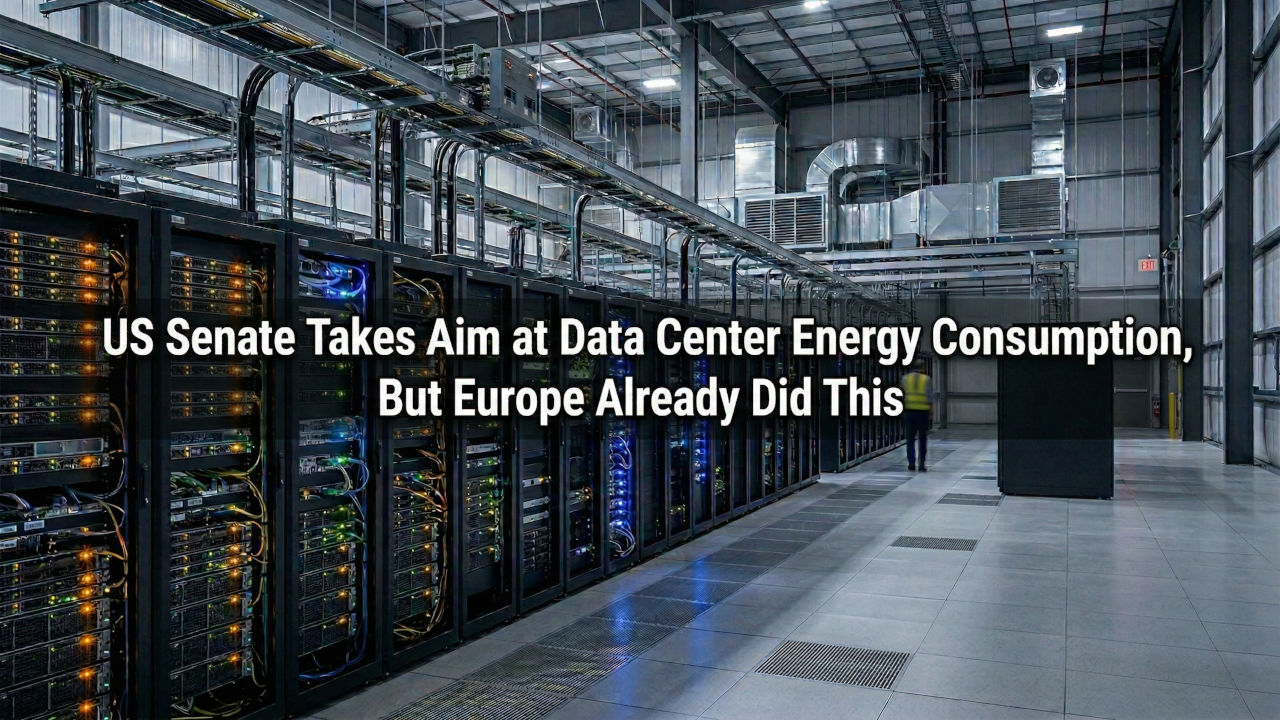
The European Union has a functioning public database of data center energy consumption. It has had mandatory annual reporting since 2023. It is now moving toward efficiency ratings and minimum performance standards. The United States Senate, in the same week, is debating whether to ask data centers to report their power bills.
That gap is the context for three legislative actions in Washington that landed within 48 hours of each other at the end of March 2026.
What Congress Is Actually Debating
On March 26, 2026, Senators Josh Hawley (R-MO) and Elizabeth Warren (D-MA) sent a bipartisan letter to the U.S. Energy Information Administration requesting that the agency establish mandatory annual reporting requirements for data centers. The data they want collected includes hourly, annual, and peak energy load; electricity rates paid; load flexibility and demand response participation; a breakdown distinguishing AI-configured servers from general cloud infrastructure; and transmission and distribution upgrade requirements, including how costs are shared among customer groups. All collected data would be made publicly available. The EIA has until April 9, 2026 to respond.
The letter’s framing is worth noting directly. “As electricity demand growth continues to accelerate after years of relative stagnation, the lack of reliable, standardized data on large load energy consumption poses significant risks to effective grid planning and oversight,” the senators wrote. The letter also explicitly calls out the Trump White House’s voluntary Ratepayer Protection Pledge, signed March 4 by Google, Microsoft, Meta, Oracle, xAI, OpenAI, and Amazon, as unenforceable without hard data. That pledge commits signatories to build or buy new generation for their own energy needs, pay for power delivery infrastructure upgrades, and voluntarily negotiate new rate structures with utilities. It contains no enforcement mechanism.
A day earlier, on March 25, Senator Bernie Sanders (I-VT) and Representative Alexandria Ocasio-Cortez (D-NY) introduced the Artificial Intelligence Data Center Moratorium Act, which would impose a nationwide pause on all new AI data center construction and upgrades to existing facilities. The moratorium would remain in place until Congress passes comprehensive federal legislation covering AI worker protections, consumer protections, environmental safeguards, and privacy and civil rights. The bill cites a single hyperscale data center as consuming as much energy as 2 million US households, and notes that residential electricity rates rose 31% between 2020 and 2025, compared to just 4% in the preceding five years. By 2028, AI data centers could consume water equivalent to 18.5 million households, the bill states. The legislation is considered unlikely to pass a Republican-controlled Congress, particularly given that President Trump has urged Congress to block state-level AI regulations.
The third bill is the GRID Act, introduced February 11 by Hawley and Senator Richard Blumenthal (D-CT). Its full name is the Guaranteeing Rate Insulation from Data Centers Act. Under this legislation, any new data center drawing 20 megawatts or more would be required to source power off-grid. Existing facilities would have a 10-year window to transition. Violations would carry a civil fine of $1 million per day. The bill also mandates public disclosure of current and projected future power usage. Hawley’s stated rationale: “American families should not have to shoulder the burden of rising electricity costs produced by data centers.”
The Scale of the Problem These Bills Are Responding To
US data centers consumed approximately 176 TWh in 2023, representing around 4.4% of total US electricity, according to Lawrence Berkeley National Laboratory. The Department of Energy projects that figure will reach between 6.7% and 12% of all US electricity demand by 2028. There are currently over 3,700 data centers in the United States. Combined hyperscaler capital expenditure is projected to exceed $600 billion in 2026.
Nowhere is the strain more visible than Texas. ERCOT, the state’s grid operator, expects approximately 24 gigawatts of new data center load by 2031. Its large load interconnection queue nearly quadrupled in a single year, from 63 GW in December 2024 to around 226 GW by November 2025. Data centers now represent about 73% of large load interconnection requests to ERCOT. The EIA has warned that data center demand could raise ERCOT power prices by 79%. Texas responded with SB-6, signed in June 2025, which requires new large loads of 75 megawatts or more connecting after December 31, 2025 to be curtailable during grid emergencies. By 2030, Texas is projected to have more data centers than anywhere in the world.
Where the EU Already Is
While the US Senate is still trying to get basic data collection off the ground, the European Union has had mandatory reporting in place through the Energy Efficiency Directive for any data center with an electrical demand of 500 kilowatts or more. Operators must report annually, with each year’s data due by May 15 of the following year. The reported data covers energy consumption, capacity utilization, waste heat recovery, and water consumption. A functioning public database already exists.
The EU is not stopping there. On March 27, 2026, the European Commission launched a public call for feedback on a new Data Centre Energy Rating Scheme, an EU-wide efficiency label for data centers. A Data Centre Energy Efficiency Package is expected in Q2 2026 and could include minimum performance standards. The direction of travel is clear: mandatory disclosure, efficiency labeling, and potentially binding performance floors.
The contrast is stark. US policymakers are debating whether to require that data centers report their electricity bills. European policymakers are debating what the minimum efficiency standard should be once the reporting data tells them what is achievable.
What This Means for Hosting Companies and Data Center Operators
For European hosting companies and data center operators, this regulatory gap has immediate practical dimensions. You are already reporting under the EU Energy Efficiency Directive. Your US competitors, including the hyperscalers who signed the Ratepayer Protection Pledge, are operating under no comparable federal requirement. The voluntary pledge gives those operators flexibility you do not have. Whether the incoming EU efficiency package closes that gap further, or creates additional compliance costs, depends on what minimum performance standards actually look like when the Q2 2026 package arrives.
For US operators, the legislative picture is fragmented. None of the three bills discussed here has passed. The GRID Act’s off-grid sourcing requirement for facilities over 20 MW, if it became law, would fundamentally alter site selection and power procurement planning. The Hawley/Warren reporting requirement is comparatively modest, but mandatory public disclosure of hourly load data, electricity rates paid, and AI versus general cloud breakdowns would expose operational details that most operators currently guard closely.
The Texas situation is also a leading indicator. SB-6 already imposes curtailment obligations on new large loads, and ERCOT’s queue numbers suggest the pressure on Texas grid infrastructure will intensify through the decade. Operators building in Texas after December 2025 are doing so under a different set of obligations than those who connected earlier.
The legislative proposals in Washington this week reflect genuine political pressure from both parties, not a coordinated strategy. The bipartisan Hawley/Warren letter and the GRID Act sit in the same conversation as the Sanders/AOC moratorium bill despite pointing in very different directions. What they share is the recognition that the current situation, in which the federal government lacks reliable data on how much electricity data centers consume and where that electricity comes from, is no longer sustainable.
Europe reached that conclusion years ago and built the reporting infrastructure. The EU is now deciding what minimum performance looks like. For European hosting companies and data center operators already filing under the Energy Efficiency Directive, the Q2 2026 package will determine whether that compliance investment becomes a competitive floor or simply a higher bar. Either way, that conversation is happening in Brussels. The one in Washington is still about whether to turn the lights on.

Łukasz Nowak
Nearly two decades in IT. A decade in web hosting - and still in the trenches. Writing about the infrastructure that runs the internet from the inside.
Sources
- Warren and Hawley Lead Bipartisan Push for Mandatory Energy Reporting for Data Centers - warren.senate.gov
- Data Centers, Get Ready: the Senate Wants to See Your Power Bills - TechCrunch
- Senators Target Data Center Power Consumption - The Register
- Bernie Sanders and AOC Propose a Ban on Data Center Construction - TechCrunch
- Sanders and AOC Introduce AI Data Center Moratorium Act - Axios
- Hawley and Blumenthal Introduce the GRID Act - hawley.senate.gov
- Fact Sheet: President Trump Advances Energy Affordability with the Ratepayer Protection Pledge - whitehouse.gov
- Rating Scheme for Data Centres: EU Commission Launches Call for Feedback - European Commission
- 2024 United States Data Center Energy Usage Report - Lawrence Berkeley National Laboratory
- ERCOT's Large Load Queue Has Nearly Quadrupled in a Single Year - Latitude Media