
DRAM contract prices more than doubled in Q1 2026, with PC DRAM rising over 105% quarter-on-quarter according to TrendForce, and Samsung and SK Hynix raising server DRAM prices by 60-70% to major cloud operators including Google and Microsoft. For hyperscalers absorbing the increase across hundreds of thousands of servers, the figure is a renegotiation. For smaller hosting operators already running on thin margins, it is a procurement crisis. Some of them have found an unconventional solution in a place most IT directors would not think to look: storage units, estate sales, and the back rooms of electronics museums.
Retro console hosting is real, it is expanding, and it has a more credible technical foundation than it appears.
The Precedent Most People Forgot
In 2010, the United States Air Force Research Laboratory assembled a supercomputer from 1,760 consumer gaming consoles. The system, known as the Condor Cluster, delivered 500 teraflops of processing power and was, at the time of its construction, the 35th most powerful supercomputer in the world. The Air Force chose consumer gaming hardware specifically because it offered the required processing architecture at a fraction of the cost of equivalent dedicated compute hardware.
The Condor Cluster is the citation that retro console hosting operators reach for when the concept requires legitimacy. “If it was good enough for the United States Air Force,” said one operator interviewed for this article, “it is good enough for a shared hosting environment.”
What Is Actually Being Deployed
The hardware in active use spans roughly four decades of consumer electronics. At the high end of the retro spectrum, operators are deploying units from the mid-1990s with 32-bit processors and between 2 and 8 megabytes of RAM. At the lower end, several operators have begun experimenting with 8-bit hardware from the early 1980s, with processors running at frequencies measured in single-digit megahertz and RAM measured in kilobytes.
One European operator, which declined to be named, confirmed it is running a cluster of 400 units of a 16-bit console manufactured in 1990, each equipped with 64 kilobytes of RAM and a 7.67 MHz processor. The cluster is marketed as a shared hosting tier. “The specifications are what they are,” the operator’s technical director said. “But the price point is extraordinary.”
An East Asian provider is taking a different approach with the MegaStation 64, a fictional-sounding name that is, in this case, the unit’s actual commercial designation. The MegaStation 64 ships with a 64-bit processor, 4 megabytes of expandable RAM, and what the provider describes as “a thermal profile optimized for continuous operation,” by which it means the unit runs very hot and has always run very hot and this has not yet caused a fire.
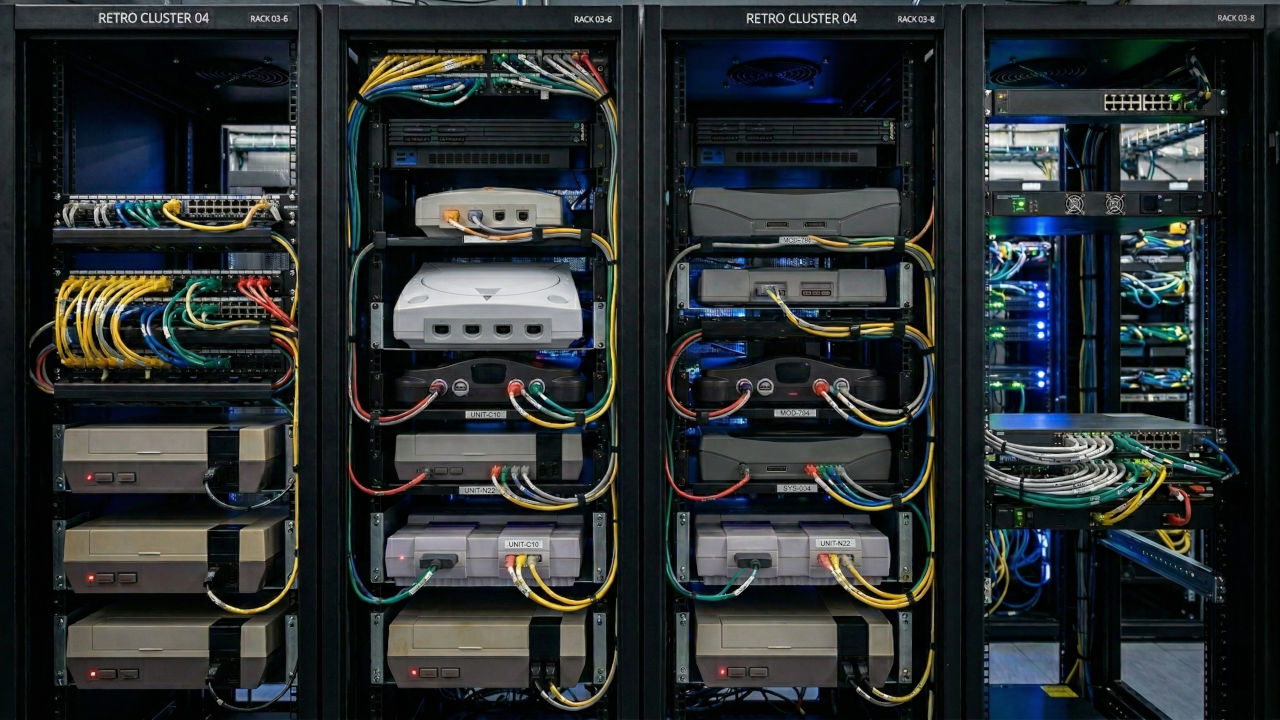
The most ambitious deployment identified in webhosting.today’s reporting involves a cluster of PolyDrive Pro units, a 32-bit console from 1994 equipped with a proprietary RISC processor and 2 megabytes of main RAM. A European operator has assembled 1,200 units sourced from a combination of a Scandinavian electronics recycling facility and a European auction house specializing in decommissioned entertainment hardware. The cluster is in production. It serves, by the operator’s own account, 47 active customers.
The Website Builder Question
Several operators in the retro console segment have extended the concept to website creation tools, deploying the HyperBox 16, a 16-bit unit from 1992 with a single-core processor and 512 kilobytes of dedicated video RAM, as the rendering engine for a drag-and-drop site builder. Build times for a standard five-page business website average between 4 and 7 hours depending on image count. The operator markets this as “considered rendering.”
“Modern site builders generate a website in thirty seconds,” reads the product page. “Ours takes longer because each element is processed individually, in sequence, without parallelism. We believe this produces a more deliberate result.”
There is no evidence that deliberate rendering produces a better website. There is also no evidence that it does not.
Operational Challenges
Operators in the segment are candid about the constraints. The primary issue is not processing power, which for static site hosting is rarely the limiting factor, but memory. A 32-bit console from 1994 with 2 megabytes of RAM will serve a static HTML page competently. It will not run a database-backed application, a modern CMS, or anything that expects more than a few hundred kilobytes of working memory to be available at a given moment.
The second issue is software. Consumer gaming hardware from the 1980s and 1990s was not designed to run Linux. Several operators have succeeded in loading stripped-down operating system images onto units that were not built to support them, with results described variously as “functional,” “mostly functional,” and “functional on Tuesdays.”
The third issue is the update cycle. Several console models in active deployment were designed to check for system firmware updates on startup. Operators who did not disable this behavior before deployment have experienced unexpected maintenance windows. One operator’s SLA now contains a clause acknowledging that “system availability may be affected by mandatory manufacturer updates that the operator is unable to prevent, patch, or predict.”
Power consumption, by contrast, is genuinely favorable. A 16-bit console from 1992 draws between 9 and 15 watts under full load. A modern server node draws between 200 and 500 watts. An operator running a cluster of 400 retro consoles is operating at a power budget comparable to a handful of contemporary servers, a fact the segment has been quick to incorporate into its sustainability messaging.
Sourcing and Supply
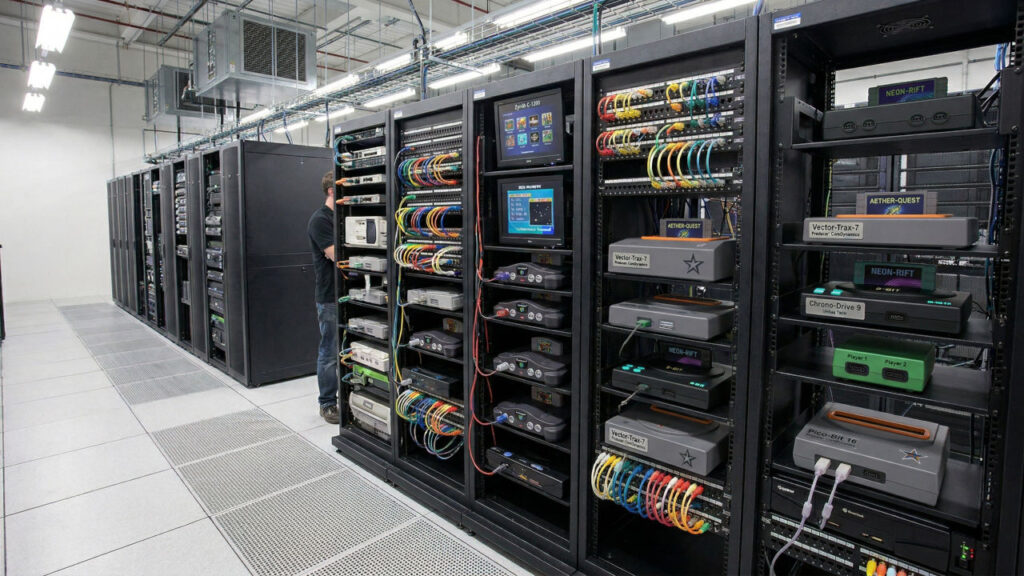
The bottleneck is not technical. It is inventory. Consumer electronics from the 1980s and 1990s are finite in supply and increasingly contested between hosting operators, private collectors, and museum acquisitions departments, a competitive dynamic that would have been difficult to predict as recently as eighteen months ago.
At least two operators have established formal purchasing relationships with electronics museums, acquiring units that curators have deemed too common for exhibition. One Northern European museum confirmed it had sold 340 units of an 8-bit console from 1983 to a hosting company in Q1 2026, describing the transaction as “a practical solution for hardware that would otherwise remain in archival storage.” The museum retained twelve units for its permanent collection and one for a temporary exhibition on the history of web infrastructure, which opens in June.
Prices for common 16-bit and 32-bit units have risen between 60% and 180% in the past twelve months on secondary markets, driven in part by hosting sector demand. At current trajectory, the economics that make retro console hosting attractive will erode within 18 to 24 months as acquisition costs converge toward the cost of conventional low-end server hardware.
Operators in the segment are aware of this window. Several have begun bulk purchasing ahead of further price increases. One American operator confirmed it has acquired 3,000 units of a 32-bit console from 1996 and is storing them in a climate-controlled facility while it builds out the infrastructure to deploy them. “We are buying time,” the operator said, and did not appear to register the ambiguity of the statement.
The American Response
European operators entered retro console hosting because DRAM prices made conventional procurement untenable. The United States hosting industry has arrived at the same infrastructure from a different direction entirely.
San Francisco-based venture capital firm just announced a $40 million fund dedicated exclusively to what its investment thesis describes as “heritage compute infrastructure.” The fund’s prospectus identifies retro console hosting as “the most defensible moat in the sub-enterprise hosting segment,” noting that the hardware is finite, the operational methodology is non-replicable at hyperscale, and customer acquisition costs benefit from what the document calls “the nostalgia premium.” The fund has made two investments to date, both undisclosed, both in North America.
The consumer-facing product built on this thesis is already in market. A company operating under the name Vintage Infrastructure launched in Q1 2026 with a shared hosting tier built entirely on 32-bit consumer hardware from the mid-1990s. The base plan is priced at $149 per month. The premium tier, which guarantees a dedicated unit rather than a shared cluster, is $499 per month. Both tiers carry a waitlist. The product page describes the offering as “intentionally constrained compute for organizations that have thought carefully about what they actually need,” and notes that “our infrastructure has never been compromised by a zero-day exploit targeting software released after 1997.”
Vintage Infrastructure’s hardware is sourced entirely from North American secondary markets. The company does not operate in Europe and has stated no intention to do so. Several European operators, when shown the pricing, declined to comment on the record.
The M&A Dimension
The gap between European necessity and American positioning has created the conditions for a consolidation wave that industry observers did not anticipate when retro console hosting was still a niche discussed in forum threads rather than investment decks.
Three acquisitions in the segment have been confirmed or reported in Q1 2026. In February, a US-based managed hosting group with backing from a mid-market private equity fund acquired a Northern European retro console operator for an undisclosed sum, describing the deal in an internal memo obtained by webhosting.today as “a strategic inventory acquisition as much as a customer acquisition.” The target operated approximately 600 units across two facilities and had been running the infrastructure for fourteen months.
In February, a second US acquirer, a publicly listed hosting company with annual revenue in excess of $200 million, acquired an operator running a mixed fleet of 16-bit and 32-bit hardware. The deal was structured as an asset purchase rather than a share acquisition, with the US buyer explicitly excluding the target’s conventional hosting business from the transaction. “We bought the consoles,” said a person familiar with the deal. “The rest was a rounding error.”
The third transaction, announced in March but not yet closed pending regulatory review, involves a different dynamic. A European holding company with hosting assets across multiple markets has agreed to acquire a smaller European retro console operator and immediately license the operational playbook to two of its existing brands. The deal is structured to give the acquirer a standardized retro console hosting product it can deploy across its existing customer base without rebuilding the operational methodology from scratch. The implied valuation attributed to the methodology, rather than the hardware or the customer contracts, is the most unusual aspect of a transaction type that would have been considered unusual on any other basis twelve months ago.
What none of these deals has resolved is the inventory problem. Every acquisition transfers existing hardware. It does not create new supply. The secondary market for 16-bit and 32-bit consumer hardware from the late 1980s and 1990s is not a market that responds to capital. The units that exist are the units that exist. Several operators on both sides of the Atlantic are now holding hardware positions they intend to use as leverage in future consolidation conversations, a strategy that assumes the category continues to attract buyers willing to pay for scarcity. So far, it has.
This article is an April Fools piece. The US Air Force Condor Cluster, however, was real.

Łukasz Nowak
Nearly two decades in IT. A decade in web hosting - and still in the trenches. Writing about the infrastructure that runs the internet from the inside.