
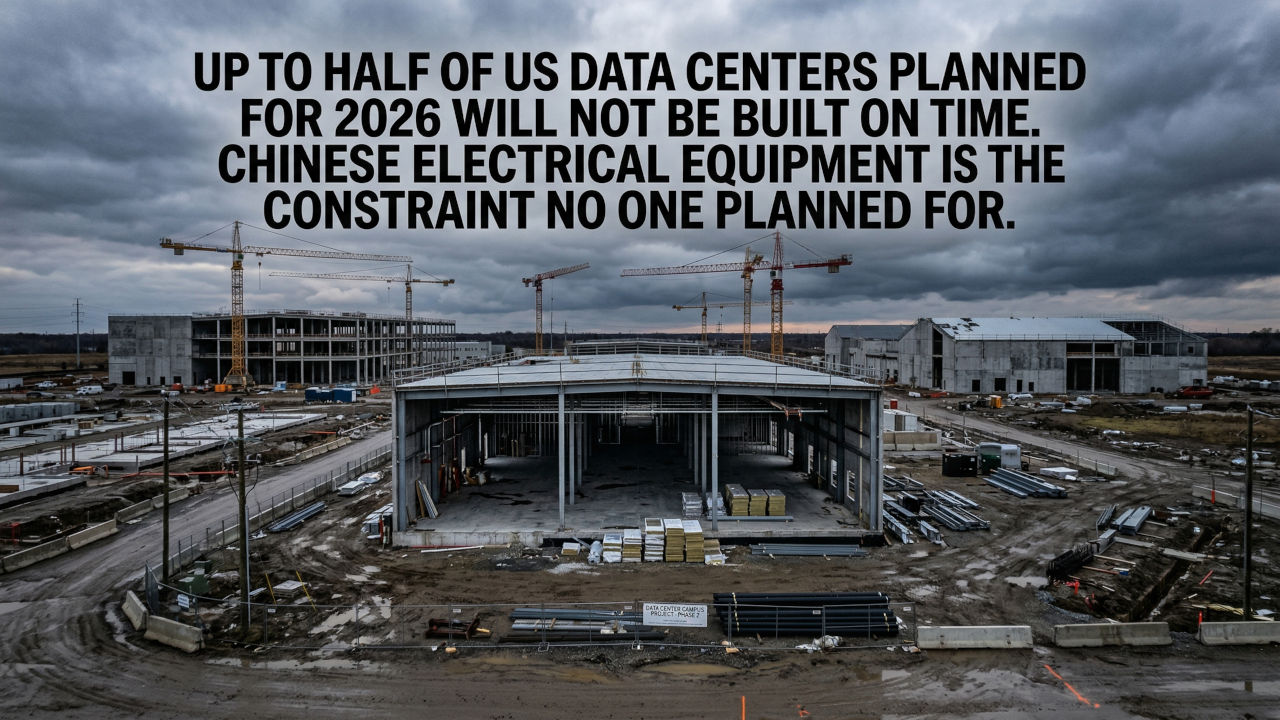
Colocation vacancy rates in the Americas ended 2025 at approximately 4.2 percent, near historical lows. The new supply that would normally relieve that tightness is not arriving. Sightline Climate published its Data Center Outlook in early April, tracking 190 GW across 777 projects announced since 2024. Its conclusion: 30 to 50 percent of large US data centers scheduled to come online in 2026 will be delayed or canceled. Of the 12 to 16 GW of US capacity planned for this year, only approximately 5 GW is actually under construction. Another 16 GW sits in announced status with no activity on the ground.
For hosting companies that buy colocation space or wholesale cloud capacity, this has a direct commercial consequence: pricing pressure on existing capacity will continue, and the supply that was supposed to ease it is not coming on the timeline that was advertised. The problem is not a shortage of investment intent. Alphabet, Amazon, Meta, and Microsoft are projected to spend a combined $650 billion on AI infrastructure in 2026. The demand is real. What is failing is the ability to convert that capital into physical infrastructure, and the reason comes down to a component most executives have never thought about: power transformers.
Why the Hyperscalers Are Insulated and Everyone Else Is Not
Before examining the equipment shortage itself, the asymmetry matters. Hyperscalers with multi-year direct procurement agreements for transformers and electrical equipment are largely insulated from spot market conditions. They saw this coming and bought ahead. The capacity that is being delayed is disproportionately the capacity not controlled by the four largest cloud operators: independent colocation providers, regional cloud platforms, and new entrants trying to build facilities that hosting companies buy from.
This is the same dynamic that played out in the memory and server market over the past two years. Hyperscalers locked in long-term supply agreements. Smaller operators negotiated from a structurally weaker position against a shortage that hyperscalers had already partially resolved for themselves. The electrical equipment market is following the same pattern, at a more fundamental level of the infrastructure stack.
The Equipment Math
A Bloomberg investigation published April 1, 2026 identified the specific bottleneck. The US imported more than 8,000 high-power transformers from China in the first ten months of 2025, up from fewer than 1,500 in all of 2022, a more than five-fold increase in under three years, based on Wood Mackenzie data. The US manufactures only approximately 20 percent of the large power transformers it uses domestically. China controls approximately 60 percent of global power transformer production capacity. These are not numbers that change quickly.
Power transformers are not a discretionary component. A data center campus cannot receive grid power without them, and there is no substitute on a shorter lead time. Before 2020, lead times for large power transformers ran 24 to 30 months. Today they average approximately 128 weeks, roughly 2.5 years. Generator step-up units average 144 weeks. One major US transformer manufacturer has disclosed a five-year wait time for new orders in extreme cases.
The mismatch is the core problem. An AI data center deployment cycle runs 12 to 18 months. A transformer procurement cycle now runs 2.5 to 5 years. Every campus announced in 2025 is dependent on transformer orders that needed to be placed in 2023 or 2024 at the latest. A campus announced in 2025 cannot be operational in 2026 or 2027 unless the transformer was on order before the campus was announced. Much of what has been announced in the past 18 months is waiting for equipment that was never ordered in time.
Wood Mackenzie projects a 30 percent supply deficit for power transformers and a 10 percent deficit for distribution transformers in the US in 2025, worsening into 2026, with demand in 2026 expected to exceed 2024 levels by 21 percent for power transformers and 16 percent for generator step-up units. The domestic manufacturing investment response is real but slow. Since 2023, US transformer manufacturers have committed nearly $2 billion to new or expanded capacity. Eaton committed $340 million to a South Carolina plant targeting 2027. Siemens Energy is building its first US large power transformer plant in Charlotte, North Carolina, targeting early 2027. ABB expanded its Tennessee and Mississippi facilities. None of this closes the gap within the 2026 planning horizon.
Tariffs on the One Thing That Cannot Be Replaced
The tariff picture for electrical equipment is materially different from the semiconductor picture. A White House presidential action from January 2026 created a broad exemption from the Section 232 chip tariff for semiconductors used in US data centers. No equivalent exemption exists for transformers, switchgear, cables, or batteries. The current structure applies a 10 percent Section 122 global surcharge on Chinese-origin goods, layered on top of existing Section 301 duties. Copper, a core transformer component, now faces a 50 percent tariff under the April 2026 expansion of steel, aluminum, and copper duties.
The two dominant Chinese transformer suppliers to the US market, TBEA and China XD Group, report their order books filled through 2027. Importing from them costs substantially more than a year ago. Sourcing from elsewhere at comparable scale is not a realistic option. The President’s National Infrastructure Advisory Council flagged in June 2024 that the transformer shortage represents a critical infrastructure risk and recommended a strategic national reserve. That recommendation has not been acted on.
Projects That Have Already Slipped
Bloomberg reported on March 6 that Oracle and OpenAI ended plans to expand the Stargate campus in Abilene, Texas, from its current 1.2 GW under construction to the originally planned 2.0 GW, citing difficult financing terms alongside changing capacity needs. Oracle disputed portions of this reporting, stating the broader 4.5 GW OpenAI agreement remains intact. Meta is reported to be in discussions to absorb the Abilene capacity OpenAI vacated, with Nvidia reportedly paying a $150 million deposit to hold the slot.
Amazon has withdrawn data center plans in Virginia due to community opposition. Google withdrew plans in Indiana after local resistance. JLL’s 2026 Global Data Center Outlook notes that community opposition, with moratoriums proposed in at least ten states including Louisiana, Michigan, New York, Ohio, and Virginia, has become a material driver of project attrition. Cushman and Wakefield confirmed that US data center capacity under construction fell to 5.99 GW at end of 2025 from 6.35 GW at end of 2024, the first decline since 2020.
JLL’s analysis rejected “data center bubble” characterizations, noting that 97 percent of capacity under construction already has committed tenants and projecting global capacity to nearly double to 200 GW by 2030. The demand is not in question. The question is whether the physical infrastructure to meet it can be built fast enough, and the answer for 2026 is increasingly no.

Łukasz Nowak
Nearly two decades in IT. A decade in web hosting - and still in the trenches. Writing about the infrastructure that runs the internet from the inside.
Sources
- Data Center Outlook: Half of 2026 Pipeline May Not Materialize - Sightline Climate
- US AI Data Center Expansion Relies on Chinese Electrical Equipment Imports - Bloomberg
- US Data Center Construction Drops as Permit, Power Delays Slow Projects - Bloomberg
- Oracle and OpenAI End Plans to Expand Flagship Data Center - Bloomberg
- US Data Center Boom Slows Due to Power Grid Limits - Bloomberg
- Power transformers and distribution transformers to face supply deficits - Wood Mackenzie
- Half of planned US data center builds delayed or canceled - Tom's Hardware
- 2026 Global Data Center Outlook - JLL
- Americas Data Center Market Shifts to Managed Growth - Cushman and Wakefield
- Addressing the Critical Shortage of Power Transformers - NIAC/CISA
- Transformers in 2026: Shortage, Scramble, or Self-Inflicted Crisis? - Power Magazine
- Nearly half of US data centers planned for 2026 facing delays or cancellation - TechSpot