

The story most people tell about AI and digital agencies is a wave story: AI is coming, agencies are adapting, the whole industry is moving together at different speeds. WP Engine’s 2026 agency survey, conducted by Promethean Research across 214 professionals in late October to mid-November 2025, tells a different story. The market is not moving together. It is splitting. The top quarter of agencies by AI capability is pulling so far ahead on client services, pricing, and client relationships that by the time the middle catches up, the front-runners will have moved again. And roughly one in six agencies says their clients are not asking for AI at all. Both facts are true simultaneously, which is what makes the data interesting.
The Split Is Already Measurable
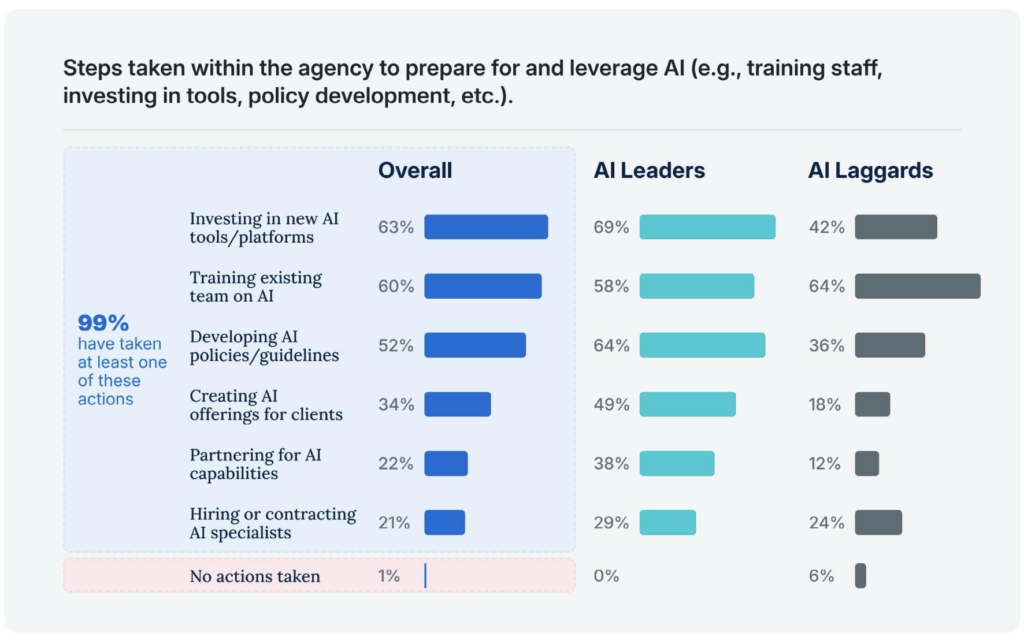
The survey segmented agencies into Leaders (26 percent, 55 respondents, self-rated Advanced or Expert in AI), Intermediate (59 percent, 126 respondents), and Laggards (15 percent, 33 respondents, Beginners). The differences between the top and bottom groups are not marginal. AI Leaders are almost three times as likely as Laggards to offer AI-based services to clients: 49 percent versus 18 percent. They are nearly twice as likely to have formal AI usage policies in place: 64 percent versus 36 percent. They are four times more likely to always initiate AI conversations with prospects and clients: 49 percent versus 12 percent. They are 2.5 times more likely to be creating new AI-based offerings right now.
The gap compounds because of how clients come to Leaders. When Leaders bring AI into client conversations first, those clients start coming back with AI inquiries on their own. The survey shows that Leaders are having more client-initiated AI conversations than Laggards too, not just agency-initiated ones. The Leaders have positioned themselves so that they are both pushing AI at clients and receiving inbound demand for it. Laggards are mostly waiting for clients to ask, and their clients mostly are not asking yet. That dynamic does not close on its own.
What the Leaders Are Actually Building Differently
Seventy-two percent of agencies have already changed their web development and design practices to serve AI systems alongside human users. The report frames this as a dual audience problem: every website now needs to perform for people who read it and for AI systems that crawl, index, summarize, and answer questions about it. The specific changes reveal where the technical work is actually happening.
The most common adjustment, adopted by 37 percent, is adding upfront content summaries and FAQ sections so that AI systems have parseable, direct answers at the top of the page rather than buried in body copy. Thirty-two percent are improving the data layer: page titles, meta descriptions, schema markup, and plain-language structure that AI tools can interpret cleanly. Thirty-one percent are enforcing consistency of business information across platforms, because inconsistent data is what causes AI knowledge graphs to return wrong information about a client. Twenty-four percent are clarifying content permissions in CMS back-ends, a practice that did not exist as a standard workflow three years ago. Eighteen percent have upgraded their tech stacks specifically to support rapid content creation and AI API integrations.
On the SEO side adapted for AI systems, 55 percent have added FAQ or Q&A-style content, 46 percent have implemented Schema markup, 45 percent have optimized pages for featured snippets and direct answers, and 32 percent are now tracking client appearances in AI-generated responses as a standard deliverable. The report uses the term Generative Engine Optimization for this discipline, and the data suggests it is already a majority practice. Only 8 percent have done none of these things. The agencies that have not yet adapted for machine-readable content are a shrinking minority, and they are the same firms whose clients are less likely to be measuring results from AI work.
AI Consulting Is Bigger Than AI Services
One of the more operationally significant findings is that AI consulting and training for clients (45 percent adoption) is more widespread than introducing new AI-based service products (35 percent). More agencies are getting paid to advise clients on AI strategy than are getting paid to build AI-specific deliverables. This is a classic pattern in technology transitions: advisory revenue precedes delivery revenue by 12 to 24 months. The agencies charging for AI consulting now are establishing the client relationships and market position that will convert into delivery contracts when clients are ready to move from advice to execution.
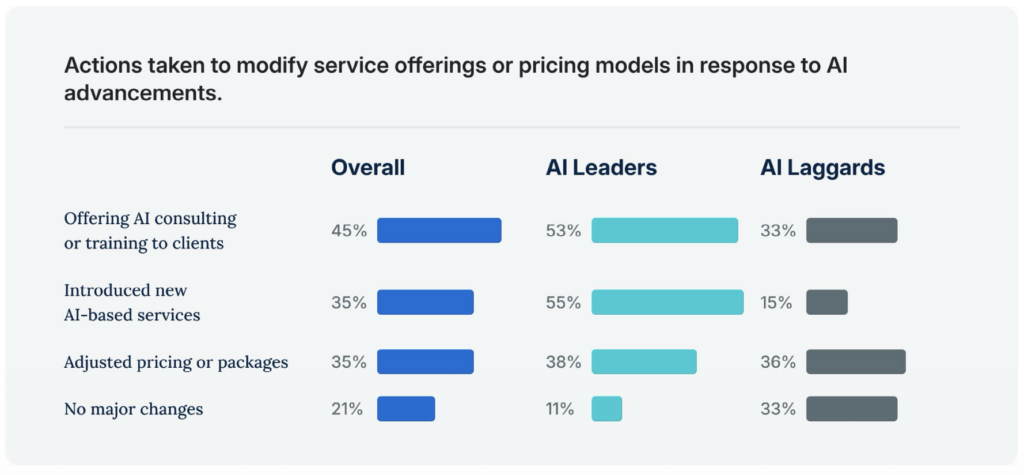
Thirty-five percent of agencies have also modified their pricing or packaging models in response to AI, meaning the commercial terms of agency relationships are changing alongside the deliverables. Only 21 percent report no major changes to services or pricing. The Leaders group is driving these changes: over half of Leaders have launched new AI-based services, versus 15 percent of Laggards. More than a third of Laggards have made no changes to their service mix or pricing at all.
The Counter-Narrative: Seventeen Percent
The number that cuts against the dominant narrative is 17 percent: the share of agencies that named limited client interest or demand as their single biggest challenge. About one in six agencies is not experiencing client pull for AI services. Their clients are either in industries where AI adoption is slower, or they are smaller businesses that are not yet at the stage of allocating budget to AI-specific work. This is not a failure of those agencies. It is a market reality that the wave story ignores.
The 17 percent figure matters for hosting providers and managed services companies because it maps onto the agency market they actually serve. If a hosting provider’s agency customer base is concentrated in verticals where client AI demand is still low, the pressure on that agency to invest in advanced AI capabilities is also lower, and the upgrade cycle for infrastructure to support those capabilities is slower. The aggregate survey data describes the whole market. The relevant number for any specific hosting operator is what that 17 percent looks like in their own customer distribution.
Results Are There. Attribution Is the Problem.
Eighty-seven percent of agencies can point to at least one positive client outcome from their AI-related work. Forty percent see improvement in website technical performance, including Core Web Vitals. Thirty-six percent see user engagement metrics improve. Thirty-three percent see improvement in client visibility in AI-generated responses specifically. Thirty-one percent see conversion rate gains. Only 13 percent report no noticeable improvement.
The challenge the report identifies is attribution, not results. Agency clients need to be able to justify AI investment with quantifiable ROI, and many improvements from AI work are real but hard to isolate from other site changes. The agencies that solve the attribution problem, building measurement frameworks that connect AI work to specific business outcomes, will have a structural advantage in renewing and expanding client engagements. The agencies that cannot demonstrate the connection will find client budgets harder to maintain as AI work becomes routine rather than novel.
The Pace Problem Is Universal
Forty-one percent of all agencies, Leaders included, named keeping up with the rapid pace of change in AI technology as their single biggest challenge. The Leaders are not immune to it: 47 percent of them cite it as the top problem, compared to 36 percent of Laggards. The Leaders are moving faster, but they are also more exposed to how fast the landscape is shifting under them. Laggards worry about falling behind. Leaders worry about staying ahead of a moving target that seems to accelerate faster than any single firm can track.
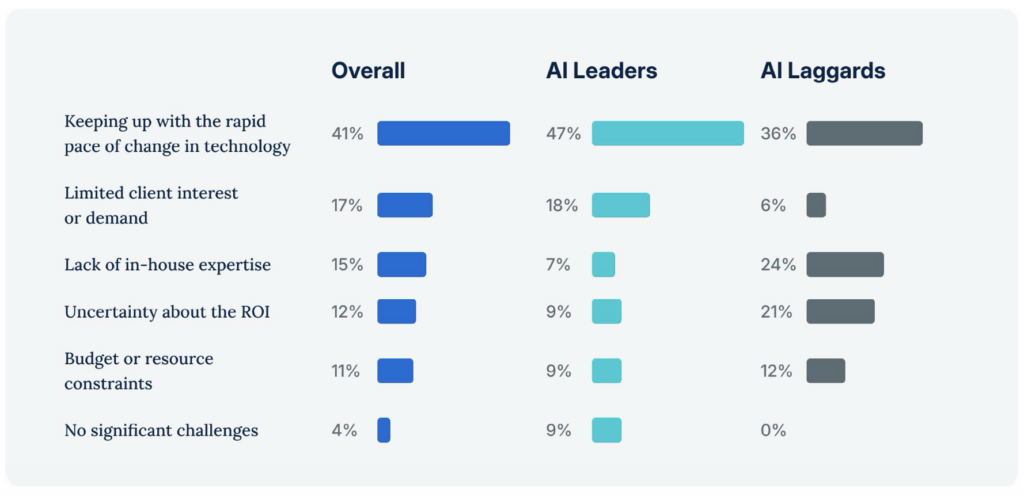
The 96 percent of agencies that identified significant challenges in the transition are not mostly complaining about budget or expertise, the two constraints that feature in most technology adoption arguments. Only 11 percent cite resource constraints, and only 15 percent cite lack of in-house expertise as the top barrier. The primary challenge is epistemic: the tools, frameworks, and approaches that were current six months ago may already be suboptimal. Building a durable strategy when the ground keeps moving requires a different organizational capability than budget alone can buy.
Methodology
The survey was conducted in late October to mid-November 2025 by Promethean Research, founded by Nicholas Petroski, a former equity analyst covering enterprise software and semiconductors. Two hundred and fourteen professionals participated, 69 percent based in the United States and 27 percent in Canada. Over a quarter of respondents were Founders, Owners, or Partners; 20 percent were Managers; 13 percent were Directors or Vice Presidents; 5 percent were CEOs or Presidents. Most agencies in the sample are small to mid-sized: 27 percent have 25 to 49 employees, 27 percent have 50 to 249, and 24 percent are in the 10 to 24 employee range. Only 8 percent are large agencies with more than 250 staff. The report was published by WP Engine.
