
WordPress.com released Studio Code in public beta on April 27. It is a CLI-based agentic tool built on Anthropic’s Claude, designed for WordPress developers who want to describe what they want and have the tool build it. The command is studio code, run from the Studio CLI. From there, a developer describes a site, a theme, a block pattern, or a configuration task in plain language and Studio Code executes the work against a real WordPress environment. The tool is free during the beta period.
What It Does and How It Works
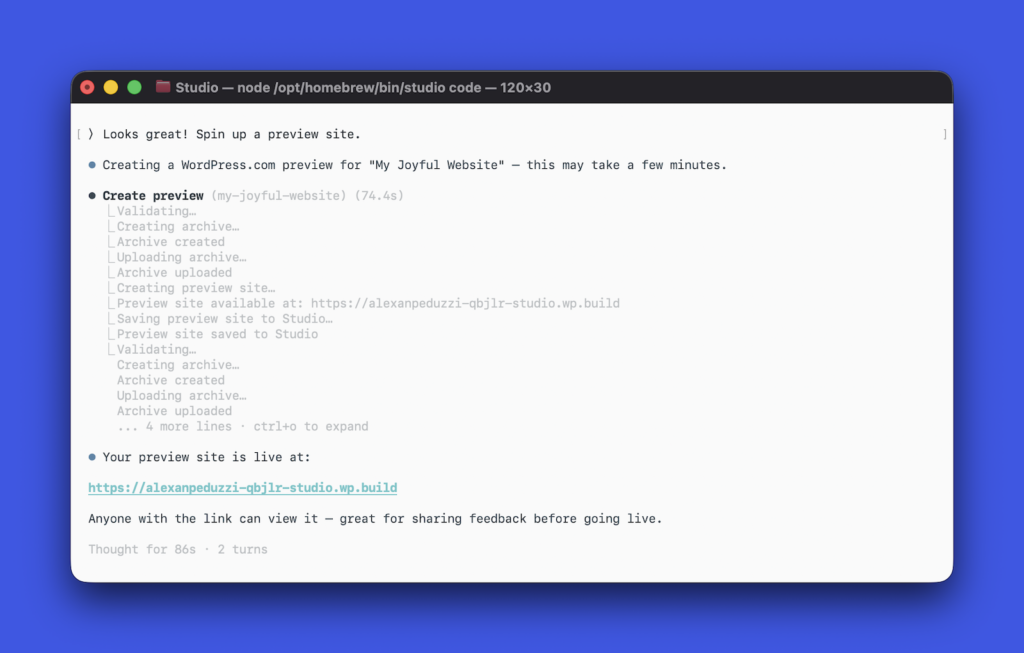
Studio Code reads codebases, edits files, runs WP-CLI commands, creates and manages local environments, installs plugins, activates themes, and pushes to or pulls from WordPress.com. Block markup is validated against the real block editor before insertion. A /need-for-speed command runs a full performance audit with actionable recommendations. Taxonomy cleanup, including identifying duplicate categories and re-categorizing posts, is built in. A /preview command deploys the local site as a live preview on WordPress.com.
Studio Code runs on Claude Sonnet 4.6 by default, optimized for speed and routine tasks. Developers can switch to Claude Opus 4.6 for complex, multi-step operations using the /model command. Authentication is via WordPress.com login through a browser approval flow, but developers who prefer direct control can bypass WordPress.com entirely and provide their own Anthropic API key using the /api-key command.
The Broader Strategic Context
Studio Code did not arrive without groundwork. In March 2026, Automattic launched full MCP write capabilities for WordPress.com, allowing AI agents including Claude, ChatGPT, and Cursor to create posts, manage content, organize media, and interact with WordPress sites through the Model Context Protocol. Read-only MCP support had launched in October 2025. Studio Code is the developer-facing CLI layer built on top of that infrastructure.
Automattic’s stated strategic position is that WordPress should become the operating system of the agentic web. The argument is structural: WordPress powers approximately 43 percent of all websites globally and holds over 60 percent of the known CMS market. Its open-source codebase, REST API, plugin review process, and now MCP integration give AI agents a consistent, auditable surface to work with. The 61,000-plus plugins in the official directory, combined with WooCommerce’s 1,200-plus extensions, represent an integration surface that no purpose-built AI site builder can replicate in the near term.
Studio Code is the execution environment for that vision at the developer level. Rather than asking developers to prompt a generic coding assistant that happens to know some WordPress, Automattic built a WordPress-specific agent that understands WP-CLI, block markup validation, the WordPress.com publishing pipeline, and local environment management as native capabilities.
What This Means for Managed WordPress Hosting
Managed WordPress hosts compete on onboarding speed, developer experience, and the depth of tooling alongside the infrastructure. Studio Code is Automattic building directly in that space, with WordPress.com as the deployment target. A developer who can describe a site in a terminal, receive a working local environment, and deploy a preview to WordPress.com without leaving the CLI has progressively less reason to evaluate competing managed WordPress platforms, not because the underlying infrastructure differs but because the workflow is embedded.
The decision to support direct Anthropic API keys alongside WordPress.com authentication is a signal worth noting. It means Studio Code can function entirely outside the WordPress.com ecosystem for developers who want local-only workflows or prefer to manage their own AI costs. The tool is not locked to WordPress.com as a deployment target; it is optimized for it. That distinction matters for how competing managed WordPress hosts should think about their own tooling roadmaps.
Automattic is explicitly collecting feedback through GitHub issues and describes the tool as something they are “still actively building.” The beta framing is real: this is not a finished product. But the direction is clear, and the infrastructure underneath it has been building for at least six months.
