
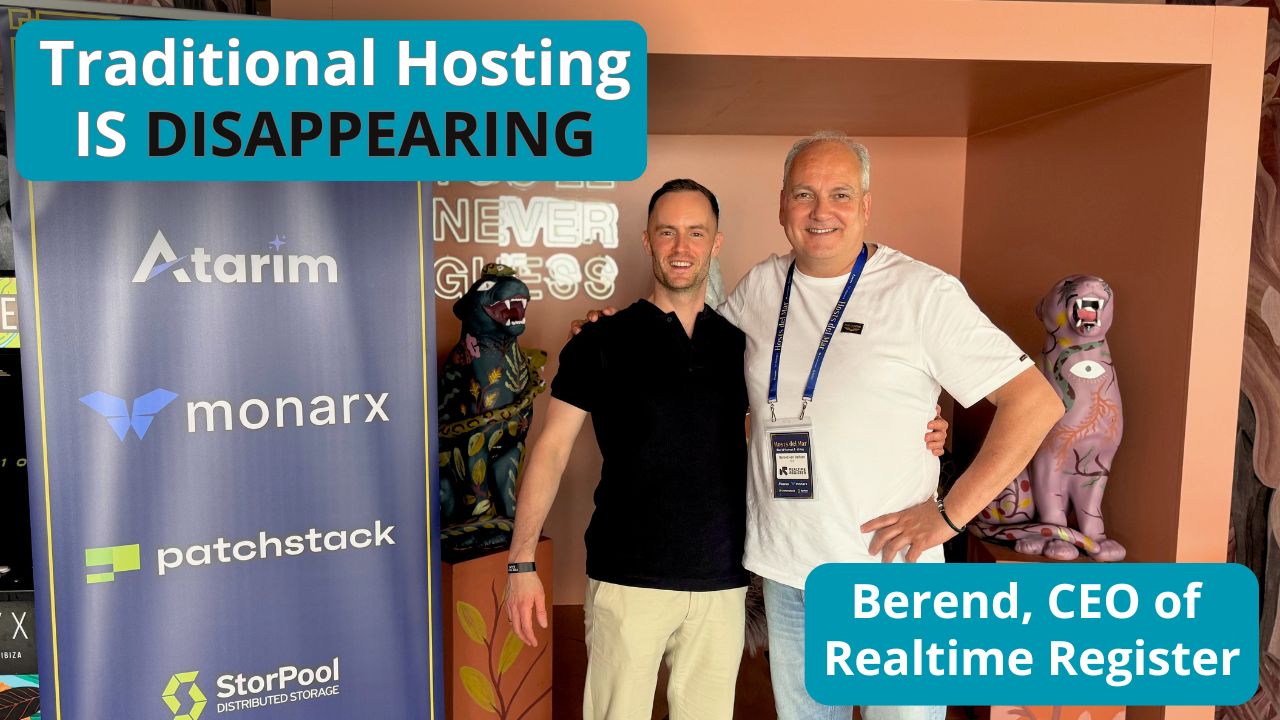
Hosts Del Mar gathered around 80 senior hosting industry figures on Ibiza for a relaxed weekend of off-record conversations rather than a classic conference. The industry is in a period of unusual movement: NIS2 regulationsare pushing companies to reconsider their domain partners, the new gTLD round is approaching, and AI is changing how end customers reach the hosting market in the first place. With Berend, CEO of Realtime Register, we talked about why the traditional model of hosting (buy a domain, pick a plan, build a site) is being reversed by AI-first website builders, how Realtime Register is expanding from a domains-only wholesale registrar to a broader vendor stack targeting both HSPs and MSPs, and why commercial and business skills will matter more than the build in the next wave of hosting.
This interview is part of a series recorded at Hosts Del Mar – a private, invite-only hosting industry gathering on Ibiza, organized by Atarim, Monarx, Patchstack, and StorPool Storage.
All Hosts Del Mar interviews →
Konrad: Second edition of Hosts Del Mar. What is your impression?
Berend: Knowledgeable, senior people from the industry. People you see at other events but never have time to catch up with, because everyone is in business meetings. Here you can sit down for a beer or a coffee and actually talk. Around 80 people, mostly Europe, but also US and even Asia. For me as a Dutch company it is a short trip, but several people travelled a long way for this.
Konrad: How is the business going at Realtime Register?
Berend: We grew over 30% last year in revenue, and even more in clients. This year we are growing fast too. With everything happening in the industry, there is never a dull moment.
Konrad: There is a lot of movement right now. NIS2 in Europe, new gTLD rounds coming, some industry incidents. How does that affect a wholesale registrar?
Berend: Honestly, some disruption is good for us. Domains are not a product that people change every week. When there are big changes at registry level, or when NIS2 forces companies to rethink their setup, or when something goes wrong somewhere in the industry, people start asking themselves whether they still have the right partner. When the pain is not big enough, people do not switch. Right now there is plenty of pain, so there is plenty of movement.
Konrad: On the product side, what is Realtime Register building?
Berend: Most people know us as an ICANN-accredited wholesale registrar. We have been in the domain business since 2003, we do wholesale only, and we do not compete with our customers by selling to end users. The core platform, the API, and the support team are what we are known for. On top of domains we added SSL, then cPanel licenses through WebPros. We have about 1,500 active resellers in over 60 countries today. What we are doing now is expanding the vendor portfolio. We are bringing in Atarim, Blackwall, Monarx, Patchstack, Acronis, more from WebPros. Realtime Register is going to act not only as the domain pillar, but also as the online presence pillar, the security pillar, and the server management pillar.
Konrad: Does that mean you are now targeting MSPs as well as hosting companies?
Berend: Yes. We used to have a clear difference between HSPs and MSPs. Those worlds are mixing. Many hosting companies now sell Microsoft solutions and other things that make them effectively an MSP. Many MSPs also handle domains, SSL, backup, security. The overlap keeps growing. We are following the customer.
Konrad: You also rebranded recently.
Berend: When you go from domains only to a wider vendor portfolio, you need a brand that matches what you actually do. New website, new logo, new branding. We did it while keeping the shop open, which is the hard part.
Konrad: What is your biggest bet on the future of the industry?
Berend: Traditional hosting as we know it will disappear. We always knew most customers are not really looking for hosting. They are looking for online presence or online success. In the old model they registered a domain, then picked a hosting plan, then built a website on top. The market is already going the other way around. People build with Elementor, Automattic, Wix, a website builder, and then attach hosting and a domain to it. I think it will go one step further. People will type in what kind of company they want to build, and the system will come up with a domain, a logo, a business plan, a website in a minute, and keep improving it. SEO, content, all automated.
Konrad: Is AI good news or bad news for the industry?
Berend: Both. The advantages are obvious. The disadvantage is that you should not believe everything that comes out of AI, and you have to stay in control. For us as a supplier to the industry, the bigger point is that the traditional way of thinking is gone.
Konrad: What does that mean for mid-sized and smaller hosting companies?
Berend: Bigger companies can put resources into AI, build a dedicated team, get everyone trained. For mid-size and small companies it is going to be a challenge. On top of that, we are going to see startups that build with AI in weeks what took us years. They will not all succeed, because success needs commercial and business skills, not just a fast build. But they will try to take pieces of the market we considered ours.
Konrad: So the barrier to entry on building is lower. What becomes the new differentiator?
Berend: Commercial and business skills. Building is easier than ever. Success needs more than the build.
