

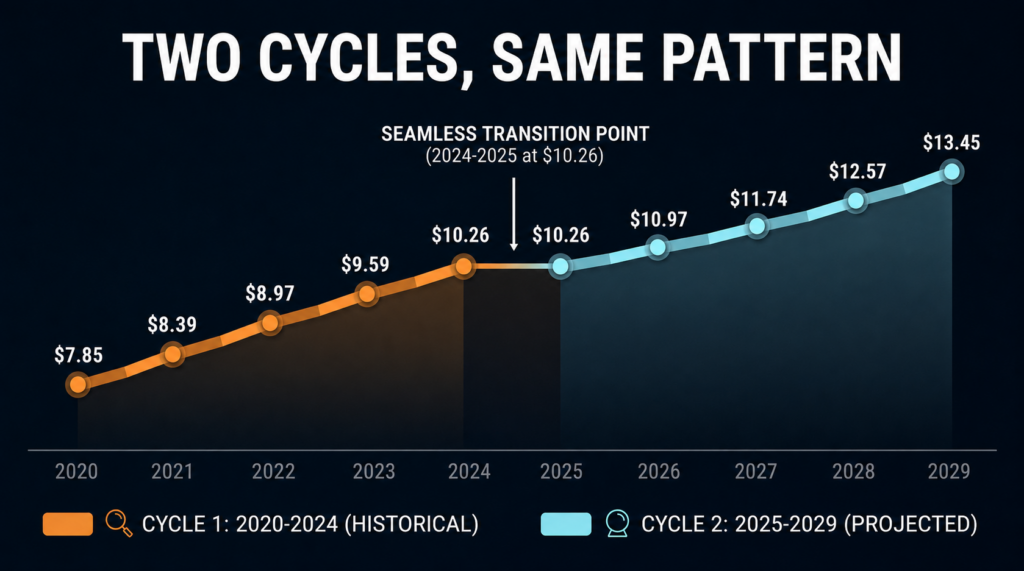
The 7% wholesale price increase for .com domains that takes effect on November 1, 2026 is being reported as a one-time event. It is not. It is the opening move of a four-year pricing cycle that, if Verisign exercises every option available under its current contract, would lift wholesale .com pricing from today’s $10.26 to roughly $13.45 by 2029. For registrars and hosting providers that have built domain-driven acquisition models on the assumption of a stable .com base price, the announcement is less a news item than a planning horizon. Every renewal cycle, plan structure, and bundled hosting promotion built around .com pricing now needs to account for compounding cost increases through the end of the decade.
A Four-Year Cycle, Not a One-Time Increase
Verisign operates the .com registry under a contract with ICANN and the U.S. National Telecommunications and Information Administration. That contract is structured in six-year cycles. In the last four years of each cycle, Verisign is permitted to raise wholesale prices by up to 7% per year. The current six-year cycle began October 26, 2024. November 2026 is the first year inside the window where annual increases are allowed.
That means three more increases are contractually possible after this one: in November 2027, November 2028, and November 2029. If Verisign exercises all four at the full 7% ceiling, the wholesale price progression looks like this:
- 2025 (now): $10.26
- November 2026: $10.97
- November 2027 (potential): $11.74
- November 2028 (potential): $12.57
- November 2029 (potential): $13.45
Whether Verisign exercises each one is a business decision, not a contractual obligation. The company reported a gross margin of 88% and an operating margin of 68% for 2025, putting it among the highest-margin operators in the S&P 500. The increases are not driven by cost pressure on Verisign. They are driven by the absence of any competitive constraint on the price of .com.
Who Carries the Cost
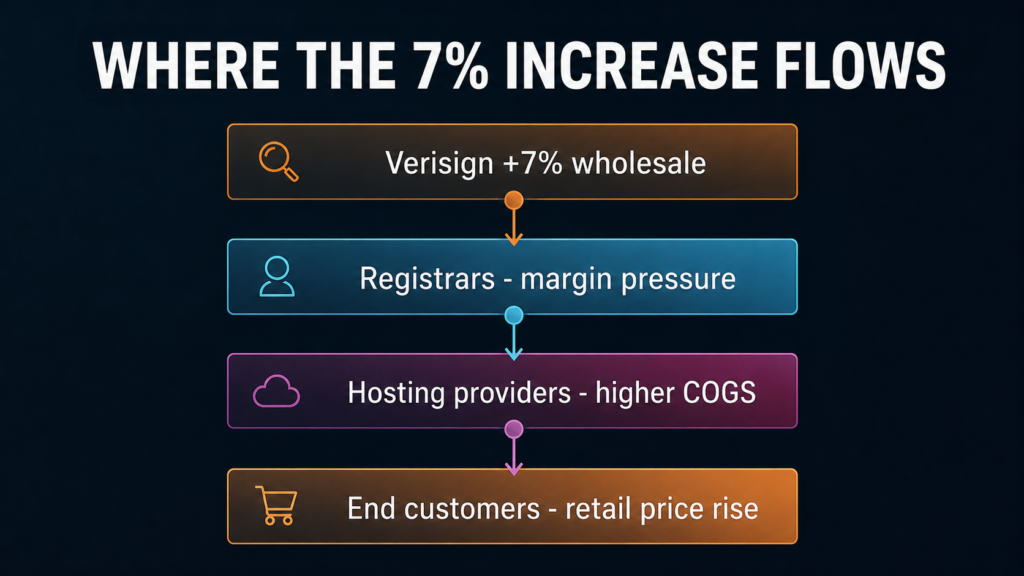
The wholesale increase does not stop at Verisign. It flows through the entire chain of businesses that depend on .com as a product.
Registrars absorb the cost first. Wholesale rates are what registrars pay Verisign for each registration or renewal. Large registrars with strong vendor relationships and high volumes have some absorptive capacity. Smaller registrars and resellers, who frequently operate on single-digit-dollar margins per domain, do not. They will either need to raise retail prices in step with each increase or watch domain profitability erode.
Hosting providers face a more specific problem. Many providers have spent years using .com domains as a customer acquisition vehicle, offering a free first-year domain with hosting plans and recovering margin on renewal. That model assumed a stable underlying cost. With wholesale prices on a four-year escalation path, every promotional .com bundled into a hosting plan now carries a higher renewal-year cost basis. Lifetime value calculations built on 2024 pricing will need to be recalibrated.
The numbers make the scale concrete. A hosting provider with 10,000 .com domains under management pays approximately $7,100 in additional wholesale cost in year one alone. If every increase in the cycle lands at the full 7%, that same provider pays $31,900 more in year four than it does today, and $76,900 cumulatively across the four-year window relative to the current $10.26 baseline. At 50,000 domains, the cumulative four-year cost increase passes $384,000. These are direct cost-of-goods-sold increases that flow straight to the bottom line unless retail pricing or plan structures absorb them.
End customers are the final stop. Retail .com renewal prices have historically tracked wholesale increases over time, with a lag. The actual customer-facing impact will arrive in the renewal notifications that go out in late 2026 and through 2027. For small business owners managing multi-domain portfolios, the cumulative renewal increase across a five-domain portfolio over four years could exceed the cost of a full hosting plan.
The Structural Reason This Will Keep Happening
The .com registry is a regulated monopoly. There is no second .com. Customers who want a .com domain have one source, with one set of rules, and that source is contractually permitted to raise prices by 7% in each of four consecutive years.
The 2020 amendment to the Verisign-ICANN contract is the document that made this possible. It replaced an earlier framework that had frozen .com wholesale pricing at $7.85 since 2012. Industry critics, including registrars and consumer groups, argued at the time that the amendment removed a competitive discipline that had no replacement.
The previous six-year cycle, which ran from October 2018 to October 2024, offers the most relevant precedent. Verisign exercised every available 7% increase across the four eligible years, lifting wholesale .com pricing from $7.85 to $10.26 in successive steps. The math is exact: $7.85 compounded at 7% for four years lands at $10.29, within a rounding step of the $10.26 price that has held since 2024. There was no year in the first cycle in which Verisign chose to forgo or reduce the contractually permitted increase. That precedent, more than any current statement from the company, is the strongest reason to assume the second cycle will follow the same pattern. The April 2026 announcement signals that for at least the first year of the new window, it already is.
Verisign’s investor positioning reinforces the pattern. Domain registrations and renewals are a recurring-revenue business with predictable churn. Price increases compound the revenue base without requiring any change to operations or customer acquisition. For a public company with an 88% gross margin, exercising the maximum contractual price increase each year is the simplest path to growth that does not require risk-taking on new products or markets.
Five Levers Hosting Providers Still Have
The November 2026 increase is six months away. The strategic decisions, however, are not about November. They are about the four-year horizon.
- Multi-year renewals as a hedge: Registrars that allow customers to renew .com domains for multiple years at the current wholesale rate lock in cost basis. Promoting multi-year renewals to existing customers in the months before each November anniversary becomes both a customer-retention tool and a margin-protection mechanism.
- Bundle versus unbundle review: The free-domain-with-hosting model worked when domain cost was stable. With cost on a steady upward path, separating domain pricing from hosting plan pricing gives operators more flexibility to adjust each independently without disrupting plan economics.
- Communication strategy with customers: Renewal-time price increases generate churn risk. Hosting providers that explain the underlying registry change proactively, rather than reactively in a renewal notice, retain trust through the cycle. The framing matters: this is an ICANN-contracted Verisign action, not a host markup.
- Alternative TLD positioning, with limits: Some providers will use this cycle to promote .net, .org, and ccTLDs as more stable alternatives. The reality is that .com remains the customer default and price elasticity on .com is low. Alternative TLDs become a useful upsell or portfolio play, not a replacement.
- LTV recalibration: Any customer lifetime value model that assumes a flat $10.26 wholesale rate for the renewal years 2027 through 2029 is now incorrect. Recalibrating LTV across the customer base before the next budgeting cycle protects against decisions taken on stale unit economics.
The contractual structure that permits this cycle expires in October 2030. What comes after that is a separate question, to be negotiated between ICANN, the NTIA, and Verisign in the next contract cycle. For now, the planning horizon is set: four years, four possible increases, and a wholesale cost basis that will look meaningfully different by the end of the decade than it does today.
