

A major outage at Cloudflare is currently causing widespread disruption across the internet, affecting many high-traffic platforms and online services. Users around the world are unable to load websites that depend on Cloudflare for routing, security, and content delivery.
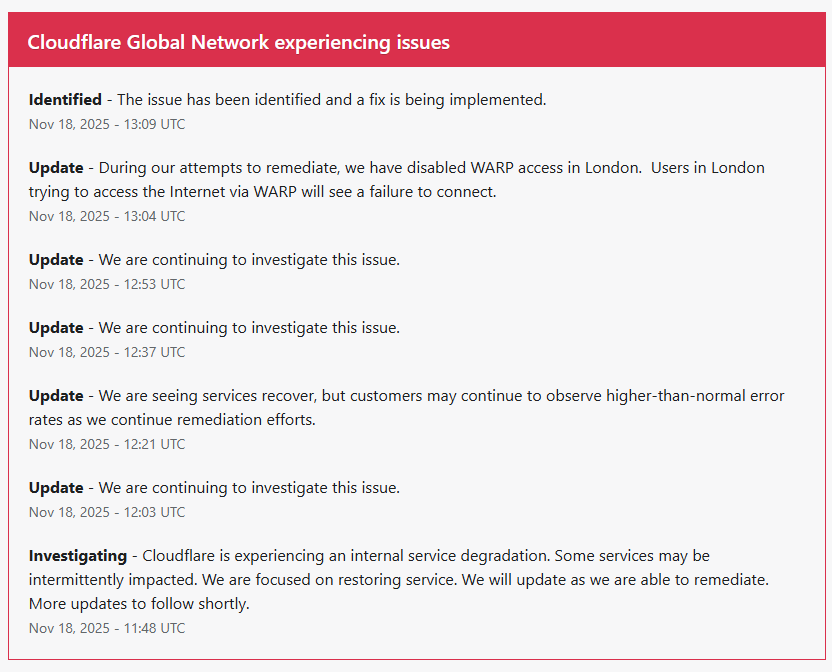
The incident begins late in the morning (UTC), when Cloudflare reports an internal service degradation. The company states that it is investigating an issue that “potentially impacts multiple customers.” Soon after, errors start appearing across major platforms. People trying to access sites such as X, Spotify, OpenAI services, Canva, Letterboxd, and PayPal are met with messages pointing to Cloudflare-related failures.
Even outage-tracking sites are impacted. Some users trying to load Downdetector see Cloudflare “500 Internal Server Error” messages. This becomes a strong sign that the problem is not regional but global in scope.
Cloudflare confirms that its dashboard, API, and parts of its edge network are failing. During ongoing recovery efforts, the company temporarily disables Cloudflare WARP access in London to stabilize the system. As a result, users in that region cannot connect through WARP at all. By early afternoon UTC, Cloudflare states that it has identified the root cause and is rolling out a fix. Services begin to recover, though error rates remain higher than normal.
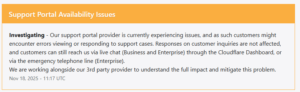
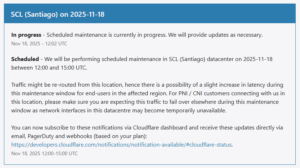
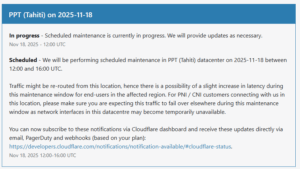
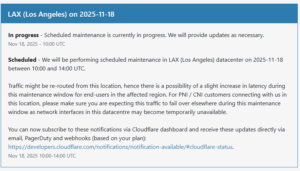
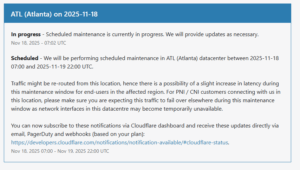
The timing of the outage creates additional challenges, since Cloudflare is performing scheduled maintenance in several datacenters, including Santiago, Tahiti, Los Angeles, and Atlanta. These maintenance events introduce routing changes and possible slowdowns, making it harder for users and hosting providers to distinguish planned work from the ongoing global incident.
Cloudflare has not yet published detailed technical information, but the symptoms strongly suggest a failure somewhere within its core networking or internal control systems. Because Cloudflare acts as a traffic layer between users and a significant portion of the internet, any disruption on its side spreads quickly and affects a wide range of unrelated online services.
Impact on the Hosting Industry
Even though Cloudflare is not a traditional hosting provider, this outage highlights several issues that directly affect the hosting sector.
1. Cloudflare becomes a critical dependency for many hosts
Hosting companies rely on Cloudflare for DNS, CDN caching, DDoS protection, and traffic proxying. When Cloudflare experiences an outage, many healthy servers appear unreachable, even though nothing is wrong with the host’s own infrastructure.
This shows how deeply the hosting world is tied to a small number of large intermediaries. A failure in one of them can instantly impact thousands of independent providers.
2. The event exposes the risks of centralization
Modern hosting setups often use Cloudflare for DNS resolution, TLS termination, reverse proxy routing, and firewall filtering. When a single company handles so many layers, a malfunction at that company can make websites effectively vanish from the internet.
For hosting providers, this raises questions about redundancy. A cluster of servers or mirrored systems does not help if DNS or proxy routing fails upstream.
3. Hosting providers face customer pressure despite having no outage
During incidents like this, hosting support teams receive a surge of complaints from customers who assume their hosting service is down. In reality, the issue lies with Cloudflare, not with the underlying server hardware or networks.
This creates a communication challenge: hosting companies must explain that their infrastructure is fully operational while acknowledging that customers still experience real downtime.
4. Hosts depending on Cloudflare’s API run into additional failures
Some hosting control panels integrate Cloudflare for automated DNS management, SSL provisioning, or security configuration. With Cloudflare’s API currently failing:
- DNS records cannot update,
- SSL renewals may stall,
- newly deployed websites cannot complete their setup.
This slows down normal hosting operations and onboarding.
5. The incident pushes the hosting industry to rethink redundancy
Hosting companies are now likely to review how they can reduce dependence on Cloudflare alone. Options include:
- keeping backups of DNS outside Cloudflare,
- offering direct-origin access for customers,
- providing alternatives to Cloudflare’s proxy layer,
- using multi-CDN or multi-DNS setups for high-availability clients.
While Cloudflare remains a powerful and widely trusted service, the current outage shows that no provider is immune to failure.
What This Outage Really Means for the Future of the Internet
The Cloudflare outage is becoming one of the most disruptive internet incidents of the year. It shows how deeply Cloudflare is embedded in global online infrastructure and how a single point of failure can affect millions of users and many unrelated companies.
For the hosting industry, the event serves as a reminder that redundancy must extend beyond hardware and datacenters. Providers need to examine their external dependencies — especially those controlling DNS and traffic routing — and consider how to keep services reachable when a major intermediary faces a global failure.