

TL;DR: GoDaddy shares hit a new 52-week low in January 2026. The company beat quarterly estimates with revenue up 10.3% year over year, yet the market reaction remained negative. To understand that disconnect, we examined GoDaddy’s latest earnings release, segment reporting, capital allocation disclosures, and recent investor materials.
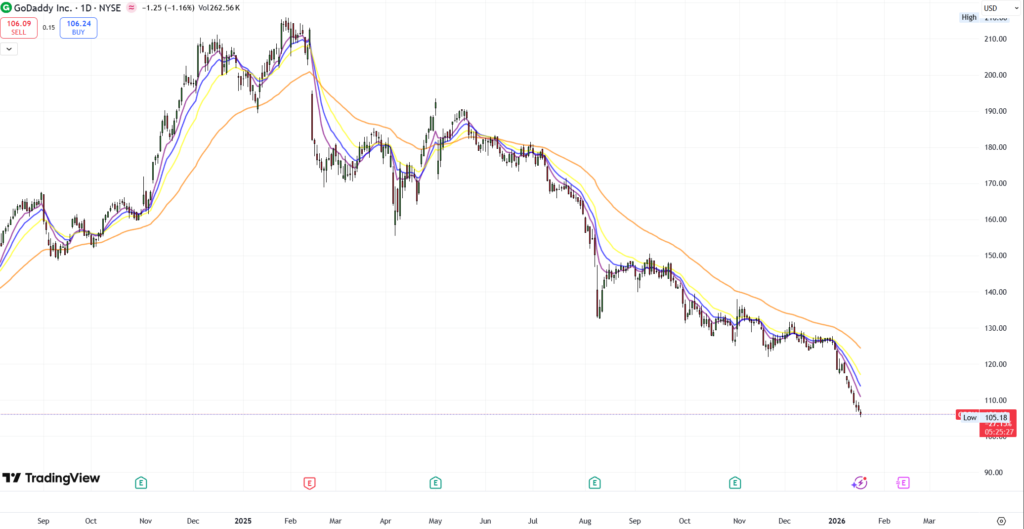
January GoDaddy fact & figures that set up the scene
- GoDaddy beat quarterly estimates (EPS $1.51 vs. $1.50; revenue $1.27B vs. $1.23B) with revenue up 10.3% year over year, while insiders sold roughly 14,115 shares (~$1.81M) over the past three months.
- On Thursday, January 8th, shares were trading as low as $114.36 (last $114.55) with a volume of 121,519 shares.
- Multiple analysts have trimmed price targets (Jefferies to $140; Evercore/UBS to $145).
GoDaddy is still executing cleanly, with double-digit revenue growth, improving margins, and record cash flow. But it can still go nowhere in valuation – that’s what the market just told GoDaddy.
In Q3 2025:
- revenue: ~$1.27B, ~10% year over year,
- operating income growth: ~17% year over year,
- free cash flow: ~$440M, ~21% year over year,
- full-year free cash flow guidance: ~$1.6B.
Segment split:
- Core Platform (domains + hosting): ~$784M, ~8% year over year,
- Applications & Commerce: ~$481M, ~14% year over year.
Capital allocation in 2025:
- buybacks: ~$1.4B,
- shares repurchased: ~9M,
- cash on hand: ~$1B,
- net debt: manageable.
💸 Our non-CFO translation:
This is a well-run business that keeps making more money. Nothing here looks broken.
Why the market reaction matters
This wasn’t a reaction to bad numbers, but to what good numbers actually represent. Solid growth, margin expansion, and strong cash generation were treated as table stakes, not upside. That’s a structural shift, where execution became the baseline and stopped driving re-rating.
Once that happens, valuation stops being about how well the business runs and starts being about how much room the company still has to grow.
Where the pressure actually sits
The market now assumes GoDaddy will execute. This quarter did not change the trajectory of the business.
There were no signals of:
The market is increasingly treating the Core Platform as the valuation reference point, assigning conservative multiples to it.
- growth acceleration,
- a step-change in demand,
- or a shift in the underlying revenue mix.
GoDaddy’s own reporting and our prior quarterly analysis have shown a pattern across multiple quarters: Core Platform delivers low single-digit growth, while Applications & Commerce expands materially faster.
Core Platform carries:
- the customer base,
- the infrastructure load,
- the support burden,
- the long-term margin profile.
Results from Applications and AI tools segments help, but they are clearly not enough to convince analysts to lift stock price targets.
AI is being priced as defense, not expansion
GoDaddy’s AI strategy is clear – it improves onboarding, reduces friction for small businesses and lowers support burden. From an operating perspective, this is rational. From a market perspective, AI is increasingly being priced as defensive infrastructure.
The implicit assumptions:
- AI improves retention more than pricing power,
- AI features are quickly commoditized across the segment,
- AI spend is required to prevent churn, not to unlock step-change revenue.
That changes AI’s role from part of expansion strategy to margin preservation tool, with decreasing impact on valuation.
What could change the narrative
The current re-rating is not irreversible, but it would require new numbers and new ideas, for example:
- sustained ARPU growth not driven by promotions,
- new customer creation rather than internal upsell recycling,
- AI features tied directly to monetization, not just retention.
Without that, the market is likely to continue treating shared hosting as a stable, cash-generative, but capped business.
The real takeaway for hosting executives
The market is not questioning whether GoDaddy is well run, but how much more value it can realistically unlock.
For many, GoDaddy is the reference point. If the category leader can execute cleanly, generate record cash flow, and still hit a new 52-week low, smaller platforms should watch out.
