

The web hosting market continues to grow, but running a hosting business is becoming more complex each year. A global survey of 446 hosting providers shows that 65% of companies reported revenue growth in 2025. At the same time, profitability is becoming harder to achieve. Hosting providers are caught between strong price competition and rising operational costs such as infrastructure, energy, and software licensing.
The result is a gradual shift in strategy. Instead of relying only on large volumes of low-cost hosting accounts, many providers are focusing on increasing the value of each customer by offering additional services and more advanced hosting products.
Place for chart: Revenue growth among hosting providers in 2025 (37% moderate growth, 28% strong growth, 29% flat, 5% decline, 2% significant decline)
How the Hosting Market Is Changing
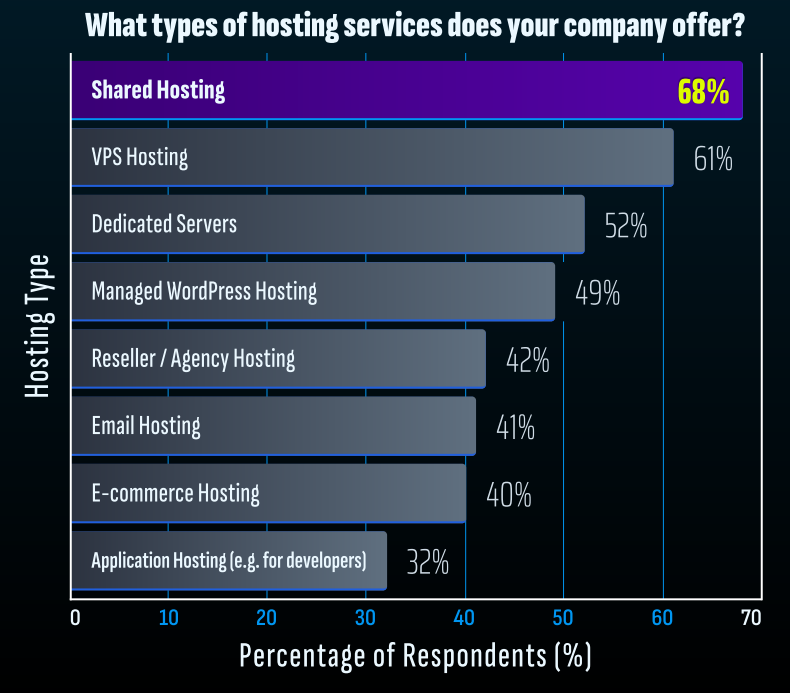
Shared hosting remains the foundation of the industry. According to the report, 68% of hosting providers offer shared hosting, making it the most common service in the market. However, the hosting stack has expanded significantly. 61% of providers offer VPS hosting, while 52% provide dedicated servers. Specialized hosting services are also becoming common, with 49% offering managed WordPress hosting and 40% offering e-commerce hosting solutions.
This shows how hosting companies are diversifying their offerings. While shared hosting remains the entry point for many customers, providers increasingly rely on more advanced products to grow their business.
When providers look at the biggest opportunities for future growth, the focus shifts even more toward higher-value services. In the survey, 26% of providers identified VPS or dedicated hosting as the single biggest opportunity, compared to 22% who chose shared hosting and 17% who pointed to cloud servers. Managed WordPress hosting was selected by 14% of respondents, reflecting the continued importance of the WordPress ecosystem.
Customer choice is driven primarily by performance. 55% of hosting providers say website speed is the most important factor when customers choose a provider, followed by price at 47% and support quality at 45%. Other factors such as security features, server location, or brand reputation play a role but are clearly less dominant.

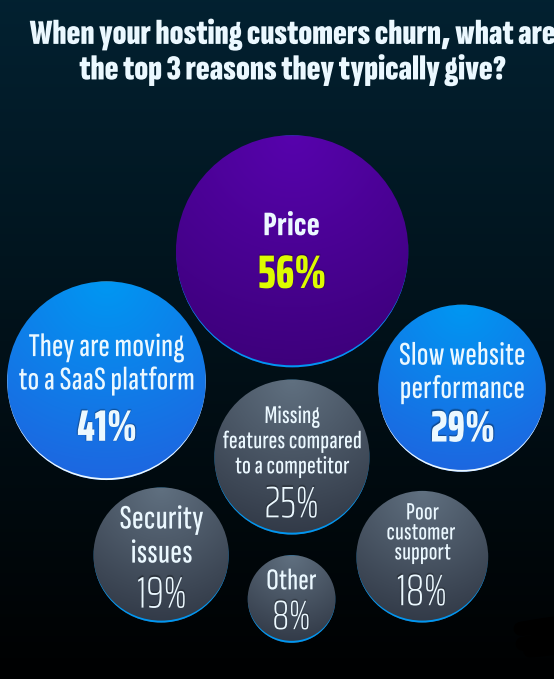
Customer retention remains a challenge across the industry. 56% of providers say price sensitivity is the main reason customers leave, which highlights the constant pressure created by low-cost competitors. At the same time, 41% of providers report losing customers to SaaS platforms such as Wix, Shopify, or Squarespace. These platforms simplify website creation and remove the need to manage hosting separately.
This shift toward SaaS platforms represents a structural change in the market. Hosting companies increasingly need to explain the advantages of open platforms while also improving the tools and services they offer.
Where Hosting Companies Are Focusing Next
One of the biggest trends in the report is the growing importance of additional services around hosting. Many companies are trying to increase revenue per customer rather than relying only on hosting subscriptions. The most common additional service is domain registration and management, offered by 46% of providers. Professional services such as migrations or consulting are offered by 40%, while 37% offer premium security services and 34% sell advanced security features or remediation services. Performance optimization services such as caching or CDN integration are offered by 30% of providers.
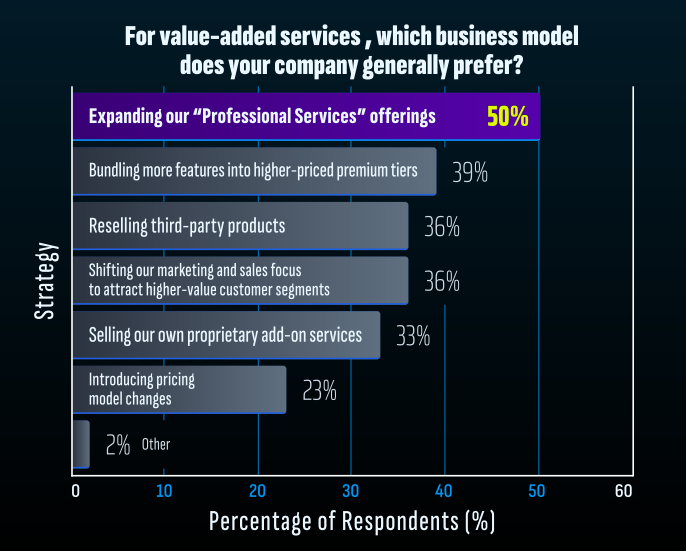
Because of this shift, many hosting companies are planning to expand service offerings even further. 50% of providers say expanding professional services is their main revenue strategy, ahead of bundling more features into premium tiers, which was selected by 39% of respondents.
Operational challenges also play a major role in the daily work of hosting companies. Support teams spend much of their time dealing with infrastructure and application issues. According to the report, 42% of providers say email problems such as spam or blacklisting consume a large share of support time, while 39% report frequent customer application or CMS issues. Performance problems and security incidents are also common, both reported by 35% of providers.
Security risks remain one of the most serious concerns. 53% of providers say outdated or vulnerable software used by customers is the biggest risk, while 51% identify malware and ransomware infections as a major threat. These problems increase operational complexity and require constant monitoring.
Artificial intelligence is starting to appear in hosting operations as a way to reduce manual work. 36% of providers already use AI tools in customer support, typically for chatbots or automated reply suggestions. 32% offer AI-powered tools directly to customers, while 30% use AI for server monitoring and optimization. Another 29% deploy AI for cybersecurity threat detection, although 27% of providers say they have not implemented AI yet.
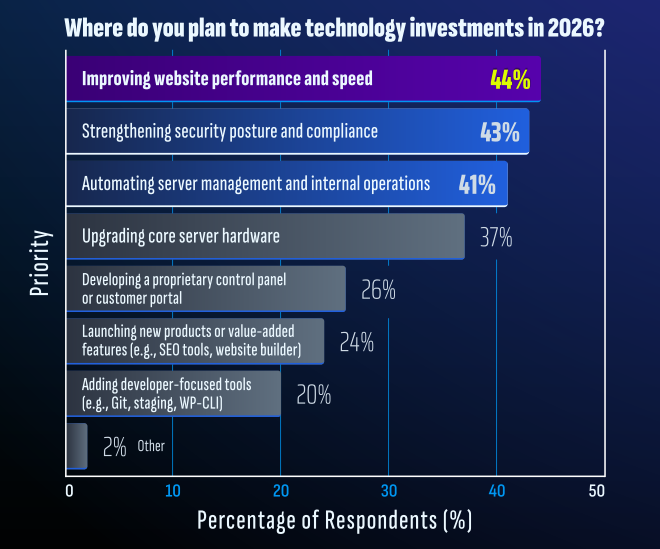
Looking ahead to 2026, the priorities of hosting providers are becoming clear. 44% say improving website performance is their top priority, 43% are focused on strengthening security and compliance, and 41% want to automate more of their server operations. These goals reflect the broader direction of the industry.
Hosting companies are gradually moving away from competing purely on price. Instead, they are focusing on performance, security, automation, and service-based revenue. In a market where basic hosting is increasingly commoditized, the ability to deliver reliable infrastructure and strong customer support is becoming the key factor that differentiates providers.
This article highlights the main insights from the Web Hosting Trends Report 2026, based on responses from 446 hosting providers worldwide. If you want to explore the data in more detail, including all charts and survey results, you can download the full report below. The complete report is available as a PDF.

Kamil Kołosowski
Author of this post.