
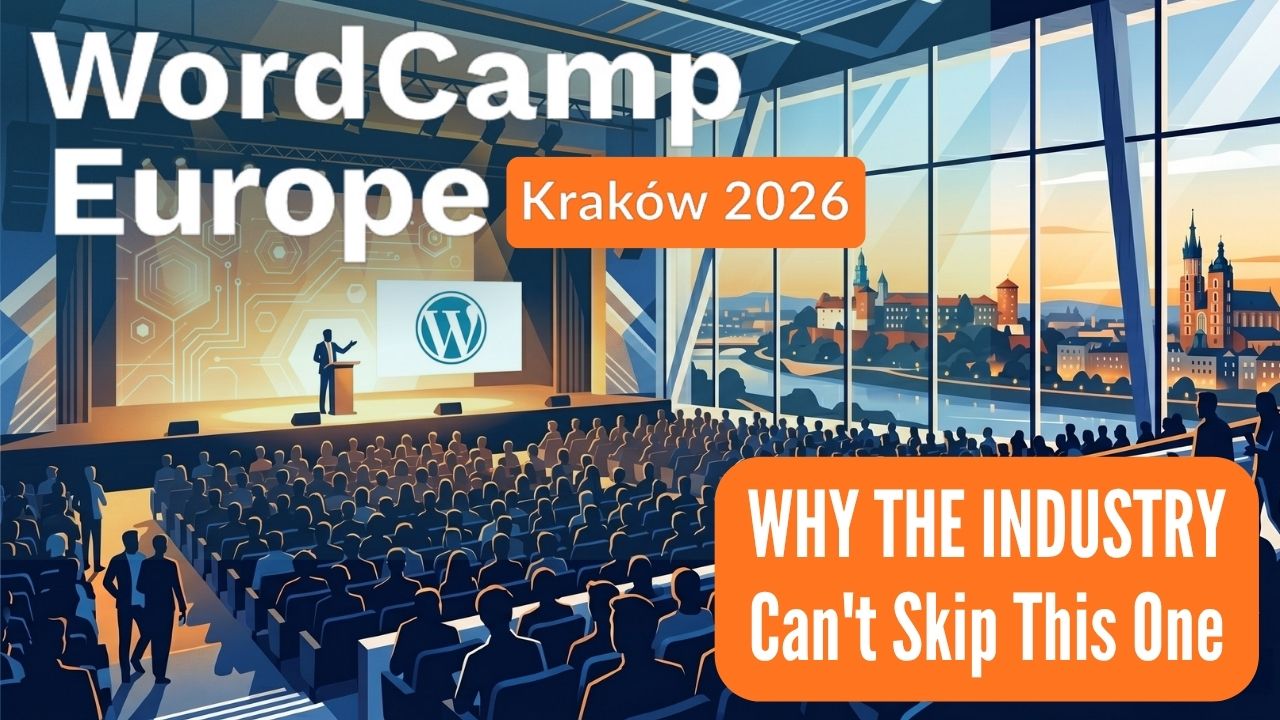
WordCamp Europe is where the WordPress industry takes stock of itself. It is where product decisions get debated in public before they reach the market, where the people building the platform meet the people selling and running it, and where Matt Mullenweg sets the tone for the year ahead. The 2026 edition runs June 4 to 6 at the ICE Kraków Congress Centre in Kraków, Poland, with more than 3,000 attendees expected across three days. Tickets are €50 for a general pass, which includes two conference days, lunch, and the official After Party.
For hosting providers, this is not a conference to monitor from a distance. WordPress runs on 43 percent of all websites globally and holds more than 60 percent of CMS market share. The decisions made and signalled at WordCamp Europe each year directly shape what those sites will require from their infrastructure over the following twelve months. Being in Kraków means understanding those decisions as they are being made, not after they have already reached customer support queues.
What Basel Established
WordCamp Europe 2025 took place in Basel, Switzerland, June 5 to 7. It drew nearly 2,000 attendees from 84 countries, with 26 percent attending for the first time. The programme ran to 45 sessions and 4 workshops with more than 60 speakers.
Two outcomes from Basel are still playing out. The WordPress project formally established a dedicated AI team, tasked with integrating text, image, and video generation, chat interfaces, and developer tooling into the platform. That team’s work is now shipping in WordPress core. The event also confirmed something broader: the conversation at WordCamp Europe does not stay at the conference. The AI team formed in Basel has since shaped the platform roadmap in ways that every hosting provider managing WordPress installations is now navigating.
Matt Mullenweg’s framing at Basel remains the clearest public statement of where the platform is heading. He described AI at that moment as still in its command-line phase, with new interaction methods still forming. Kraków is where the community assesses how far it has actually come.
Why This Edition Matters More Than Most
WordCamp Europe 2026 is the first major community gathering after several platform changes land simultaneously. WordPress 7.0 ships on May 20, two weeks before the event opens, bringing real-time collaboration and AI provider integrations into core. A raised PHP minimum takes effect with it, with direct consequences for hosting providers who have not yet updated their default environments. webhosting.today has covered the release in detail separately.
Beyond the release itself, the platform is repositioning. WordPress.com added Model Context Protocol support in October 2025, initially read-only, with full write capabilities added in March 2026. AI agents can now create content, manage pages, and handle media on WordPress sites through standardised interfaces. For hosting providers, this changes the nature of traffic on hosted WordPress installations: these sites are increasingly endpoints for automated workflows, not only for human visitors. The infrastructure implications of that shift, for resource allocation, security, and performance guarantees, are exactly the kind of questions that get worked through at events like Kraków.
Automattic published its platform positioning in April 2026 explicitly: WordPress as infrastructure for the agentic web, built on 61,000 free plugins and more than 1,200 WooCommerce extensions that are now addressable by AI agents. Kraków is where that positioning meets the operators who actually run the infrastructure.
The Commercial Ecosystem, in One Building
The 3,000-plus attendees expected in Kraków represent the full range of the WordPress commercial ecosystem: development agencies, plugin and theme authors, enterprise operators, digital marketing teams, and hosting providers. This breadth is what makes WordCamp Europe commercially significant. It is not a developer conference with a business track bolted on. It is the event where all the parts of the WordPress economy are in the same building at the same time.
The speaker selection process reflects the same range. The programme covers 50 or more talks and workshops across WordPress development, AI integration, accessibility, business operations, e-commerce, and community. SiteGround is among the confirmed sponsors, which signals where the hosting industry has already decided this event warrants a visible presence.
Contributor Day on June 4 runs the day before the main conference and is open to all registered attendees. This is where substantive work on WordPress core, documentation, accessibility, and security tooling happens in person. For hosting providers with engineers who work on WordPress compatibility or performance, Contributor Day is where that work connects directly to the people driving platform decisions.
Hosting M&A Consultation
Get one-on-one advice on maximizing your hosting company’s valuation and navigating the sale process.
The Closing Keynote and What It Signals
Matt Mullenweg delivers the closing address on June 6. At every WordCamp Europe, this keynote functions as the clearest available signal of where WordPress is heading for the next development cycle. In Basel, it shaped the AI team’s formation and the Campus Connect initiative. In Kraków, with WordPress 7.0 freshly shipped and the platform’s AI infrastructure now live in core, the keynote will address what comes next.
For any business whose product depends on WordPress remaining the dominant CMS, the closing keynote is the most efficient way to understand the next twelve months of platform direction. Reading a recap afterward is not the same as being in the room where questions can be asked and the surrounding conversations happen.
The Question Worth Answering in Kraków
WordCamp Europe is not the only WordPress conference, but it is the one where the platform’s direction gets shaped in public. Kraków in June is where the AI team that formed in Basel presents what it has built, where the implications of a freshly-shipped major release get worked through by the people running it in production, and where Mullenweg addresses what the next development cycle looks like.
For hosting providers whose core business runs on WordPress, that conversation is not optional reading. It is the planning input for the year ahead. The event runs three days, costs €50, and is open to anyone in the industry. The question is not whether the platform is moving. It is whether your organization understands the direction before it becomes a customer request.
