
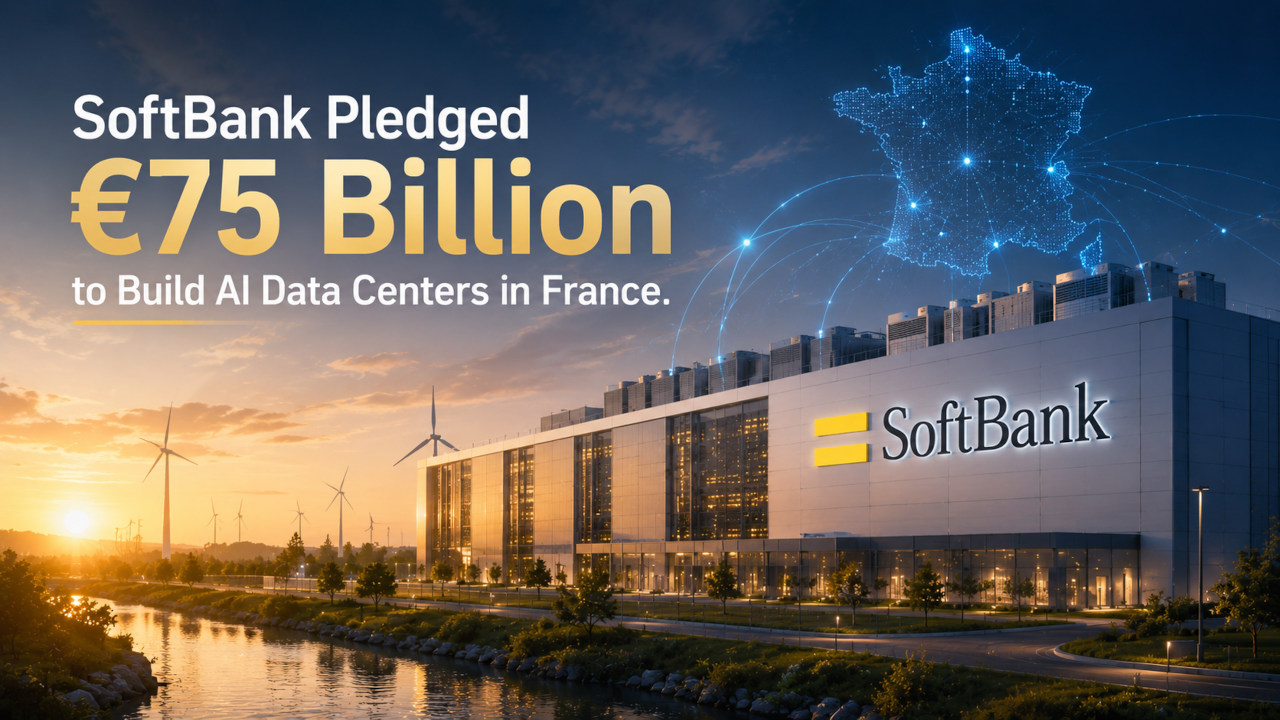
Summary: At the Choose France summit on May 30-31, 2026, SoftBank Group announced a commitment of up to €75 billion to build AI data center infrastructure across three sites in northern France, targeting 3.1 gigawatts of capacity by 2031 in Phase 1 and a total of 5 GW if a conditional Phase 2 proceeds. The summit as a whole generated €93 billion in investment pledges across 71 projects, four times the previous year’s total and more than all prior Choose France editions combined. The nuclear-heavy French grid and a new regulatory fast-track regime for large data center connections are real structural advantages. SoftBank’s ability to fund what would be the largest AI infrastructure commitment in European history is a legitimate question: the company recently scaled back a financing arrangement backed by its OpenAI stake, S&P revised its outlook on SoftBank to negative in March 2026, and the €75 billion ceiling carries an explicit “up to” qualifier. The Phase 1 commitment of €45 billion is described in firm language. The remaining €30 billion is conditional on Phase 1 execution.
The Japanese Conglomerate Betting Bigger Than Any American Hyperscaler in Europe
SoftBank Group is a Japanese technology conglomerate founded in 1981 by Masayoshi Son, who built it from a software distribution company into one of the world’s most influential technology investors. Son is known in the industry for two things: an unusually long investment horizon and a willingness to make bets at a scale that most investors consider too large to be credible. He told investors in 2000 that his planning horizon was 300 years. He has spoken publicly about his belief that artificial general intelligence will arrive within a decade and that whoever controls the compute infrastructure for AGI will control the most consequential technology in human history.
SoftBank’s most significant current asset is a controlling stake in Arm Holdings, the British semiconductor company whose chip architecture powers virtually every smartphone on the planet and an increasing share of AI accelerator designs. Arm went public on Nasdaq in September 2023 in the largest tech IPO of that year. SoftBank also became a major shareholder in OpenAI as part of the US Stargate consortium announced in January 2026, alongside Microsoft and Oracle, committing $16 billion to US AI data center infrastructure. The French announcement is a parallel and simultaneous European commitment, not a replacement for the US strategy.
The Vision Fund, SoftBank’s investment vehicle launched in 2017 with $100 billion from Saudi Arabia’s Public Investment Fund, Abu Dhabi’s Mubadala, Apple, and others, was the largest technology investment fund in history at the time of its launch. It deployed capital across Uber, WeWork, ByteDance, and hundreds of other companies across Asia, the US, and Europe. WeWork’s collapse cost the Vision Fund tens of billions and damaged SoftBank’s reputation for investment discipline. The Fund’s Asian portfolio, heavy in Indian, Southeast Asian, and South Korean technology companies, has since recovered significantly in valuation.
The French commitment is significant precisely because it comes from Asian capital, not a US hyperscaler. Amazon, Microsoft, and Google have been the dominant investors in European cloud and AI infrastructure for the past decade. A Japanese company with an Asian investor base, controlling a British chip architecture standard, committing to build the largest AI data center campus in French history is a different kind of geopolitical signal than another AWS region opening. It reflects both Son’s personal conviction about AI’s near-term trajectory and a broader pattern of Asian technology capital seeking to establish positions in European digital infrastructure before US hyperscalers consolidate control of it.
What SoftBank Is Actually Building and Where
All three Phase 1 sites are in the Hauts-de-France region, in the north of the country, chosen in part for proximity to the Channel undersea cable landing points and for available industrial land with existing grid infrastructure. Each site involves a distinct local partner.
At Dunkirk, specifically the Loon-Plage zone within the Port of Dunkirk’s Western Harbour, SoftBank is partnering with Schneider Electric. The arrangement combines a Schneider Electric power module integration facility with a SoftBank enclosure manufacturing operation at the same site, vertically integrating part of the data center supply chain within France. The port location provides logistical access for large component shipments.
At Bosquel, in the Somme department, SoftBank is working with Sesterce, a French startup that describes itself as “The European AI Factory company.” The Bosquel campus is planned at 1 GW and is described as an integrated AI compute facility combining energy procurement, compute hardware, and operational execution. Sesterce represents the French government’s interest in ensuring that some of the infrastructure spending creates a domestic industry capability rather than landing entirely with foreign contractors.
At Bouchain, in the Nord department, SoftBank is working with EDF. The site is a former coal-fired thermal power plant that went offline in 2015. EDF has confirmed SoftBank as the preferred bidder for a 400 MW data center on that site under a construction lease arrangement. Converting former fossil fuel generation sites into data center campuses is a pattern emerging across Europe; the existing grid interconnections and industrial infrastructure at power station sites reduce both cost and permitting complexity compared to greenfield builds.
The Phase 2 details are sparse. SoftBank’s press release uses softer language for the additional sites: “also plans to develop additional sites,” without naming them or providing binding timelines. The €30 billion figure for Phase 2 is characterized by analysts as aspirational rather than contractually committed, contingent on Phase 1 proceeding on schedule and on SoftBank’s financial position remaining sufficient to fund expansion.
France Won the Competition. The Summit Numbers Explain Why.
The Choose France summit is an annual investment forum organized by the French government and hosted at the Palace of Versailles, designed to attract foreign direct investment with direct access to President Macron and senior government officials. The 2026 edition produced results that exceeded all prior editions: €93 billion in confirmed investment commitments across 71 projects, surpassing the 2025 edition’s €20 billion total and exceeding the cumulative total of all previous Choose France summits combined. Macron quoted the figure directly in his closing remarks and linked it to more than 15,000 jobs.
SoftBank’s commitment accounts for between half and four-fifths of the 2026 total depending on whether the Phase 1 or full ceiling figure is used, making it by far the headline announcement. The summit format, with bilateral meetings between company executives and French government officials culminating in a plenary announcement, is designed to generate exactly this kind of large-figure headline commitment. The French approach differs from the UK or German model: rather than offering broad subsidy regimes, France offers direct executive engagement, streamlined permitting, and nuclear energy access.
The structural case for France as a European AI infrastructure destination is grounded in its electricity mix. France’s nuclear fleet generated 373 TWh in 2025, representing 68.1% of total electricity production, with reactor fleet availability improving to 74.0% from 71.5% the prior year. Data centers running AI training workloads have power utilization profiles that closely match what a nuclear-heavy baseload grid provides: large, predictable, continuous loads that nuclear plants serve efficiently. Germany’s grid, which has been transitioning away from nuclear, carries higher carbon intensity and more variable wholesale pricing. The UK grid has improved but remains more expensive for large continuous loads.
France also introduced a fast-track grid connection regime in August 2025 (CRE Deliberation No. 2025-120) that allows data center grid connections at the 400 kV level to be completed within three to four years, provided the operator secures a building permit within 16 months of signing the grid engagement agreement. For a Phase 1 targeting 3.1 GW by 2031, a five-year window from the May 2026 announcement, the fast-track regime is the relevant pathway. Grid reservation agreements for the three sites had not been publicly confirmed at time of publication.
The Credibility Question SoftBank Cannot Fully Answer
The “up to” qualifier in the announcement headline is not boilerplate. It reflects a genuine financial picture that multiple analysts and major outlets characterized as stretched.
In May 2026, Bloomberg reported that SoftBank scaled back a financing arrangement backed by its OpenAI stake from an initial $10 billion target to $6 billion, citing lender hesitation over valuing an unlisted company as collateral. S&P Global revised its outlook on SoftBank Group from stable to negative in March 2026, citing liquidity risk and the pace of investment commitments relative to available cash. The French commitment follows several other simultaneous large commitments: SoftBank has committed $16 billion to the Stargate AI infrastructure joint venture in the United States and was involved in a separate $9 billion deal involving ABB Robotics and DigitalBridge. TD Cowen analysts flagged that SoftBank may be running against its own internal debt ceiling across these parallel obligations.
Fortune, in its coverage of the Choose France announcement, explicitly described the €75 billion as “aspirational rather than firm.” The same language does not apply uniformly to the full commitment: the Phase 1 €45 billion for 3.1 GW is stated in firm delivery language in SoftBank’s official press release. The conditional Phase 2 is the portion that carries the most uncertainty.
Masayoshi Son’s track record on large investment pledges adds context without resolving it. His 2016 commitment of $50 billion in US investment following a meeting with Donald Trump was followed by the Vision Fund’s investments, which deployed capital at scale but with mixed results including the WeWork collapse. His 2023 pledge of major UK AI investment was criticized for not materializing at the announced scale. The France commitment is structured differently, with specific named sites, named local partners, and a regulatory framework that creates visible milestones. EDF’s confirmed preferred-bidder selection for Bouchain suggests at least one component of Phase 1 has moved beyond a headline pledge into a contractual relationship.
France in the European Compute Race
The Choose France result lands in a European context where multiple governments are competing for the same hyperscaler and infrastructure investment. The European Commission’s InvestAI initiative is targeting AI gigafactory development across member states. The UK has announced its own AI infrastructure commitments. Germany, despite its grid transition challenges, has been negotiating with hyperscalers over data sovereignty requirements.
France’s advantage is the combination of nuclear baseload, regulatory speed, and the Choose France format’s ability to generate committed, named projects rather than aspirational national strategies. The €93 billion total from the 2026 summit will feature in French government communications as evidence that Europe’s AI infrastructure build is concentrating in France specifically. Whether it concentrates in France or distributes across the continent matters for every hosting and cloud provider evaluating where to locate European infrastructure over the next five years.
For operators of European data centers and colocation facilities, the SoftBank announcement signals where significant hyperscale demand will be sited in northern France. The Hauts-de-France region, previously not a primary data center hub, will require a corresponding build-out in fiber connectivity, colocation services for ancillary workloads, and technical staffing. The industrial footprint of a 3 GW campus is substantial enough to reshape the regional market even if Phase 2 never materializes.

Sources
- SoftBank Group to invest up to €75 billion in French AI data centers - SoftBank Group official press release
- SoftBank says it will invest up to €75 billion to build French data centers - TechCrunch
- SoftBank's €75 billion investment in French AI data centers - Fortune
- SoftBank to spend up to $75 billion on French AI data centers - Tom's Hardware
- SoftBank in France: €45 billion for an initial AI phase, €75 billion subject to extension - ActuIA
- SoftBank plans €75 billion AI data center buildout in France - The Decoder
- SoftBank AI campus drives record €93 billion investment haul at Choose France summit - Capacity Global
- Annual Electricity Review 2025: generation - RTE France
- Building data centers in France: navigating regulatory hurdles - Bracewell LLP