
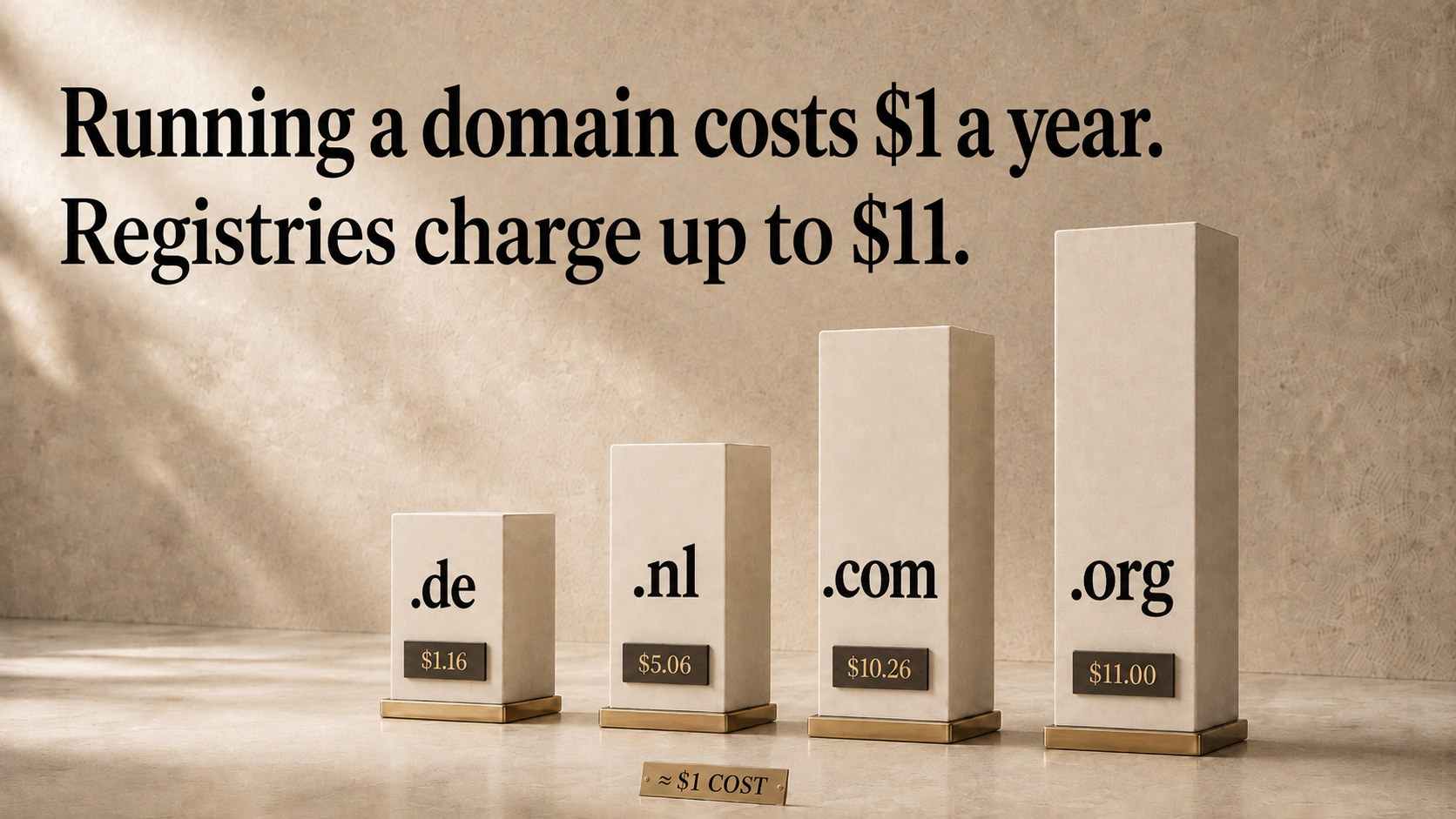
Montenegro’s case for taking .me back under state control leaned on an argument about money: the domain earned €114 million between 2008 and 2025, the state kept about a third, and it now wants at least half. Underneath sits a question the industry rarely answers with numbers: what does running a top-level domain actually cost, and how much of the wholesale fee is cost rather than allocation?
The answer is not a secret. Verisign files with the SEC, Public Interest Registry files a Form 990, and Nominet, DENIC, SIDN, AFNIC, CIRA and auDA all publish annual reports. We put those filings in one table, and three independent data points converge on the same figure: operating a domain at scale costs about a dollar a year. The wholesale prices charged for that dollar of service run from €1 in Frankfurt to $11.00 for .org, and the difference is not technology. It is governance.
Key facts (latest published accounts)
- Three independent cost yardsticks land near $1 per domain-year: DENIC’s .de member revenue (€1.01 per domain), PIR’s backend contract (about $0.88), Verisign’s cost of revenues (about $1.13)
- The prices for it diverge by roughly 10x, and the two gTLDs sit at the top: .org jumped from $9.93 to $11.00 on June 1, 2026, its first increase since 2016, and .com rises from $10.26 to $10.97 on November 1
- The nonprofit whose largest expense line is grants to its founder: PIR’s 990 shows $106.4 million of revenue and $61.3 million of grants out, including $29 million each to the Internet Society and its foundation, and net assets of minus $36 million, a position PIR itself describes as the ongoing result of contributing its cash surplus to ISOC
- ICANN’s cut: $0.2575 per .com domain-year at registry level (Verisign paid $47.8 million in 2025) plus $0.20 per transaction-year at registrar level from FY2026
| TLD | Registry and model | Wholesale price | In USD | Latest reported result |
|---|---|---|---|---|
| .de | DENIC, cooperative | ~€1 implied member fee | 1.16 | €31,000 surplus |
| .nl | SIDN, foundation | €4.38 | 5.06 | 8.3% operating result |
| .uk | Nominet, member company | £3.90, unchanged since January 2020 | 5.26 | £5.5M operating deficit after £11M public benefit |
| .fr | AFNIC, association | €5.07 | 5.86 | 2.4% net result |
| .au | auDA, nonprofit | AUD 8.64 ex GST | 6.09 | 3.6% operating surplus |
| .ca | CIRA, nonprofit | CAD 10.50 | 7.47 | CAD 1.9M deficiency |
| .com | Verisign, public company | $10.26, rising to $10.97 on November 1 | 10.26 | 67.7% operating margin |
| .org | PIR, nonprofit | $11.00 since June 1 | 11.00 | $61.3M in grants to ISOC entities |
The figures are not perfectly like-for-like: DENIC reports member revenue, PIR discloses a backend contract, and Verisign reports cost of revenues. Together they indicate the order of magnitude of registry operating costs, not a uniform accounting definition.
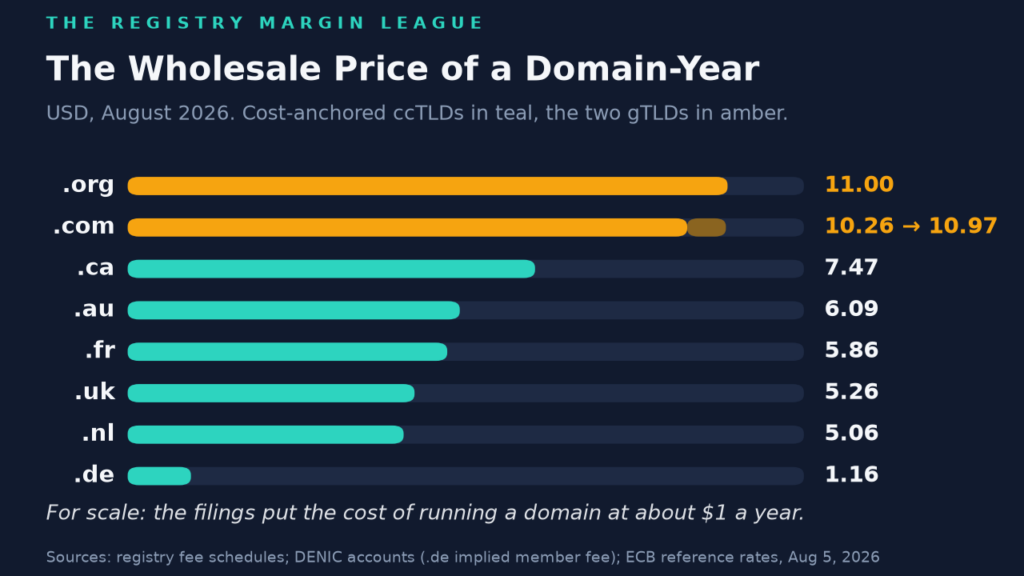
The wholesale price of a domain-year in USD, August 2026. Cost-anchored ccTLDs in teal; the two gTLDs in amber. Sources: registry fee schedules; ECB reference rates.
The Dollar of Cost, Triangulated
Three operators, three continents, three corporate forms, and the cost side of their accounts lands in the same place:
- DENIC (.de): the Frankfurt cooperative reported 2025 member revenue of €17.79 million against roughly 17.7 million domains. That is €1.01 of revenue per domain, with a year-end surplus of €31,000, because a cooperative prices to cost.
- PIR (.org): the Form 990 for 2024 discloses what PIR pays Identity Digital to operate .org’s registry infrastructure as a backend: $10.5 million. The domain passed 12 million registrations this June by PIR’s own announcement, so at today’s base that is about 88 cents per domain-year, at commercial rates, from a for-profit vendor.
- Verisign (.com): cost of revenues was 11.8 percent of $1,656.6 million in 2025, which against the company’s 173.5 million .com and .net names works out to about $1.13 per domain-year.
The public filings put the basic operation of a registry at scale on the order of a dollar per domain-year. Everything above that dollar buys something else: resilience, security and abuse-handling, development, administration, reserves, public programs, or, in the gTLD cases, margin and grants. The table shows what each regime buys.
Four Governance Models, Four Prices
The cost-anchored registries fall into two families. The cooperative prices at cost: DENIC’s €1, full stop. The foundations, associations and member companies, AFNIC among them, price at cost plus mission, and the mission is visible in the accounts:
- SIDN (.nl): books an 8.3 percent operating result that funds security research and its SIDN Fund. Its own annual report benchmarks the €4.38 price against an average of €4.40 for large European ccTLDs and €8.78 for the large gTLDs, a two-to-one gap the registry publishes without editorializing.
- Nominet (.uk): ran a £5.5 million operating deficit last year after £11 million of public-benefit spending, on a fee it has not touched in six and a half years.
- auDA (.au): pays its commercial backend, Identity Digital Australia, AUD 9.4 million a year, about AUD 2.20 per name, and runs a 3.6 percent operating surplus.
- CIRA (.ca): charges the priciest ccTLD fee in our table and still posted a CAD 1.9 million deficiency of revenue over expenses; its mandate runs well beyond the registry, including the Net Good program that has funded 245 projects with $14.2 million since 2014.
Whatever one thinks of each mission, these are recognizably cost-anchored prices: the money stays near the infrastructure or goes to declared public purposes, and price changes, when they come, are small and publicly justified. SIDN framed this January’s 2.9 percent increase as covering inflation-driven cost increases; Nominet has not moved its fee at all since 2020.
Then there are the two gTLDs, where price has come loose from cost in two different ways. Verisign’s is at least legible: $10.26 rising 7 percent to $10.97 on November 1. Its own 10-K spells out the mechanics: the .com Registry Agreement permits increases of up to 7 percent over the previous year in each of the final four years of each six-year period, and Domain Name Wire calculates the steps reach $13.42 by the end of the current cycle in 2030. A 67.7 percent operating margin, a for-profit monopoly using the full pricing flexibility its contract allows.
PIR is the more interesting case precisely because it is a nonprofit. Its 990 shows $106.4 million of revenue against $106.5 million of expenses; the expense lines tell the story: $61.3 million, well over half of all spending, is grants out, $29 million each to the Internet Society, the organization that created PIR, and the Internet Society Foundation. The filing is unusually candid about the design: PIR reports net assets of minus $36.1 million and states that it regularly contributes its cash surplus to the Internet Society, yielding an ongoing negative net asset position.
On June 1, PIR raised .org’s wholesale price 10.8 percent, from $9.93 to $11.00, its first increase since 2016 and the highest fee among the major TLDs in our table. Nothing in the contract required that restraint, and nothing caps the next move: as Domain Name Wire recalled when the increase was announced, the 2019 registry agreement with ICANN removed .org’s price caps entirely, where the old contract had allowed 10 percent a year. The mechanics are legal and disclosed, and ISOC does fund internet development. But in practice, roughly $5 of every .org domain-year funds the Internet Society side rather than the registry itself, registrants have no say in that allocation, and the 2026 increase is best read alongside that grant line, not alongside any cost curve.
What the Table Changes Downstream
For hosting and registrar executives, the table converts three vague intuitions into numbers.
- TLD mix is now a costed decision. A host bundling free first-year domains pays roughly nine times as much wholesale for .com or .org as a German host pays for .de, and the gap widens in November. Steering bundles toward cost-anchored ccTLDs is worth real margin in the price-sensitive segments where bundles matter, with the Montenegro case as the standing reminder that ccTLDs can carry political risk as the counterweight to price.
- The table is the missing baseline for renewal-price conversations. A registrar marking .com renewals to $20 and above is stacking its spread on a wholesale price that is itself roughly ten times cost. A C-level reader can now trace an SMB’s $25 renewal invoice down to the roughly one dollar of infrastructure it ultimately buys.
- The data weakens one of the main arguments against competitive rebidding. The recurring proposal to rebid gTLD registry contracts competitively usually founders on the claim that operating a registry is too complex to price. Eight annual reports say otherwise. The service has a market price: PIR’s backend contract states it, and auDA pays it to the same vendor group. And the distance between that price and the wholesale fees is visible in the accounts: Verisign booked $1,121.0 million of operating income in 2025, before this November’s increase takes effect.
Where the money goes is now documented. Whether it should keep going there is a question this table equips readers to ask. We will refresh the league annually, after each reporting season.
About the Data
All figures come from primary filings: Verisign’s FY2025 Form 10-K, PIR’s FY2024 Form 990, and the latest annual reports and fee schedules of the six ccTLD registries. Fiscal years differ per registry and are visible in the sources. Per-domain figures are our arithmetic; the .org base is PIR’s June 2026 milestone set against the FY2024 backend fee. Currency conversions use ECB reference rates of August 5, 2026. The .org and .com price increases and the $13.42 path are reported by Domain Name Wire.

Sources
- Public Interest Registry FY2024 Form 990 - ProPublica Nonprofit Explorer
- 12 Million .ORG Domains: A Milestone Powered by Purpose - Public Interest Registry
- Verisign FY2025 Form 10-K - SEC EDGAR
- .org prices to increase on June 1 - Domain Name Wire
- Breaking: VeriSign raising wholesale .com prices - Domain Name Wire
- Nominet UK Summary Financial Results FY2025 - Nominet
- Fee schedule - Nominet Registrar Resources
- Activity report 2025 (financial tables) - DENIC eG
- Annual domain statistics 2025 - DENIC eG
- SIDN Annual Report 2025 - SIDN
- Annual report 2024 - AFNIC
- Audited financial statements FY2025 - CIRA
- How much does a .CA domain cost? (wholesale price) - CIRA
- Annual report 2024-25 - auDA
- .au wholesale pricing - auDA
- Registrar fees for FY2026 - ICANN