
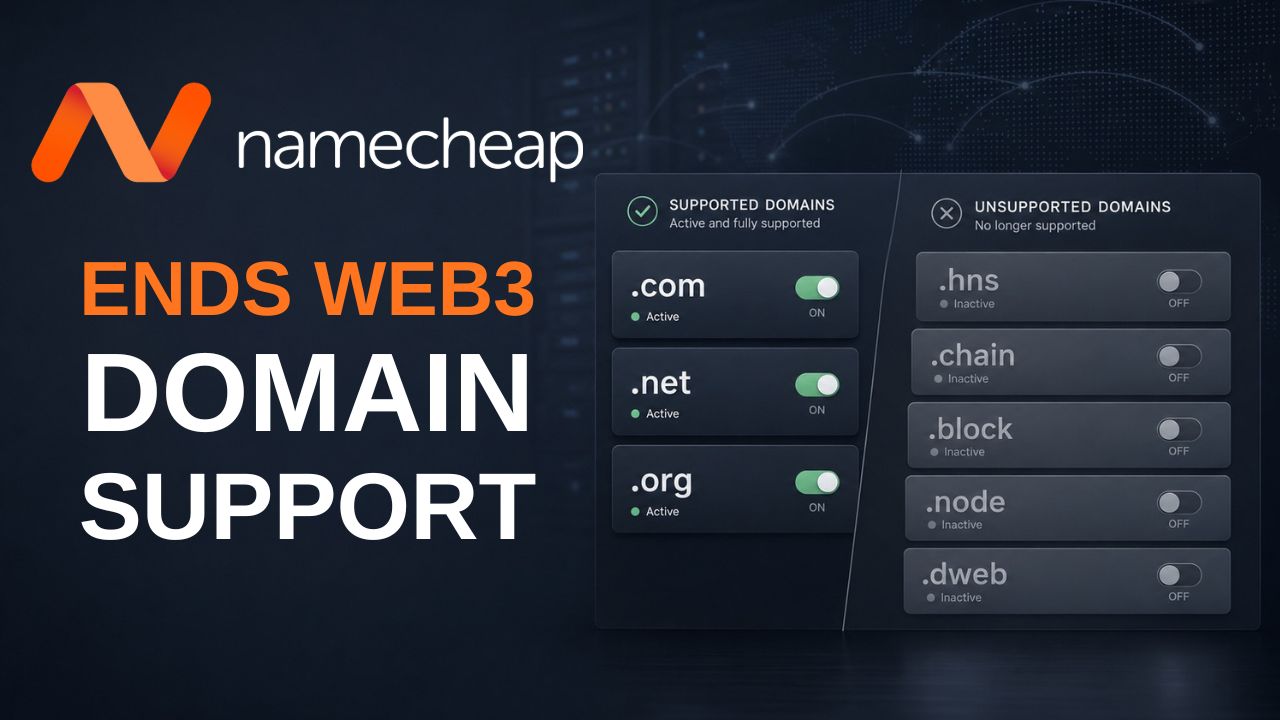
On June 10, 2026, Namecheap published a status update with immediate effect: all Handshake TLDs on its platform are no longer available for new registrations, renewals, transfers, or management. The stated reason is the wind-down of an upstream provider Namecheap did not name. The move follows the sale of Namebase, Namecheap’s Handshake marketplace, in January 2026, and closes what was once positioned as an alternative to ICANN’s authority over the domain name system. The Handshake network has over 12.7 million registered top-level domains on-chain; Namecheap was one of its largest retail registration channels. The Handshake token, HNS, trades at approximately $0.005, down from a peak of $0.85 in May 2021.
What Namecheap’s Announcement Covers and What It Does Not
The June 10 announcement halts four categories of activity on the platform: new registrations, renewals, transfers, and management of Handshake TLDs. Existing domains under the current setup will continue to operate, Namecheap states, with no timeline given for how long that remains the case.
Eleven TLDs are explicitly excluded from the halt and will continue operating as usual. Namecheap offers no explanation for why these extensions are unaffected while others are not.
sox, saas, pgp, p, orb, oot, oo, oh, ill, elite, creator
No migration path is offered to affected customers. The announcement asks for patience and understanding but provides no guidance on where to move existing Handshake domain registrations or how to do so. Users wishing to retain decentralized control over their Handshake TLDs are directed, by the community rather than by Namecheap, toward self-custody tools such as Bob Wallet.
Five Months from Marketplace Sale to Platform Shutdown
The June 10 announcement did not arrive without warning. In January 2026, Namecheap sold Namebase, the marketplace it operated for buying and selling Handshake names, to undisclosed buyers. At the time, the sale was reported as a de-emphasis of Handshake rather than a full exit; Namecheap continued selling Handshake domains, though with less prominence than before.
Namebase went offline for a migration starting February 1, 2026. After reopening under new ownership, the exchange was closed and open orders cancelled; the marketplace resumed but with limited scope. Namecheap’s June announcement describes the problem as the wind-down of the corresponding upstream provider without naming it. The timeline (marketplace divested in January, services halted in June) compresses five months between first signal and full withdrawal.
The Browser Problem That Never Resolved
The structural obstacle for all web3 domain projects was the same: mainstream browsers never added native support for blockchain domain resolution. Typing a Handshake domain into Chrome, Safari, Firefox, or Edge requires a browser extension or a custom DNS resolver configuration. For most users, this was not a step they would take.
A domain system that cannot be used directly in a browser without additional software is a domain system for developers and enthusiasts, not for businesses buying web presence. The practical consequence was a ceiling on adoption that speculative token prices and venture funding could not raise. Two failure points compounded each other:
- Browser: no native resolution in Chrome, Safari, Firefox, or Edge without an extension or custom DNS resolver
- Email: standard mail clients do not route through blockchain resolvers, so a business using a Handshake TLD for email encountered compatibility failures with every mainstream mail provider
Three Web3 Domain Projects, Three Retreats
Handshake is not alone in this trajectory. The three projects that defined the web3 domain space are each moving away from their original positions.
Handshake built a proof-of-work blockchain intended to replace the DNS root zone with a decentralized alternative. It required resolver software and browser extensions that mainstream users never adopted in meaningful numbers. The project has been in decline since 2022. Protocol governance remains technically active, but user adoption has not materialized.
Unstoppable Domains raised approximately $70 million in venture funding and sold over four million blockchain domain registrations. In March 2026, CEO Matthew Gould publicly acknowledged the shift: blockchain names were “part of the crypto craze in 2021” that “did not cross the chasm into mainstream usage.” DNS domains now represent more than 90% of Unstoppable’s business. The company became ICANN-accredited as a registrar in August 2024 and expects its focus on traditional DNS to continue growing.
ENS (Ethereum Name Service) took a different path: rather than maintain a position entirely outside ICANN’s framework, ENS applied for .ens as a traditional gTLD through ICANN’s 2026 new gTLD application round. The move acknowledges that browser compatibility requires ICANN recognition.
HNS at $0.005: What the Token Price Records
The Handshake system requires HNS tokens to register and maintain top-level domains. At peak, HNS traded at approximately $0.85 per token in May 2021, when the project attracted speculative interest alongside the broader blockchain infrastructure cycle. As of June 2026, the token trades at approximately $0.005, a decline of more than 99%. Market capitalization stood at roughly $3.38 million as of early June 2026.
The collapse reflects actual adoption levels. The system depended on resolver infrastructure, wallet software, and registrar participation to function. Each of those dependencies has contracted since 2022, and Namecheap’s exit removes one of the largest retail on-ramps to the system.
ICANN’s 2026 gTLD Round and the Naming Collision Problem
ICANN’s ongoing 2026 new gTLD application round is accepting applications for extensions that directly overlap with blockchain domain namespaces. The .wallet case is the clearest example: Unstoppable Domains sold .wallet registrations on its blockchain; if ICANN assigns .wallet to a conventional registry operator, the ICANN-governed version will resolve in all browsers and the blockchain version will not.
For Handshake TLD owners, the 2026 ICANN round creates a related pressure. Part of Handshake’s value proposition was the ability to register extensions that ICANN did not offer. As ICANN expands the available namespace, the scarcity argument for Handshake TLDs weakens.
What It Means for Domain Holders Now
Namecheap’s platform exit is an administrative consequence of an adoption failure, not its cause. The adoption failure has been accumulating since 2022. For domain holders, three things are now relevant:
- Existing domains continue to resolve under the current setup, but Namecheap provides no end date for how long that remains true. The timeline is set by the unnamed upstream provider’s wind-down, not by Namecheap.
- No renewal is possible. Domains that expire will not be renewable through Namecheap. Holders with upcoming expiry dates need to act before that date passes.
- Self-custody is the only path to independence from Namecheap’s infrastructure. Migrating to a tool such as Bob Wallet moves control of the Handshake name directly on-chain, removing the dependency on any registrar. That migration requires action before Namecheap’s existing setup changes.

Sources
- Namecheap Handshake TLDs Update - Namecheap Status
- Namecheap sells Handshake marketplace Namebase - Domain Name Wire
- Handshake Price Today, HNS to USD - Gate.com
- Unstoppable focuses on proper domains, admits crypto was "craze" - Domain Incite
- Handshake FAQ - Handshake.org
- Ethereum Name Service to apply for .ENS in ICANN top level domain expansion - Domain Name Wire
- Handshake blockchain explorer, live registration data - ShakeShift