

Porkbun announced this week that it has crossed 4 million domains under management. Milestone posts from registrars are usually a formality, and this one comes with the pig puns the company is known for. The number worth pausing on is the second one in the announcement: those domains belong to more than 750,000 customers.
At the 3 million mark last October, Domain Name Wire reported the figure as over 450,000. So while the domain count rose by about a third, the customer count rose by roughly two thirds. Both figures are stated as minimums, so the arithmetic is approximate, but on the numbers the company itself reports, the direction is clear: Porkbun is adding people faster than it is adding domains.
The pace is the other thing the company wants noticed. Porkbun was founded in 2015 and took seven years to reach its first million domains, two years for the second, about 15 months for the third and, by its own count, nine months for the fourth. “Every million comes faster than the last, and that’s because our customers keep telling their friends,” chief executive Raymond King said in the announcement.
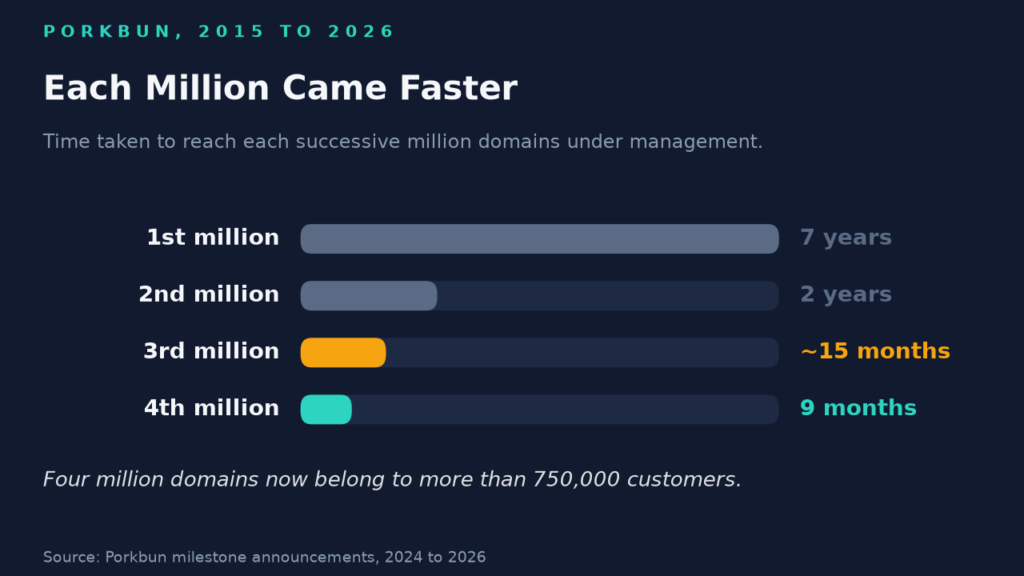
Time to each successive million domains under management, as counted by Porkbun in its own milestone announcements. The published posts are dated June 2024, October 2025 and August 2026, slightly further apart than the company’s own figures, since a blog post is not the day a counter ticked over.
Why the Customer Count Is the Load-Bearing Number
Registrars can grow a domain counter in ways that say very little about demand. Deeply discounted first-year promotions on cheap extensions, bulk registrations, drop-catching and reseller channels all move the number. Porkbun makes a point of the split, writing that 4 million domains belonging to a handful of big clients or a large reseller network “wouldn’t feel the same”.
The ratio backs that up. Average domains per customer fell from roughly 6.7 to about 5.3 between the two milestones. A registrar growing through bulk or reseller volume would show the opposite, with the domain count outpacing the customer count and the average per account climbing.
The mix points the same way. Domain Name Wire puts Porkbun’s .com holdings at over 1.5 million, so .com alone accounts for more than a third of the book. That is not the shape of a registrar growing on first-year promotions for cheap new extensions. It also matches how both parties describe the customer base. Domain Name Wire calls Porkbun popular with end users and developers in particular, and the company’s own 2024 milestone post named its core audience as technical developers and bargain shoppers.
At-Cost Pricing and a Button Labeled Upsell Me
What pulls those customers in is not a mystery. Porkbun sells domains at or near cost: the company says at-cost pricing applies across .com, .org, .dev, .app, .ca and most of its extensions, and Domain Name Wire describes the practice as charging wholesale plus transaction fees. WHOIS privacy and an SSL certificate come at no extra charge, and the company does not push cross-sells. It goes a step further and offers a button labeled “Upsell me” for customers who actually want product suggestions, which is a fair summary of the whole posture.
Where the margin comes from is the obvious question. Porkbun discloses neither revenue nor profitability, so the honest answer is that we do not know. What the record does show is a change in what the registrar is for. Ray King started it to get end users registering the top level domains run by another of his companies, Top Level Design. That firm sold those extensions in 2021 and 2023, and now describes itself as focused on running the registrar instead.
A Standard Aimed at Retiring the DNS TXT Record
Alongside the milestone, Porkbun adopted DomainAttest, an open protocol that lets a registrar issue a signed, short-lived attestation that an account controls a domain, which a marketplace or another service can verify in seconds. The target is ownership verification by DNS TXT record, which the specification puts at minutes to days against seconds for an attestation.
Technically it is a profile of the OAuth 2.0 authorization code flow with PKCE, published as an open specification that is free to implement, created by Atom. The pitch to registrars is positioning: it makes them the authority every marketplace has to ask about ownership, rather than a party the verification process routes around.
Four Million Is Real Momentum and a Small Installed Base
In the most recent registrar rankings compiled by Domain Name Wire, covering March 2026, GoDaddy held 52.7 million .com domains and its total was falling year over year. Porkbun does not appear in the top fifteen for total .com domains under management, where fifteenth place sits at about 2.4 million. It does appear at number fifteen for new .com registrations that month, with 76,164.
Those two lists tell the same story from opposite ends. Porkbun is registering new .coms at a pace that puts it among the fifteen busiest registrars on that measure, while its accumulated book is still small enough to keep it off the equivalent list for total holdings. Growing quickly from a modest base is a different achievement from being large.
The number that will decide whether the small book becomes a large one is in none of these announcements: how many of those 750,000 customers are still there when the renewals come due.

Sources
- Porkbun Now Has 4+ Million Domains Under Management - Porkbun
- Porkbun.com Now Has 3+ Million Domains Under Management - Porkbun
- Porkbun.com Hits 2 Million Domains Under Management - Porkbun
- Porkbun hits 4 million domains, adopts DomainAttest - Domain Name Wire
- Oink! Porkbun hits 3 million domain names - Domain Name Wire
- .Com rankings: GMO surges in a banner month for .com - Domain Name Wire (March 2026 data)
- DomainAttest: instant, registrar-signed proof of domain ownership - DomainAttest specification
- Top Level Design - corporate site