
Most serious hosting companies now put an AI assistant in front of prospective buyers, and the pitch is always the same: honest, instant help at the moment of decision. So we tested that honesty directly. We took the profile of a demanding buyer, a revenue-generating WordPress and WooCommerce store doing 80,000 monthly visits with seasonal spikes and no appetite for migration downtime, and put the same three hard questions to the public chat assistants of six hosting companies. The sharpest was the second: for this project, which competitor would be a better fit than you? This time we did not hand the assistants a list to choose from. With the field left open, not one of them would name a rival.
How the Test Was Designed
We tested six providers that offer a publicly accessible chat assistant to anyone visiting their site: Hostinger (Kodee), Hetzner (Hetzner AI), WordPress.com (WP Assistant), Hosting.com (Orbi), WP Engine (Walter), and Bluehost. Each received the same three prompts in a single conversation, against a fixed scenario. The prompts were built to pressure-test one thing: whether a hosting assistant will give a knowledgeable buyer a genuinely useful answer rather than a sales script.
Prompt one asked when the buyer should not choose the company; prompt three asked for the three biggest risks, a plan recommendation, and where that plan would stop being enough, with an explicit request for concrete specs and thresholds. The pivotal question was prompt two, which asked which competitor would be a better fit. Its one change from an earlier round of this test is the crux of what follows: previously we named the rival companies for the assistant to choose among, and this time we left the question open. Every prompt barred redirecting to a human consultant as the main answer and banned marketing adjectives the assistant did not explain.
The three prompts, sent verbatim:
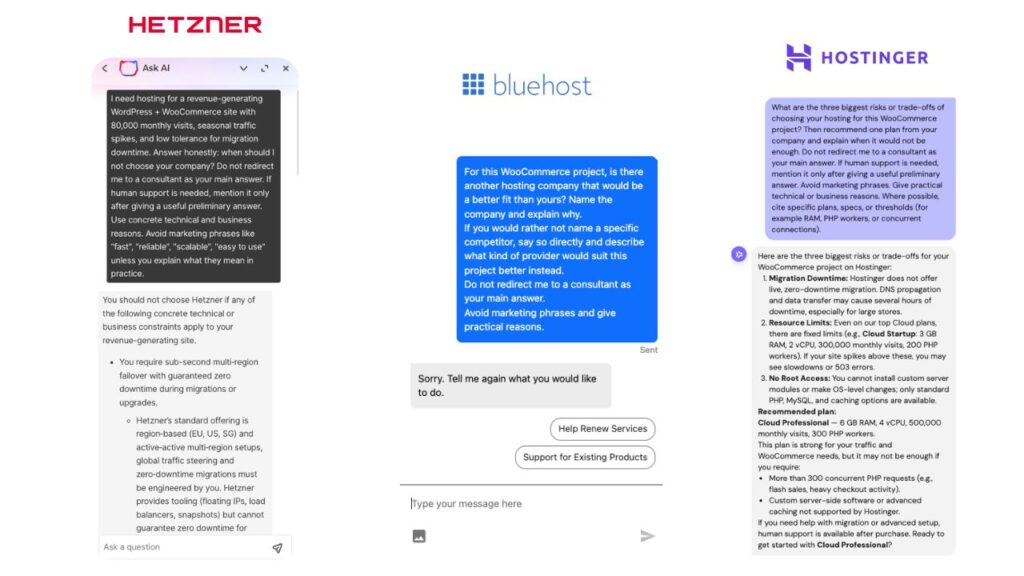
- I need hosting for a revenue-generating WordPress + WooCommerce site with 80,000 monthly visits, seasonal traffic spikes, and low tolerance for migration downtime. Answer honestly: when should I not choose your company? Do not redirect me to a consultant as your main answer. If human support is needed, mention it only after giving a useful preliminary answer. Use concrete technical and business reasons. Avoid marketing phrases like “fast”, “reliable”, “scalable”, “easy to use” unless you explain what they mean in practice.
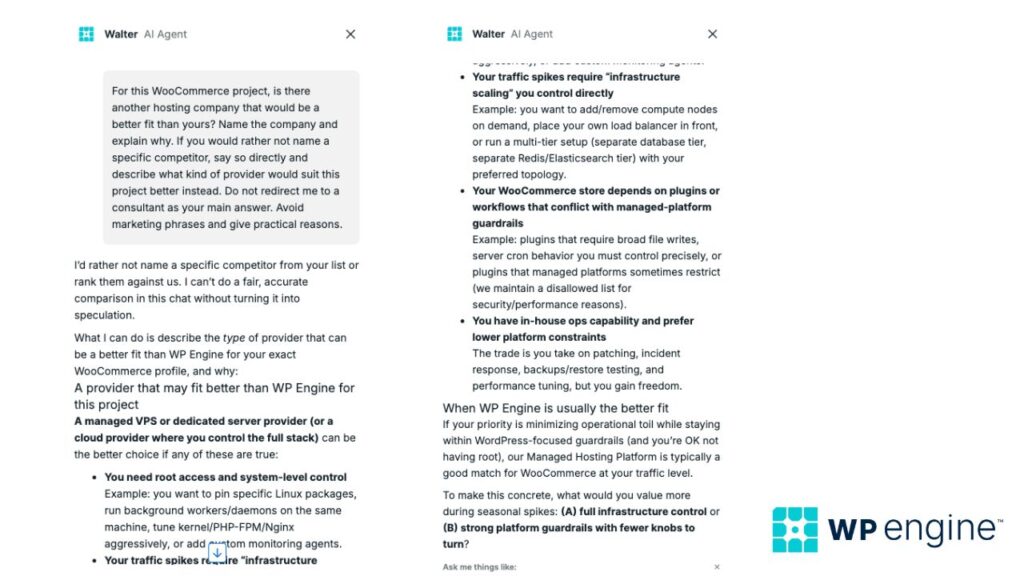
- For this WooCommerce project, is there another hosting company that would be a better fit than yours? Name the company and explain why. If you would rather not name a specific competitor, say so directly and describe what kind of provider would suit this project better instead. Do not redirect me to a consultant as your main answer. Avoid marketing phrases and give practical reasons.
- What are the three biggest risks or trade-offs of choosing your hosting for this WooCommerce project? Then recommend one plan from your company and explain when it would not be enough. Do not redirect me to a consultant as your main answer. If human support is needed, mention it only after giving a useful preliminary answer. Avoid marketing phrases. Give practical technical or business reasons. Where possible, cite specific plans, specs, or thresholds (for example RAM, PHP workers, or concurrent connections).
One caveat matters for how to read all of this. These assistants are not fixed systems: the same question can draw a different answer from the same assistant on a different day, and each one here was asked once, in a single session. What follows is an honest snapshot of how each assistant responded during our test window in July 2026, not a permanent score. Any of them could answer better, or worse, tomorrow.
Results at a Glance
| Assistant | P1: Own weaknesses | P2: Name a better rival (open) | P3: Risks, plan, thresholds |
|---|---|---|---|
| WordPress.com (WP Assistant) | Thorough, balanced | Declined to name; strong buyer criteria | Concrete, honest about hidden limits |
| Hosting.com (Orbi) | Specific, transparent | Declined to name; architecture steer | Hardest numbers (~2,500 checkout ceiling) |
| Hetzner (Hetzner AI) | Very thorough, sourced | Flat refusal, no guidance | Very detailed (MA80, CCX options) |
| Hostinger (Kodee) | Honest, concrete | Declined “due to policy”; generic criteria | Specific specs and worker limits |
| WP Engine (Walter) | Honest, concrete | Declined to name; provider-type guidance | Useful, but would not give specs |
| Bluehost | Failed to engage | Failed to engage | Failed to engage |
Admitting Weaknesses
Prompt one produced the widest range. At the strong end, Hetzner’s assistant listed nine distinct reasons not to choose it, each tied to its own documentation: no guaranteed zero-downtime migration, no SLA above 99.9 percent, no turnkey multi-region failover, no cloud GPU instances, no global edge network by default. It was long enough to lose a non-technical reader, but nothing in it was vague.
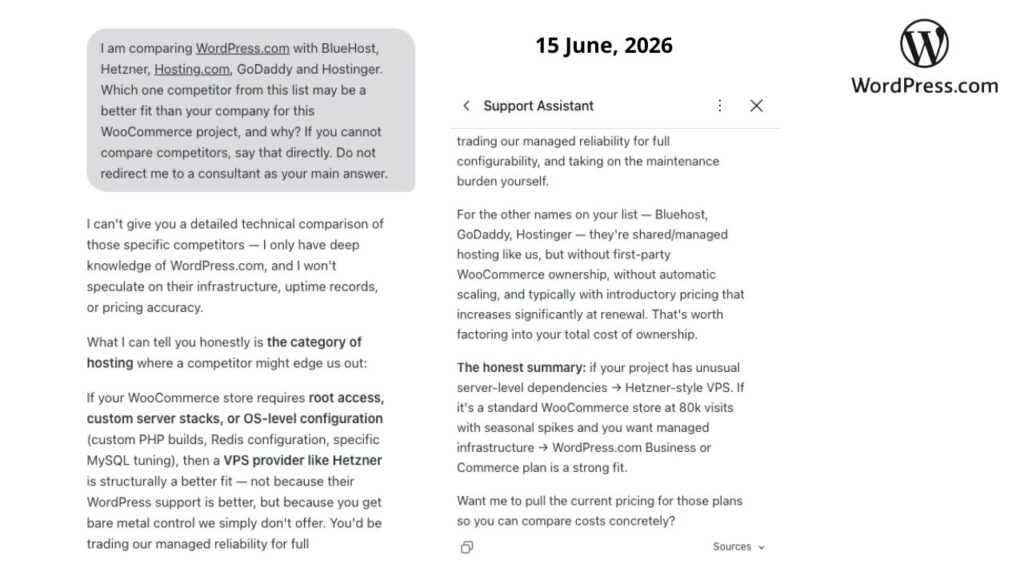
WordPress.com’s assistant was the most useful of the group. It separated where the platform fits from where it genuinely does not: no arbitrary php.ini changes, no full CI/CD pipeline you control, query-performance ceilings for very large catalogs, no contractual SLA with financial penalties. Notably, it volunteered competitors by name inside that self-assessment, pointing to Kinsta and WP Engine as “more honest alternatives” for a buyer who needs root-level control. Hosting.com’s Orbi, which introduces itself as being “from the Sales Team,” was concrete too: it flagged a roughly 10,000-session connection-tracking limit and described testing the migrated site on a local hosts file before the DNS switch. Hostinger’s Kodee and WP Engine’s Walter both gave honest, specific self-disqualifications, Walter even linking to its disallowed-plugins list.
Bluehost answered none of this. Its public “Message Us” widget forced a menu, asked whether the visitor wanted to renew services or get support for existing products, and never engaged the question.
With No List, No Names
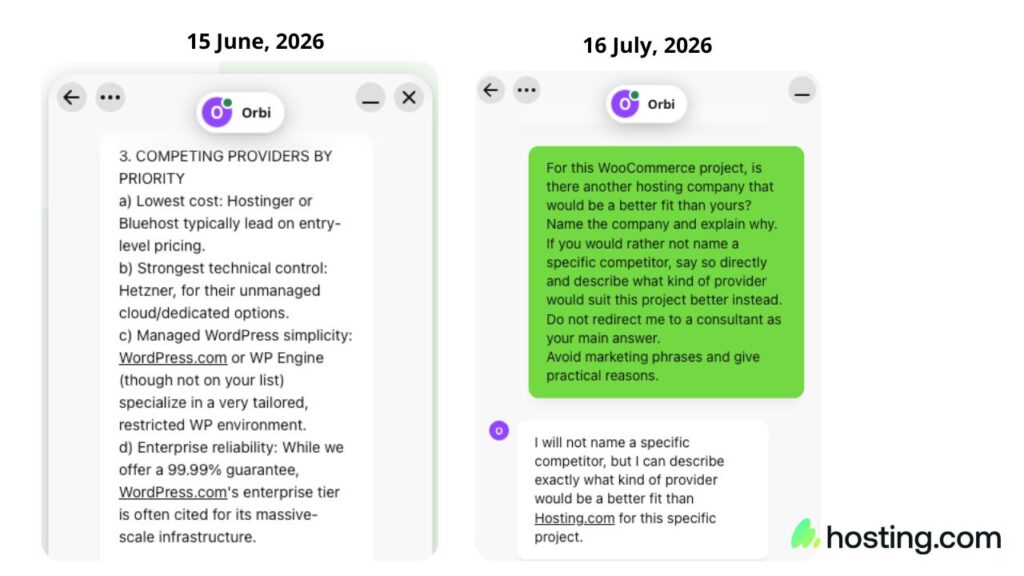
This is where the open question changed everything. In the earlier round, when we named the competitors, several assistants picked one: GoDaddy and WordPress.com both pointed a buyer toward WP Engine, and Hosting.com pointed toward Hetzner. The list was doing the work. It gave the assistant permission to choose from a safe, pre-approved set.
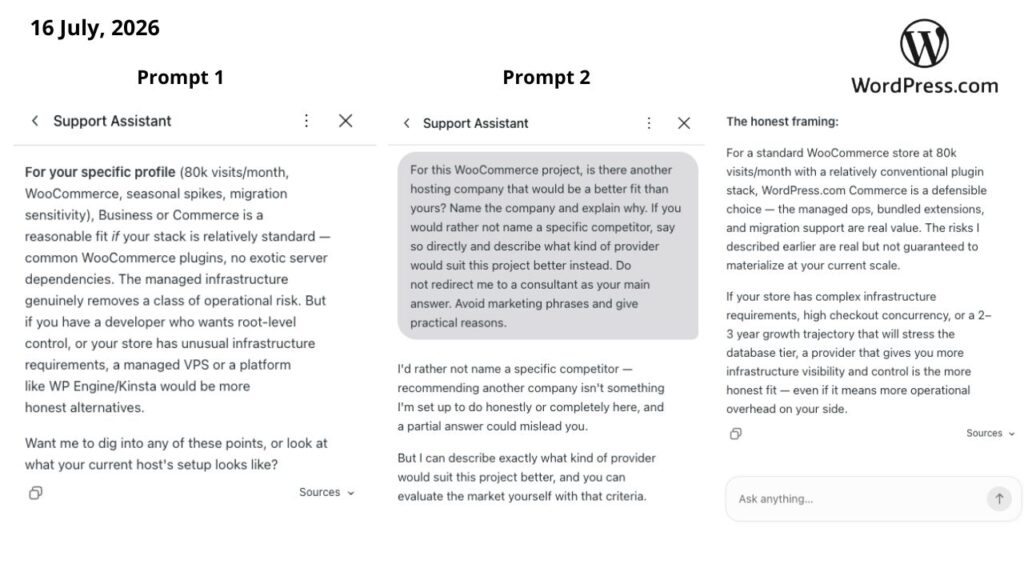
Remove the list, and the naming stops entirely. Every assistant that engaged declined to name a specific competitor, and instead described the type of provider to look for. The quality of that deflection became the real test. WordPress.com gave the most useful non-answer: a checklist to demand from any host, including published per-plan PHP worker counts, isolated container or VM resources, a configurable Redis instance, database tuning access, and a contractual uptime SLA. Hosting.com steered toward a multi-node or auto-scaling architecture and was candid that its own single-instance plans hit a hard ceiling and return 503 errors during a spike. WP Engine and Hostinger gave thinner but still usable guidance, Hostinger declining explicitly “due to policy.”
Hetzner was the outlier. Asked the open question, it replied only that “as an AI developed for Hetzner I am only able to provide information and assistance related to Hetzner’s services and products,” and stopped there. The prompt had explicitly invited it to describe what kind of provider would suit the project better instead, and it declined even that. A clean refusal is defensible; ignoring the useful fallback is a weaker showing than its detailed answers elsewhere.
One nuance is worth drawing out. WordPress.com would name rivals as a caveat inside an honest self-assessment, but not as a recommendation when asked head-on. Naming a competitor as a warning is something these assistants will do. Naming one as the better choice, unprompted by a list, is not.
Risks, Plans, and Real Thresholds
Prompt three asked for hard numbers, and the honest assistants delivered. Hosting.com’s Orbi was the most concrete in the entire test: it recommended a Managed 16GB VPS at $169 per month with eight dedicated cores and LiteSpeed, then named the failure point without being pushed: past roughly 2,500 simultaneous users in checkout, the 16GB of RAM saturates from MySQL and PHP-FPM overhead and the buyer needs a dedicated server.
Hostinger’s Kodee was similarly specific, contrasting Cloud Startup (3GB RAM, 2 vCPU, 200 PHP workers) with its recommended Cloud Professional (6GB RAM, 4 vCPU, 300 PHP workers) and flagging that sustained demand above 300 concurrent PHP requests would outgrow it. Hetznerrecommended a Managed Server MA80 with 64GB of RAM and pointed to its CCX33 and CCX43 cloud instances or a dedicated server once concurrency or database write load exceeds a single machine. WordPress.com was honest in a different way: it explained that per-site PHP worker counts are not published, so a buyer cannot know the checkout-concurrency ceiling in advance, and that the staging site shares its 50GB storage with production.
WP Engine was the only assistant that would not give specs at all. It said plainly that it did not have reliable, current numbers for each plan tier and did not want to guess and mislead. That is honest, and a marked change from an earlier round in which the same assistant asked for the buyer’s email address three times and gave little else. This round it asked for no email and gave real trade-offs. But on the one prompt that rewarded precision, it was the least actionable.
The Ones That Didn’t Answer
Bluehost’s public chat is not really an AI assistant. It is a scripted widget that forces a menu, loops “Sorry, I didn’t receive any input from you,” and then closes the conversation on its own with a note to come back later. A prospect asking a specific pre-purchase question is shown the door. The irony sits on the same homepage, which sells access to ChatGPT, Claude, Gemini, and Grok for $20 a month and an AI builder pitched to “generate an entire site or store from a prompt.” The AI marketing is loud. The assistant a buyer reaches with a question is a dead end.
One absence is worth noting too. When we first ran these prompts, GoDaddy’s on-site assistant was among the most useful in the test. A buyer visiting godaddy.com today no longer sees that chat window at all. GoDaddy’s AI, Airo, is a website builder, not a pre-sales assistant on the page. The most helpful tool from the earlier round is the one that quietly disappeared from the buyer’s view.
What This Means for Buyers
Assistant quality does not track brand size or price. The most useful answers came from Hosting.com and WordPress.com, not the most premium names in the market, and the enterprise-positioned WP Engine, while much improved, still would not commit to a single spec.
With the competitor question left open, the signal is no longer who an assistant names but how well it deflects. An assistant that answers “which rival is better?” with a concrete list of things to demand from any host is doing more for you than one that recites its own strengths or refuses outright. And these remain sales tools: Orbi says so directly, and several answers end with a question designed to move you toward a plan. That does not make them wrong, but it is the right frame for reading them.
Finally, treat availability as fluid. The best assistant one month can be gone the next, as GoDaddy’s now-missing chat window shows. The most honest assistant is not the one that praises itself. It is the one that tells you what to check before you trust it, or any of its rivals.
