
Hostinger has placed the largest server order in its history: more than 3,000 machines, enough to cover its infrastructure needs for the full year. The company announced the purchase on July 28, alongside a new data center location in Düsseldorf and capacity expansions in Paris and Asheville. Behind the record order sits an uncomfortable market: the hardware hosting is built on has become scarce and sharply more expensive. The announcement leaves the most concrete numbers out. Hostinger supplied them to our team in a written Q&A with Chief Operating Officer Aivaras Šimkus, published in full below, starting with 64GB of server memory that used to cost a few hundred euros and can now cost more than €3,000.
A Year of Hardware in One Order
Hostinger puts numbers on the squeeze from the buyer’s side: depending on configuration, the company’s overall server costs rose roughly 5-6x compared with the previous year, and some infrastructure components are now 6-8x more expensive than in early 2025. Price is only half of the problem. Some manufacturers are sold out for this year, and hardware lead times have stretched from a few weeks in 2025 to around 30 weeks today. That is what turns procurement from a routine task into planning seven months ahead.
Hostinger also published how many servers it has bought each year, and the trajectory makes the scale of the jump plain: 217 servers in 2022, 577 in 2023, 888 in 2024 and 1,353 in 2025. The 2026 batch of more than 3,000, secured from leading manufacturers, is more than double last year’s order and roughly matches the four previous years combined.
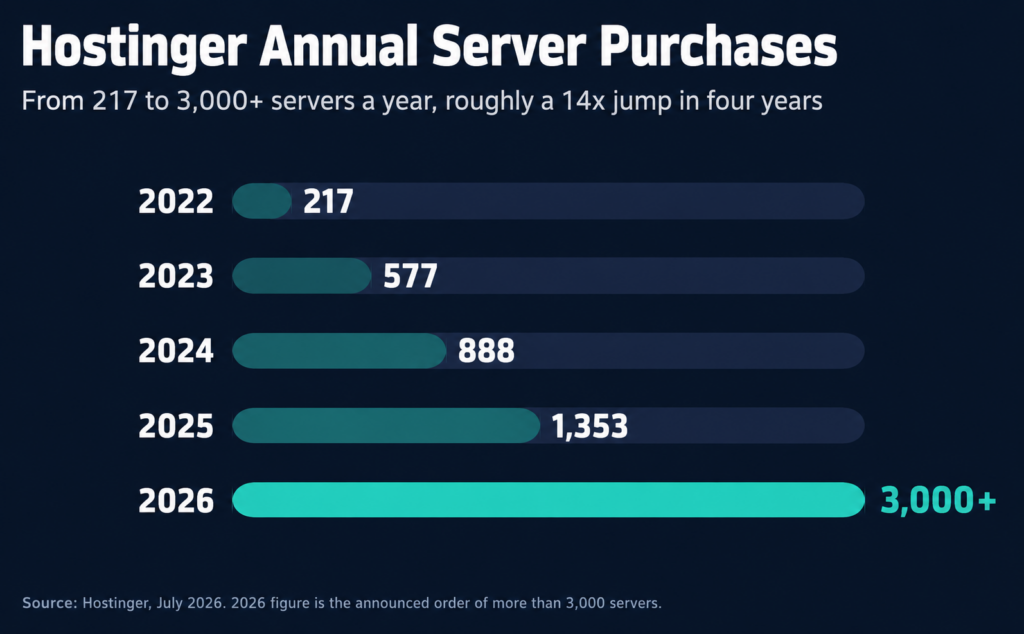
Servers purchased per year, as published by Hostinger; the 2026 figure is the announced order of more than 3,000 machines. Source: Hostinger.
The machines themselves are already going into racks. The new fleet mixes the latest AMD architectures, including AMD Genoa and AMD Turin, with DDR5 memory, read-intensive NVMe storage, RAID configurations and dual redundant power supplies, deployed across web hosting, cloud hosting, VPS and related products.
A 60 Percent Quarter in the Memory Market
None of this is specific to Hostinger. The company’s post calls the supply shock by the name the industry has settled on, RAMageddon: AI infrastructure demand, reduced memory production after the post-COVID price drop, and depleted global inventories, hitting not just RAM but CPUs, NVMe storage and server components overall. The market data backs the label. Research firm TrendForce recorded DRAM contract prices jumping roughly 60 percent in the second quarter of 2026 alone, projects a further 13 to 18 percent in the third, and notes that memory manufacturers keep shifting production capacity toward higher-margin server products as AI demand holds both DRAM and NAND supply in shortage. On the server side, TrendForce adds, part of purchases are covered by long-term supply agreements, which is moderating price increases for the buyers that have them.
For hosting, the tension is plain: component costs multiplied within a year, while plans are sold at prices customers expect to stay flat. Who absorbs that gap, and for how long, is the question the rest of this article puts to the company itself.
The Q&A with the COO
What follows comes directly from Hostinger. Our team put four questions to the company, on the numbers, the procurement, the customers and the market. The answers came in writing from Aivaras Šimkus, Chief Operating Officer, whose remit covers the infrastructure, capacity planning and hardware procurement behind this order.
webhosting.today: The post says server costs rose 5-6x year over year, with some components up 6-8x. For a representative like-for-like configuration, what did it cost in early 2025 versus today? If contract prices aren’t shareable, an indexed or percentage breakdown of what drove the increase would work just as well.
Aivaras Šimkus: The biggest drivers behind the increase have been RAM and NVMe storage. To give one concrete example, 64GB of DDR5 RAM that used to cost around €300–€400 can now cost more than €3,000.
We can’t share exact server prices, as those are commercially confidential terms agreed with our vendors, but this gives a good indication of how sharply key component costs have moved.
webhosting.today: How has the shortage changed your procurement, in lead times, commitments, and number of suppliers? And with the 3,000-plus servers covering 2026, are you planning on the crunch continuing into 2027, and further major orders with it?
Šimkus: The biggest change has been that we now have to think much further ahead, with lead times stretched to around 30 weeks. Securing more than 3,000 servers in advance gives us the capacity we need to scale from our current base of more than 5 million clients to 7 million customers.
As for 2027, we have already started preparing and are monitoring the market closely. But it is still too early to say exactly how conditions will develop or what our procurement strategy will look like, especially given how quickly the market has been changing over the past year.
webhosting.today: How much of this cost increase can Hostinger absorb through scale, existing contracts, or efficiency gains? And what should new and existing customers expect on introductory prices, renewal prices, and plan specifications over the next 12-18 months?
Šimkus: Our priority is to absorb as much of the cost increase as we can through scale, existing agreements, and operational efficiency. We are doing our best to keep pricing at similar levels and make sure building and growing an online presence remains accessible to as many people and businesses as possible.
webhosting.today: What concrete advantages does purchasing at this scale give Hostinger in pricing, availability, and negotiating power? And over the next one or two years, do you expect the hardware shortage to drive higher hosting prices, reduced capacity, or consolidation among smaller providers?
Šimkus: At this scale, the main advantage is certainty. In a market where supply is tight and lead times are long, securing more than 3,000 servers means we know the hardware will be available when we need it. It also gives us more room to plan infrastructure growth rather than reacting to shortages.
As for the broader market, higher hardware costs are likely to keep putting pressure on the industry. Beyond that, I wouldn’t want to speculate on how other providers will respond or whether we’ll see consolidation.
The answer he declined to give is the one the rest of the market must work out for itself. Smaller providers buy the same components in the same shortage, at the same 30-week lead times, without a year of hardware already on the books.
