
For most of the last decade, a whole corner of the domain business had nothing to do with websites. Millions of registered names sat parked, showing nothing but a page of machine-generated ads, and quietly earned money doing it. The engine behind most of that revenue was a single Google product, AdSense for Domains. On February 10, 2026, Google switched it off for good.
The size of what disappeared is easy to underestimate. In 2023, one London-listed company, Team Internet, booked $566.9 million in revenue from Google alone, most of it from monetizing parked and redirected domain traffic, and that was roughly two thirds of its total sales. Team Internet’s half-year update on July 24 showed how deep the loss ran: revenue from its Search business fell 63 percent in a single six-month period. And the traffic that used to flow through those ad pages has not vanished. It has moved to a less visible model that security researchers and ICANN are now examining.
Key facts
- The event: Google ended AdSense for Domains on February 10, 2026, after winding it down in stages through 2024 and 2025
- The scale: Team Internet earned $566.9 million from Google in 2023; its Search revenue fell 63 percent in the first half of 2026
- The casualties: the parking platform Bodis shut down on January 31, 2026; marketplace Sedo’s third-quarter revenue fell 66 percent and its owner put it up for sale; Team Internet cut more than 200 jobs
- The replacement: traffic moved to RSOC and to zero-click redirects; the security firm Infoblox found that more than 90 percent of the parked traffic it studied now leads to scams or malware
- The scrutiny: ICANN’s research team began measuring parked-domain redirection in March 2026, found 5.5 percent of a random sample potentially harmful, and calls the work exploratory
The ad business that had nothing to do with websites
AdSense for Domains, or AFD, ran in the background of the domain economy. A domain owner pointed an unused name at a parking service, Google read the words in the domain and filled the page with related search links, and when a visitor clicked, an advertiser paid. Google kept a share and passed the rest to the parking company or the domain owner. It was never about content or a real website. It was about catching stray traffic, people mistyping an address or clicking an old link, and turning it into an ad click.
At scale, that added up to real money, and not only for the parking specialists. Ordinary registrars and hosting companies took part too: registrars monetized customers’ unused and expiring domains and shared the revenue, and hosts ran ads on error pages. Programs like GoDaddy’s CashParking paid domain owners a cut of the take. For anyone holding a portfolio of generic names, parking income was a small but real offset against the cost of renewing them each year.
Google pulled the feed in stages
The shutdown was not a single announcement. It came in stages:
- September 2024: Google stopped automatically enrolling new advertiser accounts in ads on parked domains.
- Spring 2025: it began opting existing advertisers out by default, in batches.
- September 2025: a final purge removed the remaining advertisers, and parking income dropped to what Domain Name Wire called pennies on the dollar.
- February 10, 2026: parked domains stopped being an advertising surface on Google’s Search Partner Network, the formal end.
Google never gave a public reason for the wind-down, and trade coverage attributed it to the weak results advertisers were getting from parked-page traffic.
The damage spread across the industry:
- Bodis, one of the best-known parking platforms, shut down on January 31, 2026.
- Sedo, the large marketplace owned by the German hosting group IONOS, reported third-quarter 2025 revenue down 66 percent, and IONOS put the business up for sale.
- Team Internet, owner of the parking and traffic-monetization brands ParkingCrew and TONIC, cut more than 200 jobs, about a quarter of its staff.
The traffic did not disappear. It went to zero-click.
Losing the Google feed did not stop people from typing domain names or clicking old links. That traffic still exists, and operators have moved it to two replacements. The first is Related Search for Content, or RSOC, another Google product that shows search-style ads inside a page of content rather than on a bare parked page. Google tightened the rules on RSOC in August 2025, limiting how many search terms a page can show and demanding more proof of genuine content, which narrowed its use for pure arbitrage.
The second replacement is harder to see. In a zero-click, or direct search, setup, a visitor to a parked domain is redirected straight to an advertiser without ever seeing a page or choosing a link, often through a chain of intermediaries that can change the destination based on the visitor’s location and device.
How dangerous that is depends on what you look at. The security firm Infoblox, studying the parked domains that use these zero-click redirects, reported that more than 90 percent of visits now lead to scams, malware, or fake antivirus offers, against fewer than 5 percent a decade ago. ICANN’s own research team took a broader view: across a random sample of parked domains, its March 2026 measurements found most redirects fairly constrained and unlikely to be harmful, with 5.5 percent showing some potential for harm. The two readings are not in conflict, since Infoblox measured the zero-click traffic where abuse concentrates while ICANN sampled the whole parked-domain population. ICANN called its work exploratory rather than enforcement, and did not name Google. But the direction of travel is clear enough that the body overseeing the domain name system is now measuring what parked domains do.
The cushion that paid for holding domains
The end of parking income lands hardest on the people who quietly relied on it. For domain investors holding large portfolios, parking was the difference between a name that paid for itself and one that only cost money. A domain earning even a few dollars a month covered its own annual renewal and then some. The same name now earns next to nothing. Elliot Silver, who writes the DomainInvesting blog, called Google’s move another nail in the coffin for parking, a business he noted has been fading for ten to fifteen years. With that offset gone, the math on holding thousands of speculative names changes, and some owners will let more of them drop. Whether that meaningfully lowers aftermarket prices is still a matter of opinion rather than settled fact, but the pressure runs one way.
Registrars and hosts feel a smaller version of the same loss. Parked pages, expiring-domain landers, and error pages were a modest revenue line that helped subsidize cheap registrations and hosting. Domain Name Wire noted that losing it will affect how some companies deliver and price their services. None of this is a crisis for a well-run registrar, but it removes a cushion that had been there for years.
Team Internet is leaving both the arbitrage and the domains
Team Internet’s half-year figures show how a company built on domain monetization is remaking itself. Group revenue fell 32 percent to $179.1 million, but with the lowest-margin arbitrage revenue stripped out its margin actually rose, to 34.1 percent from 27.6 percent, and adjusted earnings fell by a fifth, to $19.5 million, a shallower decline than revenue. The Search business that fell so hard has already been cut back to profitability, returning to a monthly profit in June. The growth is now in Comparison, its price-comparison marketing arm, where revenue rose 18 percent and earnings 54 percent.
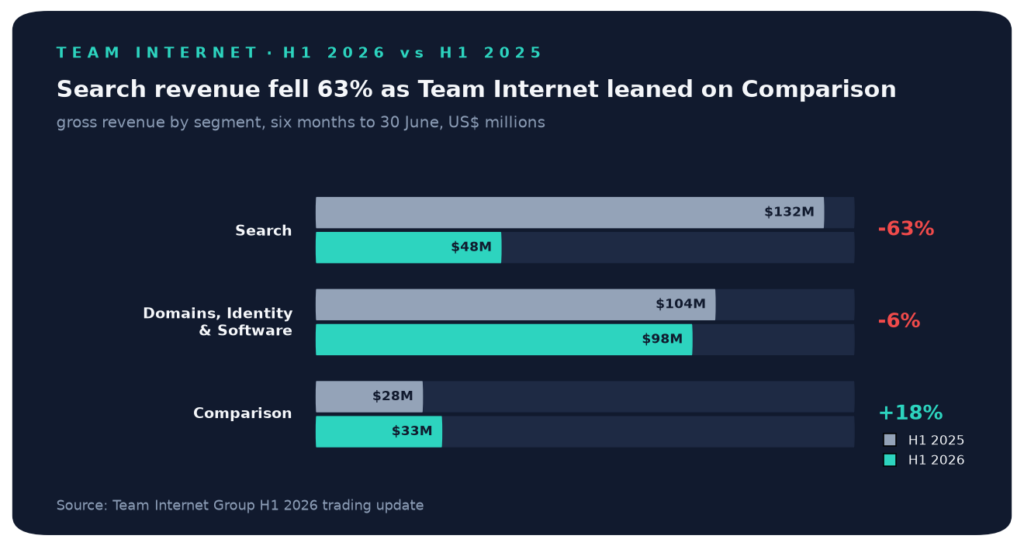
Team Internet’s half-year revenue by segment. Search, the domain-monetization business, fell 63 percent, while the smaller Comparison arm grew. Source: Team Internet Group H1 2026 trading update.
At the same time, the company is trying to sell the domain business itself. Its Domains, Identity and Software division, which includes registrar and registry operations, is the subject of a sale process the board expects to complete during 2026. Notably, the July update dropped its earlier guidance of an outcome by the middle of the third quarter, pointing instead to a further update with its interim results on September 7. Net debt rose to $117.5 million over the half, though the company tied that to a scheduled tax payment and working-capital timing rather than new borrowing, and expects it to fall again. The pattern is hard to miss: the business that once earned two thirds of its money from parked and redirected traffic is now exiting both the arbitrage that built it and the domains at its core.
About the Data
This article draws on Team Internet Group’s July 24, 2026 half-year trading update for its financial figures, Google’s own Search Partner Network notice for the February 10, 2026 end date of AdSense for Domains, and reporting by Domain Name Wire on the shutdown’s timeline and effects. The picture of what replaced parking comes from a threat-intelligence report by the security firm Infoblox and from early measurements published by ICANN’s research team in March 2026, which ICANN describes as exploratory rather than regulatory. Company ownership and closure details were confirmed against primary announcements. This is analysis, not investment advice.

Sources
- Team Internet Group H1 2026 Trading Update and Notice of H1 2026 Report - Investegate
- Team Internet reports first-half 2026 results - Domain Name Wire
- Parked Domains and the Search Partner Network - Google Ads Help
- 2025 in Review: The death of AdSense for Domains - Domain Name Wire
- Google's parked domain purge devastates parking revenue - Domain Name Wire
- Bodis to cease operating on January 31 - DomainInvesting
- Sedo's revenue fell 66% in Q3 as Google changes hit - Domain Name Wire
- Research: most traffic to parked domains redirects to bad sites - Domain Name Wire
- ICANN Examines Parked Domains and Zero-Click Redirection - ICANN
- Google clamps down on RSOC as AdSense for Domains dies - Domain Name Wire
- A look inside Team Internet's 2023 annual report - Domain Name Wire