

Between April 27 and April 29, HostPapa bought two hosting companies on two different theses. Between May 5 and May 14, HOSTAFRICA did the same on another continent. And at the top of the market, the largest data-centre transaction in history, BlackRock-led AIP’s ~$40 billion purchase of Aligned, was clearing its final approvals. This publication has covered most of these transactions individually; laid side by side, the first half of 2026 resolves into something more useful than a deal list. It is a map with four kinds of buyers and two kinds of sellers, strategic and forced. Its forward calendar is legible in two debt instruments that both had to buy time this year: Newfold’s recapitalized term debt, pushed out to April 2029, and iomart’s revolving credit facility, extended in June to mid-2028. Here is the full map, the multiples underneath it, and what it says about who transacts next.
Key facts
- The core wave: CyberFolks–Shoper (~US$1B combined, shareholder-approved July 20), Com Laude–MarkMonitor ($450M EV, closed December 31), HostPapa ×2 (Tailor Made Servers, Hostwinds), HOSTAFRICA ×2 (Evoweb, Zanode), your.online ×6 (Dtch. Digitals, UK2 Group, Shellrent, NordLEI, Sansec, Blacknight), Axxess–Absolute, OpusDNS–fruits.co, PlanetHoster–Digital Forest, 11:11 Systems–Ntirety
- The infrastructure layer: Aligned ~$40B closed July 21 (largest DC deal ever), atNorth ~$4B (≈$4M per secured MW) awaits an August 11 EU decision, STT GDC at S$13.8B EV is cleared in India but not yet closed, and Digital Realty added ~$4.6B of stakes in late June; ~84% of data-centre deal value is now PE-funded
- The multiples: Namecheap at ~3.8x 2024 revenue on CVC’s reported $1.5B deal, an MSP median of 8.9x EV/EBITDA across 120 deals, PE buyers paying ~3 turns over corporates, while software buyouts overall fell 43%
- The forced sellers: Google’s AdSense-for-Domains shutdown cut Sedo’s quarterly revenue 66% and Team Internet’s Search EBITDA 84%; both assets remained unsold in late July
- The two clocks, rewound: iomart extended its revolver in June to mid-2028 at a stepped-up margin, leverage at 4.2x; Newfold’s December recap pushed its wall to April 2029 at the cost of a $100M sponsor injection and the MarkMonitor sale
- One termination in the background: CoreWeave–Core Scientific (~$9B) was voted down by target shareholders last October, the cautionary tale hanging over AI-infrastructure paper
Hosting M&A Consultation
Get one-on-one advice on maximizing your hosting company’s valuation and navigating the sale process.
The Core Map: Hosting and Domains
The half-year’s defining transaction is the CyberFolks–Shoper full-absorption merger, announced May 21: a share-swap (0.2281 CyberFolks shares per Shoper share, set on three-month average prices) that folds the e-commerce platform CyberFolks already 49.9%-controlled into a single listed entity of roughly US$1 billion in combined market value, completing a vertical stack (hosting, Shoper, PrestaShop, a €54M purchase closed this February, and Sylius) whose commerce platforms front about €35 billion in annual GMV. CEO Jakub Dwernicki’s stated logic was capital-markets pragmatism: simplify the structure, raise the free float, become legible to global institutions. Shareholders of both companies approved the merger on July 20; the court registration that fixes its effective date is pending. It is the clearest European statement of the thesis that hosting is no longer just a business but an acquisition layer for a software stack.
The enterprise domain layer consolidated at the turn of the year, when PX3-backed Com Laude closed its acquisition of MarkMonitor from Newfold on December 31, creating a combined “Markmonitor Group” at an initial enterprise value of about $450 million, a corporate domain registrar, and, from the seller’s side, a liquidity event for a company servicing $3.7 billion of debt at what was then a Caa3 rating. The deal’s two faces (buyer building a champion, seller selling the family silver) are the half-year in miniature.
Below the headline deals, the pattern was serial buyers running parallel processes:
- HostPapa (more than ten acquisitions since 2020, backed by a $130M credit facility) bought Dallas dedicated-server veteran Tailor Made Servers on April 27 and Seattle’s Hostwinds on April 29, the latter bringing data-centre operations in Seattle, Dallas, and Amsterdam. Two closings two days apart means two deal teams, not one.
- HOSTAFRICA (18+ acquisitions, 100,000+ customers) bought Evoweb’s hosting division on May 5 and developer platform Zanode on May 14, densifying its South African home market after two years of pan-African expansion.
- Axxess, the South African ISP, bought Johannesburg’s Absolute Hosting in late April, a bolt-on adding hosting revenue and domestic footprint.
- OpusDNS, the registrar launched only last October by Hexonet and InterNetX co-founders, bought aftermarket platform fruits.co (2.6 million domains) on May 20, seven months after its own launch: wholesale infrastructure, monetization, and EU VAT compliance assembled at startup speed.
The Adjacent Layer: Hosting Groups Buying Everything Except Hosting
The most acquisitive European hosting group of the half-year bought no hosting at all. team.blue (valued at €4.8B in its 2024 CPP Investments deal, 3.3 million customers) added influencer-analytics firm Storyclash and marketing-data platform Windsor.ai on the same January day, then Czech sales-intelligence firm Saleskit in March: more than a dozen SaaS deals since mid-2024, each one a product sold into the same SMB base its hosting brands already bill, on CEO Claudio Corbetta’s stated thesis that “digital presence alone is not enough.”
The Dutch consolidator orbit ran the same play at higher tempo. your.online and Your.Cloud, from the same Dutch investor stable, closed at least seven deals between them:
- digital agency Dtch. Digitals in January
- the UK2 Group in February, the 1998-vintage stable of UK2, Midphase, Westhost, and Resell.Biz, materially extending the group’s UK and US footprint
- Italian host Shellrent days later
- Scandinavian Legal Entity Identifier issuer NordLEI in February, a services bolt-on well outside hosting
- e-commerce security firm Sansec in May, whose protected stores were shielded before March’s PolyShell exploitation wave began
- Ireland’s best-known independent registrar and host Blacknight in June
- Your.Cloud took UK MSP Cloud Geeni, its fourth UK deal, in April
Three more deals carry theses bigger than their price tags:
- 11:11 Systems closed Ntirety on January 8, its sixth purchase of an authorized VMware partner: consolidation running directly downstream of Broadcom’s licensing upheaval, where every repricing round converts another VMware-based provider into either a buyer or a target.
- Canada’s PlanetHoster bought France’s Digital Forest in February, installing founder Simon Cardon as PlanetHoster’s CEO Europe and framing the deal explicitly as building a sovereign, high-performance, ecofriendly cloud in Europe: the sovereignty premium, now visible at SMB-hosting deal size.
- Cloudflare acquired the Astro framework company on January 16, the content-site framework used by Unilever, Visa, and NBC News, kept open source but now stewarded by what may be the hosting industry’s most underpriced threat. When the disruptor buys the framework layer, hosting-neutrality becomes a promise rather than a structure.
The Infrastructure Layer Repriced Everyone’s Floor
Above the hosting market, the capital got heavier and more institutional:
| Target | Buyer | Value | Status (July 28) |
|---|---|---|---|
| Aligned Data Centers | AIP (BlackRock’s GIP, MGX) with Microsoft, NVIDIA, xAI | ~$40B | Announced October 2025, closed July 21. History’s largest data-centre deal, ~2.4x Blackstone-AirTrunk |
| STT GDC (remaining 82%) | KKR-led consortium with Singtel | S$6.6B (S$13.8B EV) | Pending; cleared by India’s competition authority in mid-July. 12 markets, 2.3 GW design capacity |
| atNorth | CPP Investments and Equinix, from Partners Group | ~$4B | Pending; EU merger decision due August 11 |
| Three Northern Virginia data centres (64% stake) | Digital Realty, from Blackstone funds | $3.5B ($7.8B gross value) | Announced June 29. 288 MW, fully leased |
| Teraco (stake to ~77%) plus Columbia Capital | Digital Realty | ~$1.1B | Announced June 22. Africa’s largest carrier-neutral platform |
| BXDC REIT | Blackstone | ~$2B raise | S-11 filed April 10, listed in May. Not a deal but a permanent acquisition vehicle, which is a forecast of deals |
The atNorth price, about $4 million per megawatt against the 1 GW of secured power cited in the announcement, is the cleanest single number for what AI-era power scarcity has done to asset pricing. Industry-wide, roughly 84% of data-centre transaction value is now private-equity funded, with $151 billion aggregate across 575 deals from the start of 2024 through this February, per Synergy Research, and Digital Realty’s $4.6 billion late-June spree shows the listed operators buying back in. The half-year’s smaller regional entries fit the same pattern at lower stakes: Digital Realty agreed in January to buy the TelcoHub 1 data centre in Cyberjaya from CSF Advisers for a Malaysian market entry, and Spain’s Templus added three Iberian facilities in Lisbon, Madrid, and Valencia.
Two counterpoints keep the picture honest. CoreWeave’s ~$9 billion all-stock bid for Core Scientific died last October when target shareholders voted it down, a standing reminder that AI-infrastructure paper is not universally accepted currency. And the broader software M&A market moved the opposite direction: buyout value down roughly 43% year-over-year in the first five months of 2026, per PitchBook data first reported by the Financial Times, on AI-disruption fears. Hosting and digital infrastructure are not riding a general M&A wave; they are the exception to its absence, which is precisely what makes the sector’s multiples worth a CFO’s attention.
The Multiples Stack
The half-year’s pricing data points, assembled: CVC’s Namecheap deal at a reported $1.5 billion equals about 3.8x 2024 revenue for a registrar growing 18%. On the EBITDA ladder, the gap between commodity and platform has never been wider:
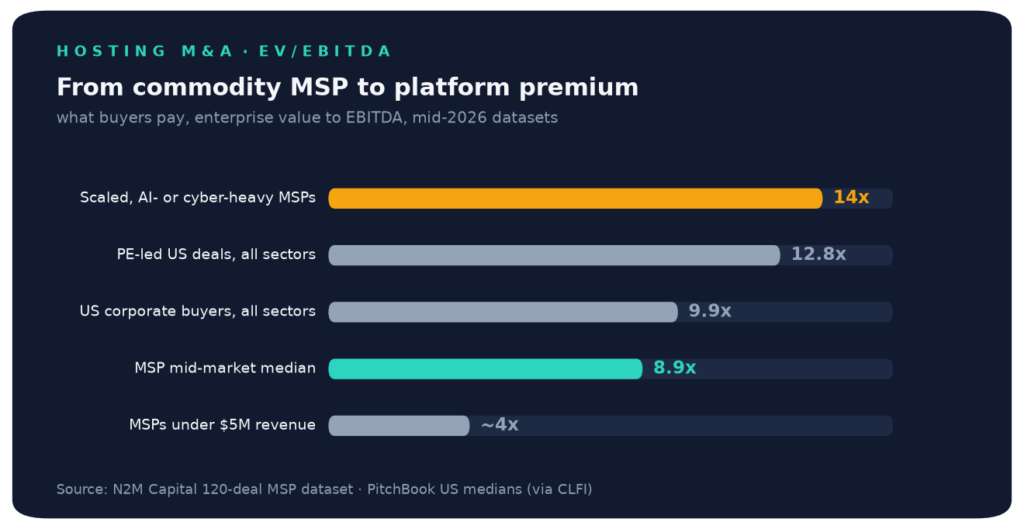
What buyers pay: EV/EBITDA from N2M Capital’s 120-deal MSP dataset, alongside PitchBook’s trailing US medians for PE-led and corporate deals. The commodity floor sits near 4x; scaled, AI- or security-heavy platforms reach 14x.
For founders, the practical read of the ladder: scale, recurring software revenue, and owned infrastructure each add turns; commodity shared hosting with rented racks sits at the bottom, and PE-led US buyers are paying roughly three turns more than corporates across all sectors, per PitchBook. HostPapa’s purchase of Hostwinds’ data-centre operations and Axxess’s purchase of speed-to-credibility show strategics paying for exactly the attributes the ladder rewards.
The Forced Sellers: Google Made the Supply Side
Every map needs its distressed quadrant, and this half-year’s was made in Mountain View. Google’s shutdown of AdSense for Domains, finally removed from the Search Partner Network on February 10, 2026, detonated the parking-monetization economics that two major domain businesses were built on. The supply side it created was still unsold in late July:
- Sedo: quarterly revenue fell 66% year-over-year; IONOS reclassified it as a discontinued operation and is targeting a sale this year, with CEO Achim Weiß’s framing that the business needs “increasing management attention… which we cannot provide optimally on a permanent basis” doing heavy diplomatic lifting. Cuts reported in May took out more than half its staff, and no buyer has been named.
- Team Internet: Search-segment EBITDA fell 84% in 2025, to $9.0 million; the group is selling its Domains, Identity & Software division, which it believes is worth more than its entire market capitalization, a sentence that is itself the distress signal. Its July 24 update reported discussions “advancing with selected parties”, no certainty of a deal, and a fuller report due September 7.
- Tucows continues shopping its capital-hungry Ting fiber unit, explicitly to deleverage and rebuild as a “build and buy” platform around domains, a future acquirer assembling dry powder by divesting; its next scheduled update is August 6.
Two aftermarket platforms and a registrar group, all sellers at once, into a buyer’s market: for anyone who wants domain-industry infrastructure, SedoMLS alone connects more than 650 registrar and sales partners, this is a once-in-a-decade discount window, and an obvious competitive opening for GoDaddy’s Afternic.
The forward calendar moved this year, because both of its clocks had to buy time:
- iomart, the UK managed-hosting consolidator whose debt-funded Atech acquisition came with a profit warning and a departed CFO, extended its £115m revolver in June from mid-2027 to June 30, 2028, at a margin stepped up to 3.5% over SONIA and with leverage at 4.2x. Extensions price time; they do not repair balance sheets.
- Newfold pushed its wall out in December: a $100M injection from sponsors Clearlake and Siris funded a recapitalization that moved its principal maturities to April 2029 and earned a January ratings upgrade, with the MarkMonitor sale providing further deleveraging. The wall moved; the debt did not shrink.
Neither company’s assets disappear in a restructuring; they come to market. The brands, customer books, and infrastructure inside both groups remain the most predictable M&A supply of the next two to three years, and acquirers with integration capacity are visibly keeping powder dry for it.
Who Is Buying: The Fund Map
Follow the ownership rather than the press releases and the half-year’s most important structural fact is concentration of a different kind:
- CVC Capital Partners owns WebPros (cPanel, Plesk, and WHMCS, the tooling layer under more than 60 million domains) and has agreed a majority stake in Namecheap, the second-largest retail registrar by domains under management: one fund holding the industry’s picks-and-shovels and one of its largest storefronts, a structural conflict that gets its first live test in the autumn licence-price round.
- Hg and CPP stand behind team.blue’s SaaS sprawl.
- Oakley Capital stands behind the 30-plus-brand roll-up now trading as hosting.com, and keeps a minority in Contabo alongside majority owner KKR.
- Cinven stands behind group.one’s 55-transaction decade.
- Pension funds, sovereign wealth, and infrastructure capital bought the top of the stack: Aligned, atNorth, and STT GDC are toll-road assets now held by patient money whose return requirements reprice every asset beneath them.
When the same pension fund underwrites team.blue at €4.8 billion and atNorth at $4 million per megawatt, the valuation gravity reaches down to what a 10,000-customer regional host is worth, and in H1 2026 it pulled upward.
What the Map Says About H2
The second half did not wait to start transacting: Aligned closed on July 21, Verisign’s long-contested .web was delegated on July 22, a registry event rather than a deal, but one that hands the domain market a new premium asset, and Arcus agreed to take Volta’s central-London colocation site off Verne’s hands. The windows below are already open.
The four models are now explicit, and boards should know which one they are on the wrong side of. Every H1 deal fits one of four buyer playbooks, and each implies a different bid for the same target:
- Brand consolidation: World Host Group rebranding as hosting.com and progressively integrating its 30-plus acquired brands
- Infrastructure acquisition: HostPapa buying Hostwinds and its data-centre operations
- Geographic densification: HOSTAFRICA and Axxess in South Africa
- Vertical stack-building: CyberFolks and team.blue buying software, not servers
A founder considering sale should price all four buyer types, not the first inbound.
The cost stack is the engine, and it is regulatory as much as hardware. The EU compliance bill (NIS2 and the Data Act directly, the CRA and AI Act through the products and AI features hosts ship) falls proportionally hardest on the smallest providers; add the memory-driven hardware repricing and the collapse of affiliate acquisition economics, and every input to the independent host’s P&L is pushing the same direction. CENTR warned as early as 2021 that the compliance burden “will result in more market consolidation”; per this map, that is no longer a forecast but a quarterly report.
The independents holding out are doing it on structural advantages, not nostalgia. Hetzner (family-owned, owned DCs), OVHcloud (founder control), Hostinger (€275.4M revenue in FY2025, up 51%, a fourth consecutive year above 50%), DigitalOcean and Scaleway each hold at least one of: owned infrastructure, structural cost advantage, or a differentiated acquisition channel. The map’s implicit lesson for everyone else is uncomfortable but actionable: in a market where the buyers are this organized and the cost curve this hostile, independence is a strategy only when it is funded by one, and the H2 windows, from the Sedo sale to the autumn cPanel price round to the 2028-2029 debt walls, will sort the industry into those who chose their transaction and those whose covenants chose it for them.
Scope note: this map covers announced transactions in hosting, domains, web-presence software, and digital infrastructure in the first half of 2026, with deal status updated to July 28, 2026, and pre-window context where a deal’s effects land in the half-year. Private micro-acquisitions that are never announced, customer-book and brand purchases below disclosure thresholds, are by nature outside any public map.

Sources
- CyberFolks and Shoper Agree Merger Plan - PAP Biznes
- Com Laude Completes Acquisition of MarkMonitor - PR Newswire (official)
- HostPapa Acquires Hostwinds - HostPapa (official)
- Axxess Acquires Absolute Hosting - MyBroadband
- HOSTAFRICA Acquires Zanode - HOSTAFRICA (official)
- HOSTAFRICA Acquires Evoweb - HOSTAFRICA (official)
- OpusDNS Acquires fruits.co Domain Sales Platform - Domain Name Wire
- Cloudflare Acquires Astro - Cloudflare (official)
- KKR-Led Consortium to Fully Acquire STT GDC at S$13.8 Billion Enterprise Value - STT GDC (official)
- AIP to Acquire Aligned Data Centers - Business Wire (official)
- Sansec Joins Your.Online - your.online (official)
- UK2 Group Joins Your.Online - your.online (official)
- 11:11 Systems Completes Acquisition of Ntirety - GlobeNewswire (official)
- PlanetHoster Acquires Digital Forest - PlanetHoster (official)
- IONOS Reports First Nine Months of 2025; AdTech Business to Be Sold - IONOS Group (official)
- Team Internet Reports 2025 Results, Still Plans to Sell Domains Business - Domain Name Wire
- Tucows Plans Strategy Post-Ting - Domain Name Wire
- Core Scientific Shareholders Vote Against CoreWeave Deal - Data Center Dynamics
- MSP M&A Valuation Report 2026 - N2M Capital
- Data Center M&A Deals Broke All Records - Synergy Research Group
- Data Center M&A Outlook Robust in 2026 - Data Center Knowledge
- Empowering SMEs: Insights from Claudio Corbetta, CEO of team.blue - European Business Magazine
- AIP, MGX and BlackRock's GIP Close Acquisition of Aligned Data Centers - Aligned Data Centers (official)
- Digital Realty Announces Purchase of Blackstone Interest in Three Northern Virginia Data Centers - GlobeNewswire (official)
- Digital Realty Announces Transactions to Drive Continued Platform Growth - Digital Realty (official)
- https://www.mediaexpert.pl/komputery-i-tablety/komputery-pc/mini-pc/komputer-minisforum-ms-01-s1390-i9-13900h-wi-fi?srsltid=AfmBOopiu_aFKPPsyZObg8rwpC3Clt81C0_2rYBffpTecWda7_eY5iMs
- iomart Group Final Results - Investegate (official RNS)
- Newfold Digital Secures $100 Million Investment - PR Newswire (official)
- Shareholders of cyber_Folks and Shoper approve the merger - Bankier.pl
- Team Internet Group H1 2026 Trading Update - Investegate (official RNS)
- Arcus and Verne announce agreement for Arcus to acquire Volta Data Centres - Verne (official)
- NIS 2: pay attention or pay the costs - CENTR
- Hostinger posts fourth consecutive year of 50%+ growth - Hostinger (official)
- CPP Investments and Equinix to Acquire atNorth for US$4 Billion - Equinix (official)
- Blackstone Digital Infrastructure Trust Announces Public Filing of Registration Statement - Blackstone (official)
- Software buyout market slumps to post-pandemic low as AI disruption weighs on valuations - Private Equity Wire
- M&A EV/EBITDA multiples: PE vs corporate - CLFI (PitchBook data)
- Private equity firm is buying Namecheap in deal that values company at $1.5 billion - Domain Name Wire
- Namecheap ended 2024 at $398M in revenue - TheDomains
- team.blue welcomes new investment from CPP Investments in transaction worth €4.8bn - team.blue (official)
- Digital Realty enters Malaysia, strengthening Southeast Asia's digital backbone - GlobeNewswire (official)
- Templus acquires three data centers from Grupo Aire in Lisbon, Madrid and Valencia - BeBeez International
- Core Scientific shareholders reject $9 billion CoreWeave offer, deal terminated - CNBC
- cyber_Folks Completes PrestaShop Acquisition, Integrating Sylius and BitBag - GESSEL
- Com Laude buys larger rival Markmonitor - Domain Incite
- Newfold Digital Completes Sale of MarkMonitor to Com Laude - PR Newswire (official)
- HostPapa Expands Dedicated Hosting Infrastructure with Acquisition of Tailor Made Servers - HostPapa (official)
- AI-powered data integration platform Windsor.ai joins team.blue - team.blue (official)