
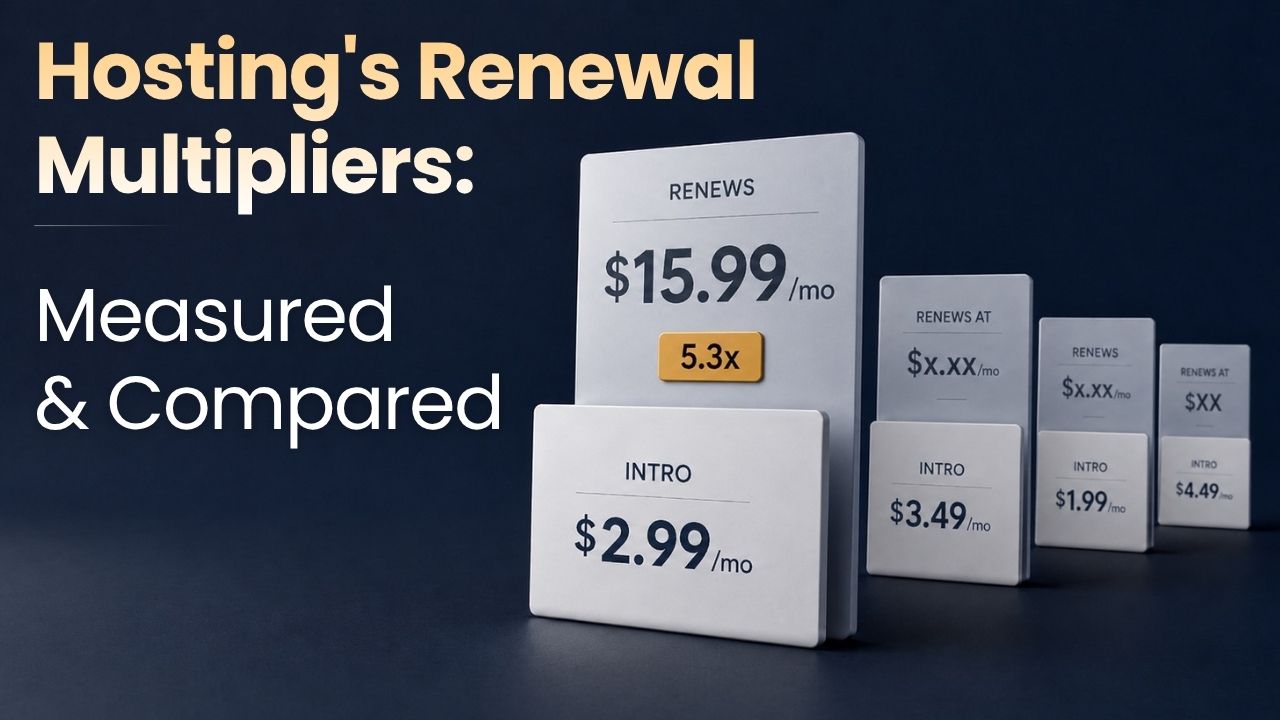
A shared-hosting plan has two prices: the introductory rate that sells it and the renewal rate that bills it for years afterward. How wide the gap runs, and at which host, has been easier to assert than to measure. So we measured it, twice: a baseline run on June 11, 2026, and this edition’s on July 29. Each run retrieved the live pricing pages of the major shared-hosting providers and recorded, for each plan, the advertised introductory price, the required term, and the disclosed renewal price, then divided. The result is the first edition of a recurring instrument: the webhosting.today Renewal Multiplier Index.
The headline findings: across ten providers and 27 plans, multipliers run from 1.0x at the price-lock practitioners to 5.3x at SiteGround; the biggest brands are not the steepest, with GoDaddy, HostGator, and Namecheap mid-band at 1.7–3.7x. And one pattern runs through the whole table: at every provider with a full plan range, the entry plan renews at a higher multiple than the top plan. The jump is regressive, and it lands hardest on the buyers who shopped hardest on price.
Key facts: Index v1.0 (measured July 29, 2026; baseline June 11)
- Highest measured multiplier: SiteGround StartUp: €2.99 intro → €15.99 renewal = 5.3x (12-month term)
- The jump is regressive: at all eight providers with a full plan range, the entry plan renews at a higher multiple than the top plan
- Mass-market center of gravity: Hostinger 3.3–4.5x (48-month prepay), DreamHost Launch 3.8x, HostGator 2.1–3.7x, SiteGround range 4.7–5.3x
- Moderates: IONOS 1.7–2.0x, GoDaddy 1.7–3.0x, Namecheap 2.4–2.6x (IONOS’s $1 Plus promo renews at $14, a 14x promotional artifact we exclude from comparisons)
- Newly measured: Bluehost at 1.5–2.5x across Starter, Business, and eCommerce
- The 1.0x club: HostMetro ($59.40 → $59.40); InterServer locks a disclosed $7 rate after a $2.50 first month
- Why it matters: New York’s §527-a attaches consent-or-refund duties to repriced renewals, the EU DFA targets silent renewals, and the steepest jumps sit on the cheapest plans, where buyers are most price-sensitive
The Index
All figures as displayed to a first-time visitor on the provider’s public pricing page on July 29, 2026. Multiplier = disclosed renewal price ÷ advertised introductory price for the same plan and billing cycle.
| Provider | Plan | Intro price | Term | Renewal price | Multiplier |
|---|---|---|---|---|---|
| SiteGround | StartUp | €2.99/mo | 12 mo | €15.99/mo | 5.3x |
| SiteGround | GrowBig | €5.49/mo | 12 mo | €27.99/mo | 5.1x |
| SiteGround | GoGeek | €8.49/mo | 12 mo | €39.99/mo | 4.7x |
| Hostinger | Unlimited | $3.79/mo | 48 mo | $16.99/mo | 4.5x |
| DreamHost | Launch | €2.89/mo | 12 mo | €10.99/mo | 3.8x |
| Hostinger | Premium | $2.99/mo | 48 mo | $10.99/mo | 3.7x |
| HostGator | Baby | $4.50/mo | 36 mo | $16.49/mo | 3.7x |
| HostGator | Business | $6.25/mo | 36 mo | $21.99/mo | 3.5x |
| Hostinger | Cloud Startup | $7.99/mo | 48 mo | $25.99/mo | 3.3x |
| GoDaddy | WordPress Basic | $4.99/mo | 36 mo | $14.99/mo | 3.0x |
| HostGator | Hatchling | $3.75/mo | 36 mo | $10.99/mo | 2.9x |
| InterServer | Standard (monthly) | $2.50 first mo | monthly | $7.00/mo, locked | 2.8x, then 1.0x |
| Namecheap | Stellar Plus | $2.98/mo | 12 mo | $7.88/mo | 2.6x |
| Namecheap | Stellar | $2.28/mo | 12 mo | $5.88/mo | 2.6x |
| Bluehost | Starter | $3.99/mo | 36 mo | $9.99/mo | 2.5x |
| GoDaddy | Economy | $4.99/mo | 36 mo | $11.99/mo | 2.4x |
| Namecheap | Stellar Business | $4.98/mo | 12 mo | $11.88/mo | 2.4x |
| HostGator | Pro | $13.95/mo | 36 mo | $29.69/mo | 2.1x |
| GoDaddy | Deluxe | $7.99/mo | 36 mo | $16.99/mo | 2.1x |
| IONOS | Essential | $4/mo | 12 mo | $8/mo | 2.0x |
| Bluehost | Business | $6.99/mo | 36 mo | $13.99/mo | 2.0x |
| IONOS | Ultimate | $10/mo | 12 mo | $18/mo | 1.8x |
| GoDaddy | Ultimate | $12.99/mo | 36 mo | $21.99/mo | 1.7x |
| IONOS | Starter | $6/mo | 12 mo | $10/mo | 1.7x |
| Bluehost | eCommerce Essentials | $14.99/mo | 36 mo | $21.99/mo | 1.5x |
| DreamHost | DreamPress | €14.99/mo | 12 mo | €19.99/mo | 1.3x |
| HostMetro | Mega Max | $59.40/yr | 12 mo | $59.40/yr | 1.0x |
| IONOS | Plus (promo artifact) | $1/mo | 12 mo | $14/mo | 14x, excluded* |
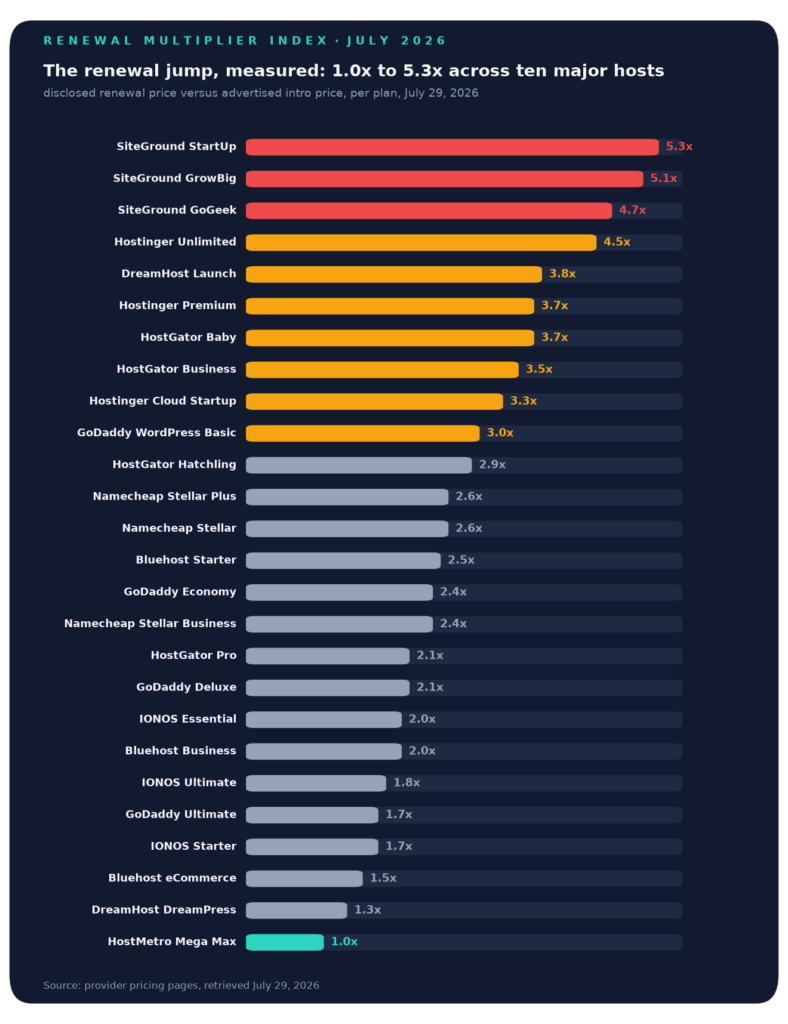
The Index, visualized: red above 4.5x, amber 3 to 4.5x, slate below 3x, teal at 1.0x. Two table rows are not charted: InterServer’s two-step price (2.8x, then locked) and IONOS’s $1 promo artifact.
*IONOS Plus’s 14x is a $1 first-year promotion renewing at the tier’s ordinary $14, a promotional artifact excluded from comparative claims
What moved between June 11 and July 29
- Bluehost entered the measured set at a moderate 1.5–2.5x; its prices were not retrievable in the June runHostinger reshuffled its lineup. The Business plan ($3.99 intro, 4.3x) is gone from the pricing page; in its slot sits Unlimited at $3.79 intro renewing at $16.99, which lifts Hostinger’s top shared multiplier to 4.5xEvery other price measured in both runs was identical across the seven weeks: the multiplier reads as a stable structure, not a fluctuating promotion
What to Do With It
Buyers and procurement: multiply before you sign. The advertised price is a marketing variable; the renewal price is the contract, and it multiplies hardest on the cheapest plans. Every provider in this table now has its number.
Providers in the 3x+ band: the index is now public, dated, and recurring, and the next edition lands after New York enforcement, DFA drafting, and another quarter of renewals have each had time to work. The strategic options were laid out in this publication’s renewal-regulation and price-lock analyses: reprice transparently, lock and advertise it, or watch the multiplier become the headline a regulator or a competitor writes for you.
Providers in the 1.0x club: you are, as of this edition, in possession of a measured, citable, third-party number that says so. The table is public, dated, and built to be cited.

Sources
- Web Hosting Plans and Pricing - Hostinger (official)
- Web Hosting - SiteGround (official)
- Shared Hosting - DreamHost (official)
- Web Hosting - IONOS (official)
- Web Hosting - InterServer (official)
- Price Lock Guarantee - HostMetro (official)
- Shared Hosting - Bluehost (official)
- NY Quietly Amends Automatic Renewal Law - Kelley Drye & Warren
- Digital Fairness Act - European Parliament Legislative Train (official)