
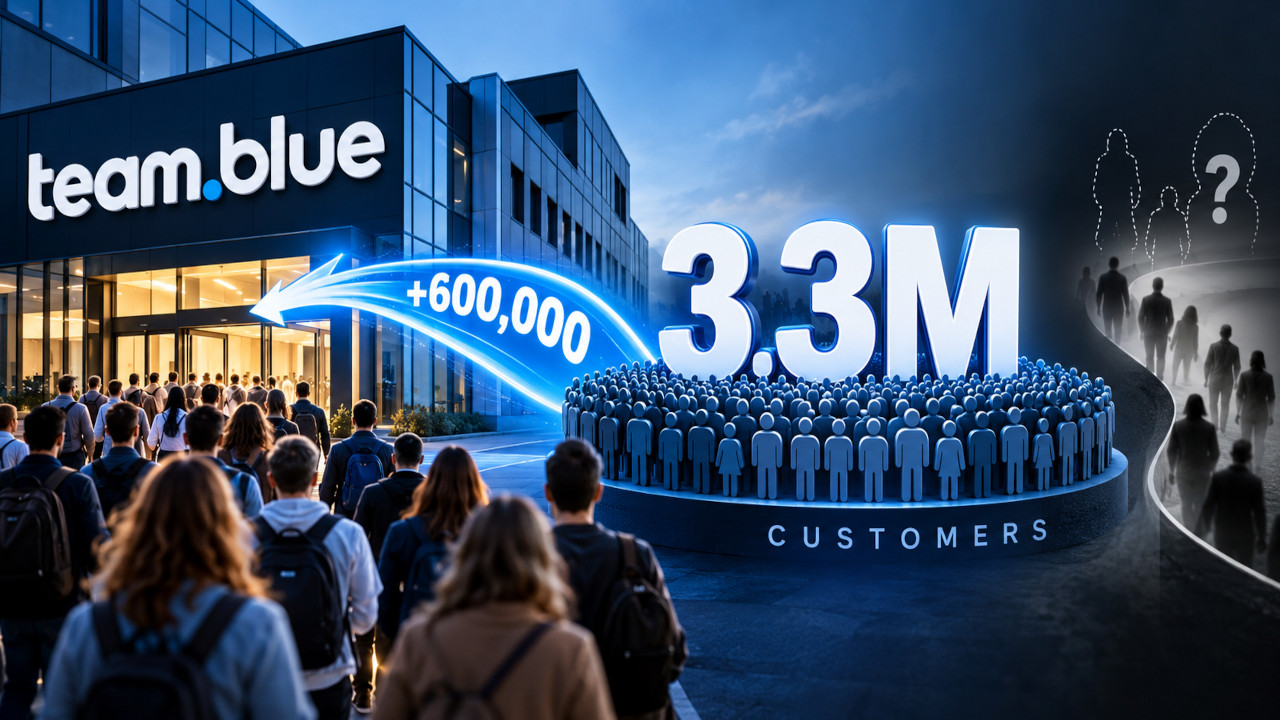
team.blue put its Year in Review 2025 with four numbers: €866 million of annual recurring revenue, 3.3 million customers, more than 600,000 new customers in a year, and more than 4,000 people. The report itself is not new. Its PDF was generated on July 7, the same day the Ghent-based group’s press release announced it had surpassed €850 million in ARR, and its foreword, in which Claudio Corbetta writes that the group “crossed €850M+ in ARR,” is signed by a chief executive who on September 3 was announced as stepping down as group chief executive at the end of the year. What is worth doing now is reading the numbers the group chose to publish next to the ones it did not.
The headline figures are strong on the measures private equity cares about. Reported revenue reached €784 million in FY2025, up from €616 million a year earlier, with an adjusted EBITDA margin of 42 percent, gross margin of 77 percent and 90 percent cash conversion. Net revenue retention is over 100 percent, which means existing customers spend more each year than the group loses to churn. But organic growth is 11 percent, so most of the 27 percent reported growth was bought, and the customer count, 3.3 million in the report and “more than 3.4m” in the boilerplate of the group’s 2026 press releases, is within rounding of the 3.3 million that CPP Investments cited when it bought about a fifth of the company in July 2024. Somewhere between 600,000 new customers and a total that moved by at most a hundred thousand or so sits a departure figure the report does not print.
Hosting M&A Consultation
Get one-on-one advice on maximizing your hosting company’s valuation and navigating the sale process.
- The numbers: ARR €866 million; reported revenue €784 million in FY2025 after €616 million, €505 million and €429 million in the three prior years; organic revenue growth 11 percent; adjusted EBITDA margin 42 percent; gross margin 77 percent; ARPU above €240; NPS +76; LTV to CAC 13x.
- The customers: 3.3 million, about 2.7 million on internet infrastructure and about 600,000 on SaaS, across 23 countries, plus about 30,000 agency and reseller partners. The five largest bases are the Netherlands (~425,000), Italy (~375,000), Sweden (~325,000), Denmark and Czechia (~250,000 each).
- The mix: infrastructure is 73 percent of revenue and 75 percent of EBITDA; SaaS is 27 percent and 25 percent. About €300 million of revenue has been acquired since 2020, and more than 90 percent of founders stay beyond their earn-out.
- The AI claims: AI-enabled products were about 50 percent of new customer ARR in December 2025 and their ARR grows about twice as fast as non-AI products; the group cites a 41 percent developer productivity gain from AI tooling and is deploying MCP servers so external agents “such as Claude and GPT” can operate its products.
- The timing: report and press release dated July 7, 2026; LinkedIn promotion September 29; Ido Erlichman joined as deputy chief executive on September 7 and becomes chief executive on January 1, 2027, with Corbetta moving to deputy chair.
Twenty-Seven Percent Reported, Eleven Organic
The revenue chart on page eight runs €429 million, €505 million, €616 million, €784 million for FY2022 to FY2025. The last step is 27 percent. The organic figure the group states for the same year is 11 percent, and the difference, roughly 16 points, is what acquisitions contributed. That is consistent with the deal count: we reported in March that team.blue completed 11 SaaS acquisitions in 2025 and three more in the first ten weeks of 2026, Windsor.ai, Storyclash and Saleskit, and the report’s own tally is about €300 million of acquired revenue since 2020. Eleven percent organic is a good number for a business that is three quarters domains, hosting and email. It is not the number on the LinkedIn post.
The ARR figure sits above reported revenue, €866 million against €784 million, which is what a subscription business acquiring through the year should show: the run rate at December includes a full year of companies that contributed only part of one to reported revenue. The report gives no FY2024 ARR, so the ARR growth rate cannot be derived from it. The press release’s “€850M+” milestone is the same number rounded down.
What the report does document well is the shape of the profit. Internet infrastructure, the domains and hosting business inherited from Combell, Register and the rest, produces 73 percent of revenue and 75 percent of EBITDA. SaaS, the part the group has been buying, produces 27 percent of revenue and 25 percent of EBITDA. The strategic argument the report makes for the SaaS purchases is that infrastructure acquires the customer and SaaS deepens the relationship. The financial fact is that after roughly €300 million of acquired revenue, the acquired part earns a slightly lower margin than the old part: 25 percent of EBITDA on 27 percent of revenue.
Six Hundred Thousand In, and the Total Barely Moved
CPP Investments’ release of July 10, 2024, announcing its approximately €550 million purchase of about 20 percent of team.blue at a €4.8 billion valuation, described a group of “60+ successful brands who serve 3,3 million customers” across 22 countries. The Year in Review 2025 describes 3.3 million customers across 23 countries, after “600,000+” new customers joined in FY2025 and after 11 acquisitions, each of which brought its own customer list. The group’s press releases of July and September 2026 round the figure up to “more than 3.4m.” On the report’s own figures, the gross additions were about 18 percent of the base, and over the eighteen months from CPP’s release to the end of 2025 the base grew, allowing for rounding to the nearest hundred thousand, by somewhere between nothing and roughly 150,000.
The report does not give a churn rate, a gross retention figure or a count of customers lost, so the arithmetic stops there. Net revenue retention above 100 percent says the customers who stay spend more; it says nothing about how many stay. A hosting group with 2.7 million infrastructure customers loses some every year to closure, consolidation of domains into fewer accounts and competitors, and the group’s ARPU of more than €240 means each departure is worth more than it was. The number that would let a reader judge the 600,000 is the one the report leaves out. We noted in July, on the group’s impact report, that its consolidation model makes a validated emissions path harder to hold; the same model makes a customer count harder to read, because every acquisition resets the base.
Half of New ARR Is a Claim About Products, Not Revenue
The AI section makes three numerical claims. AI-enabled products accounted for about 50 percent of new customer ARR in December 2025. Their ARR grows about twice as fast as that of non-AI products. And the group’s engineers are 41 percent more productive with AI tooling. The first two are share and growth figures for a category the group defines itself; “AI-enabled” covers the AI website builder, Macaly’s application generator, which we covered on December 31, and AI features across the group’s SaaS clusters. Nothing in the report says what share of total ARR, or of the €784 million, those products represent, so the LinkedIn line about products “growing at roughly twice the rate of the rest of the portfolio” is true of a base whose size is not disclosed.
The more concrete part is infrastructure. The report says MCP servers are being deployed across the portfolio so that external agents “such as Claude and GPT” can observe and operate the group’s products, and it describes blue.hub, an orchestration layer with a unified footer on more than 95 percent of brands, as the path to unified identity, billing and cross-brand recommendations. Windsor.ai’s case study says it built and listed an MCP server after joining in January. That is the same direction cPanel took with the MCP support in cPanel AI, which we covered on September 25, and the same open question: the group has 60-plus brands with separate logins, and blue.hub is the project to make them one customer record. The report calls the foundations live; the unified billing it describes is a destination.
The Foreword Is Signed by a Chief Executive on His Way Out
Corbetta’s foreword is the report’s argument in his voice: 30 years of data, a distribution network across 23 countries and SaaS covering “every core SMB workflow” give an AI agent the context and the tools to act, and 65 percent of European SMBs “still lack basic digital solutions.” On September 3, two months after the report was dated, team.blue announced that Ido Erlichman would join as deputy chief executive on September 7 and take over as chief executive on January 1, 2027. Erlichman ran Kape Technologies from about $38 million to more than $620 million of revenue before its 2023 sale at a $1.58 billion equity value, currently leads Outpost24, and has advised team.blue’s SaaS division since 2024. Corbetta, after 26 years at Register.it and team.blue, becomes deputy chair.
Dawn Marriott, the executive chair, put the emphasis on deals in her statement: “His experience of scaling technology businesses in Europe, his track record in disciplined M&A and platform building, and his two years already spent inside team.blue as a strategic advisor make him uniquely well-placed to lead the company forward.” Jonas Dhaenens, founder and president, said the group “would not exist in its current form without Claudio.” Erlichman called team.blue “one of the most interesting technology platforms in Europe, with a strong culture, a talented team and significant opportunity ahead.” None of the three statements mentions organic growth. For a group whose reported growth is 60 percent acquired, whose largest investor Hg has held it since 2019 and whose €4.8 billion valuation CPP Investments paid into in 2024, and whose new chief executive is introduced by his acquisition record, the report’s strongest number, 11 percent organic on a €784 million base, is also the one the next twelve months will test.
