
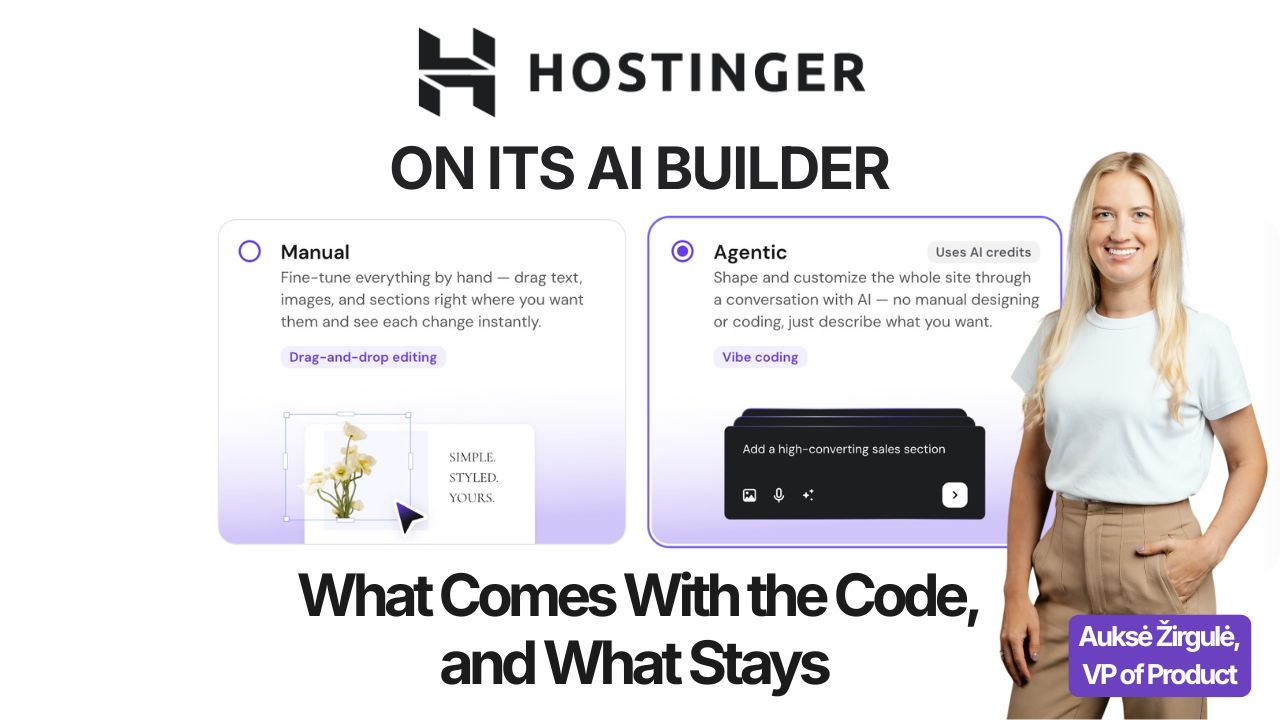
Hostinger has folded its two building products into one platform called AI Builder, and the pitch is that the AI no longer stops at the first draft. According to the announcement, asked to let people create accounts it provisions a database and sets up sign-in; asked to start selling it opens a store; asked to reach customers it works through the company’s own email marketing product.
That raises a question a brochure site never had to answer. When the AI has built the logins and the project has accumulated customer data, what can the customer take somewhere else?
We put it to the company. The answer, from vice president of product Auksė Žirgulė, draws a clean line: the codebase exports, the database stays. Customers “can export the entire project codebase, including the backend logic, and host it elsewhere,” she told us, but “the database itself is not exported, so any existing database records and user account data cannot currently be downloaded.” An exported project “would start with a fresh database rather than the data already collected on Hostinger.”
Key facts
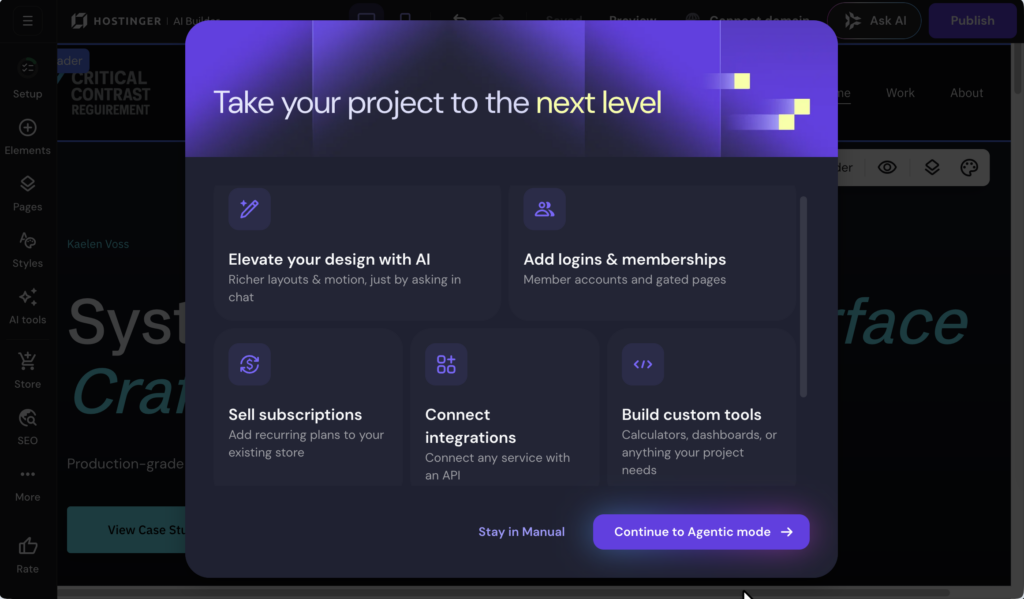
- What launched: AI Builder, announced August 18, 2026, merging Hostinger Website Builder into a manual mode and Horizons into an agentic mode. Available globally to new and existing customers; existing projects keep working.
- What exports: in agentic mode, the project codebase including backend logic. Database records and user account data cannot currently be downloaded, and edited code cannot be imported back into AI Builder.
- If a plan lapses: the site goes offline and data is kept for 30 days, restored on renewal. On a refund it is deleted immediately.
- Whose AI: the agent, platform and deployment pipeline are Hostinger’s. The language models come from external providers including OpenAI, Google and Anthropic, routed per task.
- Credits: charged dynamically to two decimal places. Editing stops when they run out; the published site stays online.
Nearly One in Five Projects Is Not a Website
The launch follows a change in what customers build, the company says. A year ago fewer than 4% of projects created on the platform fell outside traditional website categories. Today nearly one in five are software-as-a-service products, internal tools or learning platforms.
The figure is the company’s own and cannot be checked externally, but Žirgulė gave us the method behind it when we asked. It combines both builders, the classic Website Builder and Horizons. Projects are classified automatically, by analyzing prompts and project content rather than by what customers select from a menu, and anything that cannot be clearly classified is counted as “Other” in the share.
It is also the reason the company gives for the product direction. A customer portal needs authentication, a store needs ecommerce infrastructure, and a learning platform needs somewhere to keep records. Those are the pieces a customer used to assemble alone, and Hostinger calls that handoff the point where most AI building tools stop.
Source: Hostinger
Thirty Days to Renew, and the Records Stay on the Platform
That limit bites hardest on exactly the projects whose share Hostinger says has grown fivefold. A brochure site that leaves carries most of what matters in its files. A customer portal that leaves carries its code, but not the customer records held in Hostinger’s database.
Žirgulė was equally specific about what happens at the end of a plan. If it expires, “the site goes offline but the data is kept for 30 days,” and everything is restored if the plan is renewed inside that window. The single exception runs the other way: on a refund, the data is deleted immediately.
Neither point appears in the launch material, and both came in answer to direct questions. On portability, the qualifier was “currently.”
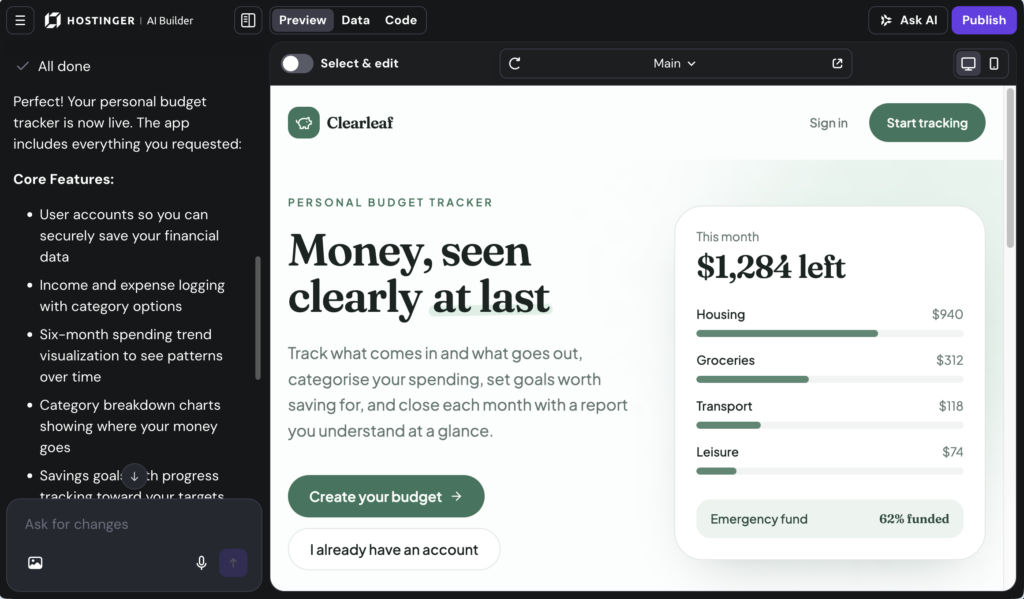
Hostinger’s own documentation, updated this month, fills in the shape of that export. It is written for agentic mode, and describes the output as a Node.js project built with React and Vite, currently the only format available. The code can be deployed as a Node.js application on supported Business and Cloud plans or on a VPS, and it can be built into static files for conventional hosting. What is closed is the way back: once a project has been exported, the page states there is “no way to import the edited version back to Hostinger AI Builder and continue with prompting.”
Source: Hostinger
The AI Acts Because the Backend Is Hostinger’s
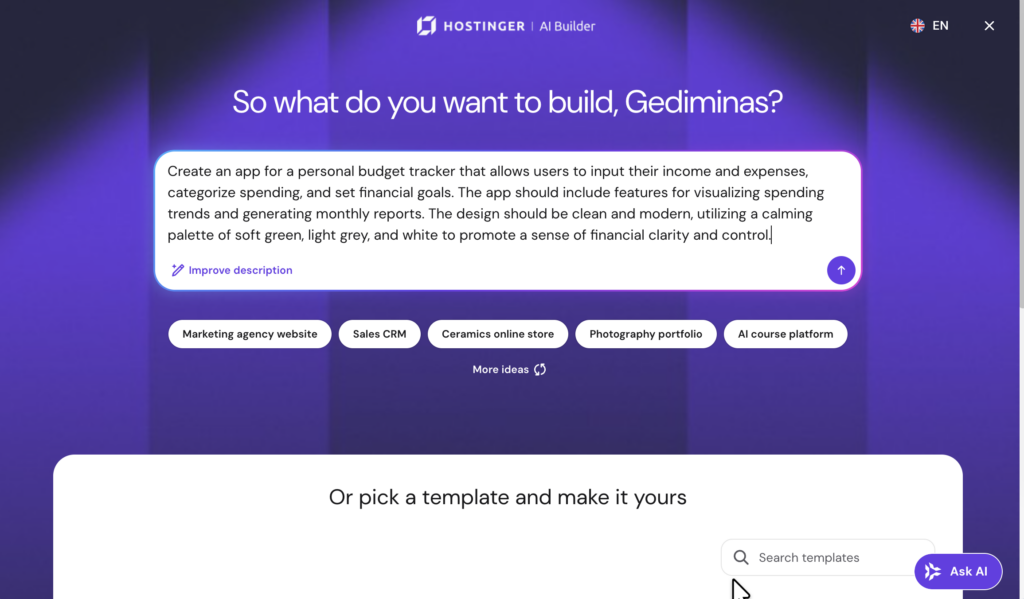
What lets the AI provision a database, a login system or a store is that the core backend and ecommerce systems are native to Hostinger’s platform. Data, authentication, user accounts, file storage and application logic run on Hostinger rather than through third parties, which is the difference between an assistant that recommends a provider and one that provisions the thing itself.
Asked to let people create accounts, AI Builder sets up sign-in from passwords and one-time passcodes through to Google and Apple logins, along with the confirmation and reset emails. Campaigns run through Hostinger Reach. None of it, the company says, requires the customer to research providers, open accounts elsewhere or connect APIs.
The company’s own integrations documentation shows where that boundary ends. It lists Stripe among common integrations, for “setting up payment gateways and handling transactions,” alongside Google AdSense, Mailchimp and Zapier, and it notes that an integration “may require specific details, like API keys, credentials, or account IDs.”
The company says the AI works in an environment kept separate from the published project, and that changes reach the public only when the owner publishes them. That separation is what Hostinger points to when it describes letting the AI work on a business that is already trading.
Agentic access also runs the other way. Hostinger Connector, included free with every plan, lets a customer’s own assistant act on the same account. Claude Code, Cursor and VS Code are named. “A platform is not a platform if only your own AI can use it,” Žirgulė said in the announcement. “A developer’s assistant and our own agent carry out the same operations against the same account.”
Source: Hostinger
Hostinger’s Own Agent, With Models From External Providers
The company boilerplate at the foot of the release says Hostinger “develops its AI capabilities in-house,” while the product pages refer to using the best available models, so we asked which is which. Žirgulė drew the line at the product itself, meaning the agent, the platform and the deployment pipeline, which she said “is all our own engineering.” The models come from outside: “The underlying language models come from providers like OpenAI, Google, and Anthropic. We pick the best model for each task and route between them.”
An engineering post published in January, describing Horizons before the rebrand, put numbers on that routing. Head of Hostinger Horizons Dainius Kavoliūnas said Anthropic’s Sonnet 4.5 led at the initial prompting stage while Google’s Gemini 3 was better for subsequent fixes, with other models invoked as needed. The company reported that adding Gemini 3 lifted its automatic error-fix success rate from 50% to 80%, that mixing models cut total response time by 25%, and that a background error check that took 40 seconds a month earlier had come down to 12 seconds. Those figures describe Horizons in January rather than AI Builder today.
What the Credit Meter Counts
Credits are the practical limit on how much the AI does. Hostinger charges them dynamically rather than per message, calculated to two decimal places, with its documentation giving 0.12 and 2.45 credits as examples of what a simple request and one involving heavy code generation might cost.
Two details are easy to miss. Manual edits made in the select-and-edit mode also draw down credits, typically 0.01 to 0.05, because the documentation says they are processed the same way as AI-generated changes. And top-up bundles, which the company states cost more per credit than a subscription, expire three months after purchase if unused.
The plan pages, as listed on 25 August, put 5 builder credits on the entry Premium plan and 15 on both Unlimited and Cloud Startup, with separate allocations of 500 and 1,000 credits for AI agents on the two higher tiers. The prices shown alongside them are promotional and tied to a 48-month term. Hostinger also says an upgraded AI architecture produces better results earlier, reducing unnecessary prompt iterations and credit usage, a claim that cannot be checked from outside. When credits run out, Žirgulė said, “AI-powered editing stops, but the live website stays online because hosting and AI credits are separate.”
About the Data
The launch announcement, the AI Builder plan pages and Hostinger’s support documentation on dynamic credits, code export and integrations were all read directly on 25 August, as was the January engineering post on model selection. The full press release, including boilerplate absent from the public post, and Auksė Žirgulė’s answers on export, retention, model sourcing and credits were supplied to us and attributed throughout. The share of projects falling outside traditional website categories is the company’s own measurement and cannot be verified externally. The classification method above came from the company in answer to our question.

Sources
- Hostinger Brings the Full Online Journey Into the Agentic Era With AI Builder - Hostinger (company announcement)
- AI Builder - Hostinger (product and pricing page)
- Balancing Performance, Speed, and Cost - Hostinger (engineering blog)
- Hostinger AI Builder: Understanding Dynamic Credits in Agentic Mode - Hostinger (support documentation)
- Hostinger AI Builder: How to Export Code in Agentic Mode - Hostinger (support documentation)
- Hostinger AI Builder: How to Use Integrations in Agentic Mode - Hostinger (support documentation)