
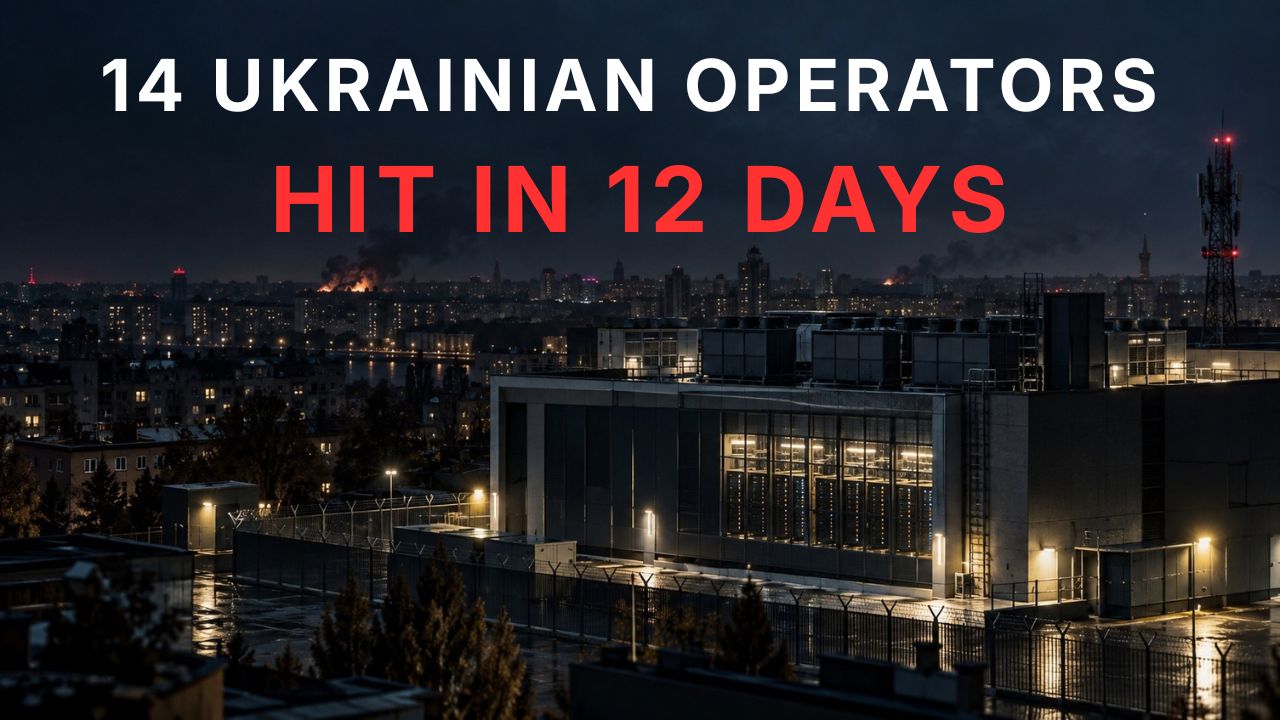
On September 26 Russia’s defense ministry said it was striking Ukrainian data centers because they “process and transmit intelligence data for the Ukrainian Armed Forces.” The next day it posted an image of a drone on social media captioned “Digital detox”, with the comment “Mandatory!”. By then at least fourteen named Ukrainian operators had reported damage to facilities or equipment carrying their networks or services, in twelve days, ending on September 27 with the head office of Kyivstar, the country’s largest mobile operator.
The Institute for the Study of War wrote on September 25 that Russian forces “are intensifying efforts to specifically target Ukrainian data centers and telecommunications infrastructure” as part of a strike campaign aimed at degrading Ukraine’s economy since 2022.
Ukraine’s foreign minister Andrii Sybiha calls the facilities “critical civilian infrastructure that ensures people can access life-saving information” and says they are “not a military target”. The wider Russian strikes of September 23 killed two people and injured more than forty, according to Sybiha, while the attacks on communications infrastructure disrupted internet access for about 100,000 households in Kyiv and the surrounding region, according to Ukraine’s Digital Transformation Ministry.
Key facts
- The scale: at least fourteen named operators reported damage to facilities or equipment carrying their networks between September 15 and 27, from data center operators to retail providers.
- The measurable loss: about 100,000 households in Kyiv and the surrounding oblast lost internet after the September 23 attack, according to the Digital Transformation Ministry.
- The competing accounts: Russia’s defense ministry names military and intelligence use. Ukrainian officials call the sites civilian. The claims about each building could not be independently verified.
- What held: Datagroup and Cosmonova kept or restored services from backup sites, and MiroHost says about 95 percent of its customers run outside Ukraine.
From BeMobile on September 15 to Kyivstar on September 27
On September 15 a Russian drone attack damaged the BeMobile data center in Kyiv. UCloud, which provides services from the facility, confirmed its Kyiv data center had been affected, and the websites it serves, among them that of Ukraine’s National Paralympic Committee, were expected back within several hours, W.Media reported.
Quoted by TASS, the ministry said the strike hit “the B-Mobile data center, which stores, processes and transmits data, including intelligence data, and supports the operation of network equipment for Ukrainian troops.” Two days later another commercial data center in Kyiv was reported hit. On September 19 the target was De Novo, described by W.Media as one of Ukraine’s largest commercial data centers, operating at Tier III standards and hosting major Ukrainian financial institutions.
| Date | Reported hit or disrupted |
|---|---|
| September 15 | BeMobile data center, serving UCloud |
| September 17 | A further commercial data center, not named |
| September 19 | De Novo |
| September 23 | UTELS, Pavutyna, Kyiv traffic exchange point. Service cut for Crazy Network and Fex.net |
| September 24 | Etherlink, MiroHost, CityHost, Domonet, Kievnet, Faust |
| September 25 | Datagroup, Cosmonova |
| September 26 | Cosmonova a second time, Kolo.TV a third time |
| September 27 | Kyivstar head office |
The strikes of September 23 were the first in this sequence to reach retail internet users. UTELS said its core equipment “remains without power, which may cause disruptions to the network and access to services.” Pavutyna said “one of the data centers was damaged in an enemy attack, leaving some of our subscribers without service.” Crazy Network said a strike on Kyiv’s central traffic exchange hub cut service for subscribers in Kyiv, Vinnytsia and Khmelnytskyi oblasts, and the cloud service Fex.net was affected.
Moscow claimed strikes that day on two more Kyiv data centers, New-Telco and United DC, saying the first handled traffic for Ukraine’s defense ministry and the second served security agencies. The Kyiv Independent reported that those claims could not be independently verified.
Overnight into September 24 several more hosting and internet providers reported direct infrastructure damage. Etherlink lost its main network node and relocated the core of its network, equipment belonging to CityHost.UA was destroyed, and so was the data center housing MiroHost’s infrastructure. Domonet, Kievnet and Faust reported damage to their infrastructure. Ukraine’s telecom regulator NKEK said that day that providers were completing emergency restoration, and Domonet estimated service would return by 21:00 that evening. The ministry said it had also struck the Kyivstar and Parkovy telecommunications centers, which it said served Ukraine’s armed forces.
A Datagroup data center was damaged on September 25, and a Cosmonova facility the same day. On September 26 Cosmonova was hit a second time, which took down both its data center and its COSMONOVA|NET backbone and interrupted broadcasts by several television channels, while the Kyiv provider Kolo.TV took its third strike.
On September 27 Reuters reported that Russia hit the head office of Kyivstar, which told Interfax Ukraine there were no casualties, and that the defense ministry said it had struck a data center belonging to Vodafone Ukraine. Vodafone Ukraine did not respond to Reuters’ request for comment. President Volodymyr Zelensky said a Kyiv data center was struck twice that morning, wounding two children and an adult.
What the Strikes Did and Did Not Do
The 100,000 households figure is the one that measures the effect on users, and it describes disrupted access in Kyiv and the surrounding region after September 23 rather than the customer base of any hosting company. MiroHost’s founder Oleksandr Olshanskyi, who also heads Internet Invest Group, told NV Business that his own data center had been destroyed and that about 95 percent of the company’s customers operate outside Ukraine and were unaffected.
“Most critically important data and systems have been moved abroad or to the cloud,” he said. “If an online store stops working, that’s unpleasant but not a tragedy.” He called rumors of a full internet blackout or sharp price rises baseless, and said that destroying all internet access “in a simple way is impossible, you’d have to use nuclear or chemical weapons or destroy 70-80% of buildings in Kyiv.”
ISW’s assessment reaches a similar conclusion from the other direction. Strikes on data centers and telecommunications “can cause temporary internet outages but are unlikely to lead to a complete internet shutdown”, it wrote, placing the campaign alongside earlier Russian targeting of port and railway infrastructure.
Anatolii Frolenkov of the 1-IX internet exchange point told the Kyiv Independent that a nationwide blackout would be extremely difficult to achieve, while describing what is happening now as systematic. “This is the beginning of a phase where, since September, they have started taking it out systematically,” he said. His expectation is that comparable facilities in western Ukraine become targets next.
Olshanskyi’s reading of the intent is that the strikes are meant to unsettle rather than to win anything. “The enemy’s goal is to cause damage, inflame panic, and heighten nervousness,” he said, adding that the destruction of his data center “will not affect the situation at the front in any way.”
What Carried the Load: Backup Sites, and Who Pays for Them
The operators that kept running are the ones that had somewhere else to run from. Datagroup said its services continued from backup sites after its data center was damaged. Cosmonova, hit on September 25, said the building was damaged but that customer data was preserved through copies held at remote sites, and after the second strike it began restoring all services from backup locations away from the damaged facility. Etherlink relocated its network core. Kolo.TV deployed backup resources and rerouted traffic, a job it expected to take several hours.
That redundancy is bought, not assumed. Frolenkov noted that duplicating equipment, keeping backup routes and spreading infrastructure across locations including outside Ukraine is expensive, which leaves many providers without enough of it. HostingJournalist made the same point from the buyer’s side: a provider can have resilient software and still lose the building, the power feed or the exchange point its recovery plan depends on. The questions that follow are where the second site actually sits, whether backups can be restored without the primary one, and who pays for a second independent connection.
Two of the people quoted here disagree about what that costs the customer. The owner of UTELS told Nasha Niva that stable internet at 300 to 350 hryvnias a month, roughly six to seven dollars, is a thing of the past, because operators providing backup power and backup channels cannot keep working at the old tariffs. Olshanskyi called talk of sharp price rises baseless.
The State Response, and a 2027 Timetable
After a meeting of the Staff of the Supreme Commander-in-Chief on September 25, Zelensky said that “additional decisions were also adopted to protect and ensure the uninterrupted operation of our data-center infrastructure and other facilities that are of critical importance in the communications sector.” He named no measures, no covered sites and no funding.
Prime minister Serhiy Koretskyi put the position more plainly: “All infrastructure is at risk. That was true before, it is true now, and it will remain true until the war ends.” In building a system to protect communications infrastructure, he said, “we need to plan for the worst-case scenario and prepare accordingly.”
The same day brought an expansion announcement. MeetKai and Kyivstar said they would build a sovereign AI data center in Ukraine, with first capacity targeted for 2027 and a design that could grow from 15 MW to 100 MW on NVIDIA infrastructure, selling compute to government agencies, critical infrastructure operators, businesses and Kyivstar’s own customers. No GPU count, financing or contracted workload volume was disclosed. As HostingJournalist observed when the plan was announced, a design target of 100 MW is not a construction schedule. Two days later Kyivstar’s head office was hit.
Russian statements about the military use of particular buildings are reported here as claims, and no outlet cited has verified them. The count of fourteen is our tally of the named operators that reported damage to facilities or equipment carrying their own networks or services between September 15 and 27: BeMobile, De Novo, UTELS, Pavutyna, Etherlink, MiroHost, CityHost, Domonet, Kievnet, Faust, Datagroup, Cosmonova, Kolo.TV and Kyivstar. Crazy Network and Fex.net appear in the sequence but are not counted, because the reports describe their service being cut rather than damage to anything carrying it. Nor are the buildings named only by Russia’s defense ministry, or the unnamed commercial data center of September 17.
Provider names are given as the cited outlets spell them, and the transliteration of Oleksandr Olshanskyi’s surname varies between them. Olshanskyi’s 95 percent is his own figure as given to NV Business, and the Kyiv Independent renders it as 90 to 95 percent. None of the companies named were contacted for this article.

Sources
- Russia hits Ukraine's largest mobile provider, strikes data centres - Reuters via Yahoo News
- Russia puts Ukraine's internet in its sights as attacks on Kyiv infrastructure intensify - The Kyiv Independent
- Russian strikes on Kyiv data centers disrupt operations at several Ukrainian media outlets - The Kyiv Independent
- "Killing Ukraine's internet would take nuclear or chemical weapons": MiroHost founder whose data center Russia just destroyed - Euromaidan Press
- Russian attacks damage data centers in Kyiv - W.Media
- Russia launches new attacks on Kyiv data centers - W.Media
- Russia attacked six Ukrainian providers in two days. Part of Kyiv left without internet - Nasha Niva
- Russia strikes Kyiv data center Cosmonova again, hits ISP Kolo.TV for a third time - MediaSat
- Russia keeps attacking Ukrainian data centers, calling it a "mandatory digital detox" - Meduza
- ISW Russian Offensive Campaign Assessment, September 25, 2026 - Kyiv Post
- Ukraine to Strengthen Protection of Data Centers and Critical Communication Infrastructure - UNITED24 Media
- Russian Strikes Force Ukraine to Reassess Data Center Protection - HostingJournalist
- MeetKai and Kyivstar Plan a Ukraine Sovereign AI Data Center - HostingJournalist
- Russia Hits Ukraine's Largest Mobile Provider, Strikes Data Centers - The Moscow Times