
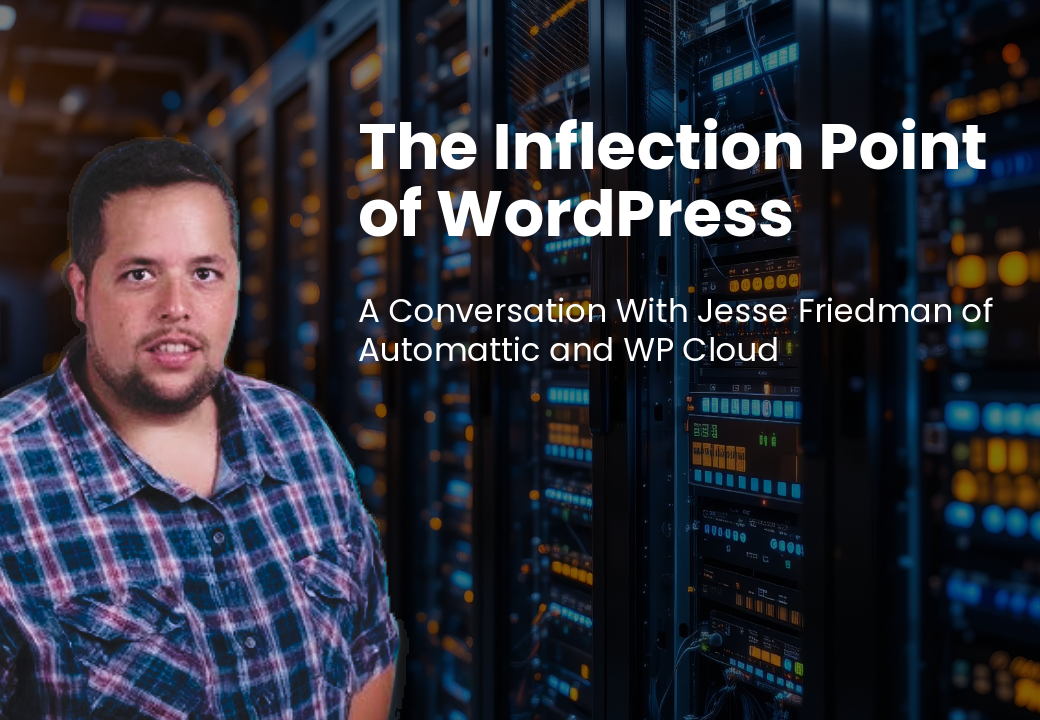
Conversation With Jesse Friedman of Automattic and WP Cloud
The WordPress ecosystem is always evolving, but right now the pace of change feels faster than ever. Nowhere was that more obvious than at State of the Word, This event has grown beyond a community event for developers and site builders. Today, it’s a strategic gathering of board members, decision makers, product managers, and infrastructure engineers, who are actively shaping how the internet is built, delivered, and experienced.
It was against this background that I first spoke with Jesse Friedman, a WordPress pioneer at Automattic and the Head of WP Cloud. What was initially a discussion about specific events quickly developed into the much more abstract issues of responsibility and ownership, and what it means to defend the open web in a world of closed platforms.
This was more than just an interview; it was an articulation of WordPress’s current position and environment.
From WordCamps to Executive Summits, How WordPress Events Are Maturing
WordCamps have always been an important part of the WordPress ecosystem. Events from other platforms don’t compare, and many of the other events are much more expensive. The events are educational and help bring the community together. Those events help strengthen the community and are a great place for first-time users to get a taste of what WordPress can do. For many first-time users, this is where WordPress really starts to make sense. Users become confident enough to launch a site and install plugins.
As the WordPress community has grown and diversified, so have the types of users and use cases. WordPress meets the needs of enterprise publishers, global brands, and other mission-critical infrastructure. They also require a broader, deeper type of conversation than WordCamp can offer.
Business-oriented events like CloudFest, Domain Days, and PressConf offer a new space for the WordPress ecosystem to explore sophisticated discussions on scaling agencies, deal-making, risk, acquisitions, compliance, and hosting. These events add to the WordCamp ecosystem, rather than diminishing it. Like WordPress, the ecosystem is becoming modular, and new events can serve new needs.
“WordCamps are incredibly accessible and curriculum-based, but these newer conferences give us the opportunity to solve niche problems, just like WordPress itself does.”
The growing diversification of events has mirrored the maturation of the WordPress ecosystem. WordPress has grown to have an ecosystem where diversification can flourish.
The Hidden Cost of a Bad First Experience
When events turned to hosting, Jesse returned to a theme important to his role, the significance of the first experience with WordPress.
The first interaction a user encounters, whether on a hosting platform, in the WP-Admin, or during plugin onboarding, is arguably more important than many companies acknowledge.
“The first WordPress experience could often be the last WordPress experience, and everyone who touches that moment has a responsibility.”
For new users, WordPress is a single product, not a collection of companies and plugins. If a site is slow and full of upsells, and it’s hard to grasp, users don’t analyze why that is and conclude that WordPress isn’t the solution for them.
That was the primary reason Jesse started the Impressive Hosting Podcast. Besides promoting companies, the podcast focuses on the various elements that contribute to a positive WordPress experience, including performance, security, onboarding, and usability over time.
“If someone comes in, has a terrible experience, and leaves for Shopify or Squarespace, they don’t think ‘WordPress on a bad host.’ They think ‘WordPress doesn’t work.”
This statement exemplifies the fundamental lessons to be learned to fully understand that hosting is not the product; experience is. This understanding can help to bridge the many gaps that have existed for far too long in the ecosystem.
For instance, not too long ago, simply offering a CMS to users was often a powerful differentiator. But today, it is simply not enough. Providing a CMS to users exposes a business to fierce competition.
These companies do not lead with the technical specifications of their hosting or infrastructure. They lead with outcomes, simplicity, and confidence. They are trusted to be safe, predictable and approachable.
“Most WordPress users don’t care about RAM or workers. They just want a working website.”
Hosting companies in the WordPress space need to change how they market themselves. Performance is important, but it is not enough. What is important is the user experience. Is it to get started? How empowered does it feel to manage the site? How supported is the user when issues arise?
This is where solutions like Extendify, PanelAlpha and WP Cloud come in.
WP Cloud, Infrastructure as a Responsibility
WP Cloud started as a performance-oriented company and, by industry standards, they had great success. There are many success stories documenting sites that migrated to WP Cloud and began managing significantly more traffic, to the point where no additional optimizations were needed.
“We constantly hear the same story: customers move to WP Cloud, change nothing, and instantly handle more traffic.”
However, performance is one piece of the puzzle. WP Cloud is primarily infrastructure for infrastructure. It is an API-driven infrastructure that allows hosting companies and service providers to provide WordPress hosting without the operational headaches of managing large-scale infrastructure.
Currently, WP Cloud drives hosting for leading platforms such as WordPress.com, Pressable, Bluehost, and Convesio.
The value for hosts is not speed and scale. It is largely the freedom that comes with it.
“We manage everything under the infrastructure layer so that the hosts can concentrate on how they would like to serve their customers.”
The ability gives hosts the opportunity to stand out with support models, bespoke interfaces, or specialized offerings, rather than being in a race to the bottom to undercut each other on pricing or features.
Why the Open Web Needs Defending
While WP Cloud concentrates on infrastructure, Jesse turns to a more abstract and pressing concern: the state of the open web.
His main concern is how social platforms are changing how people conceive of the web, particularly younger people.
“A lot of people think Instagram, TikTok, and Amazon are the internet. They don’t realize how small a slice that actually is.”
The problem is all but hypothetical. Creators pour countless hours building a following on platforms that they don’t own. Years of work can be wiped out in an instant because of an algorithm tweak, a suspension, or a policy change.
“You can spend thousands of hours building an audience, and then all of a sudden you have no way to reach them.”
For Jesse, the solution is not to stop using social media, but to reclaim influence on open platforms such as WordPress, where creators have control over their content, data, and communication.
The Overlooked Effect of a WordPress Feature Update
Jesse was asked what one change he would make to WordPress Core, as he has extensive experience with WordPress and understands it well. Most answers focus on performance or features, but Jesse cares most about usability.
More specifically, he cares about usability during onboarding.
“Everyone’s trying to help the user, but the result is a wall of banners and pop-ups.”
He admits it could be improved by having a single onboarding schema stored in WordPress so that plugins can reference it instead of selling the user things and being annoying.
“If plugins shared onboarding data, the experience would finally feel cohesive instead of overwhelming.”
This is a great example of how a little idea with a lot of thought can dramatically improve service levels and the user experience.
Identifying Reliable Web Hosts
Web hosting providers can be a mystery to users and agencies. The lack of clear marketing, the slanted terms of service, and the silence on the providers’ commitment to ethics and security make for a cloudy onboarding experience.
Jesse points to the Secure Hosting Alliance, which he says, along with the i2Coalition, shows early signs of an industry standard he is right to recognize.
“It’s about establishing a baseline of ethics around security, accessibility, and user experience.”
The badge indicates to customers that a hosting company has taken the steps necessary to protect users and the web as a whole.
The Bigger Picture
Considering all of Jesse Friedman’s points, it is clear that WordPress’s future depends on more than its features or how much of the market it can capture. It’s about experience, responsibility, and ownership.
More effective onboarding keeps users.
Improved hosting saves reputations.
A more robust free web defends creators.
That mission is critically important as the world is increasingly dominated by closed platforms and rented audiences.

Jason Nickerson
With over 20 years of experience building and shaping the web, Jason Nickerson has worked across just about every corner of the industry. Jason’s career has mirrored the internet’s evolution — from the recovery after the .com crash to the open-source movement and the rise of cloud services that power the web today.