
TL;DR – The Government of Monaco lost an attempt to seize Monaco.com from a private owner using UDRP. This was proof that governments do not automatically control matching names in .com, even when the name is a country. Unlike ccTLDs, gTLDs still operate under trademark and bad-faith rules, not state sovereignty.
What happened
The Government of Monaco, acting through its trademark holding entity Monaco Brands, filed a UDRP complaint to World Intellectual Property Organization (WIPO), to take control of the domain Monaco.com.
Key facts:
- The domain was in escrow as part of an active sale,
- Escrow.com was holding the domain during the payment plan transaction.
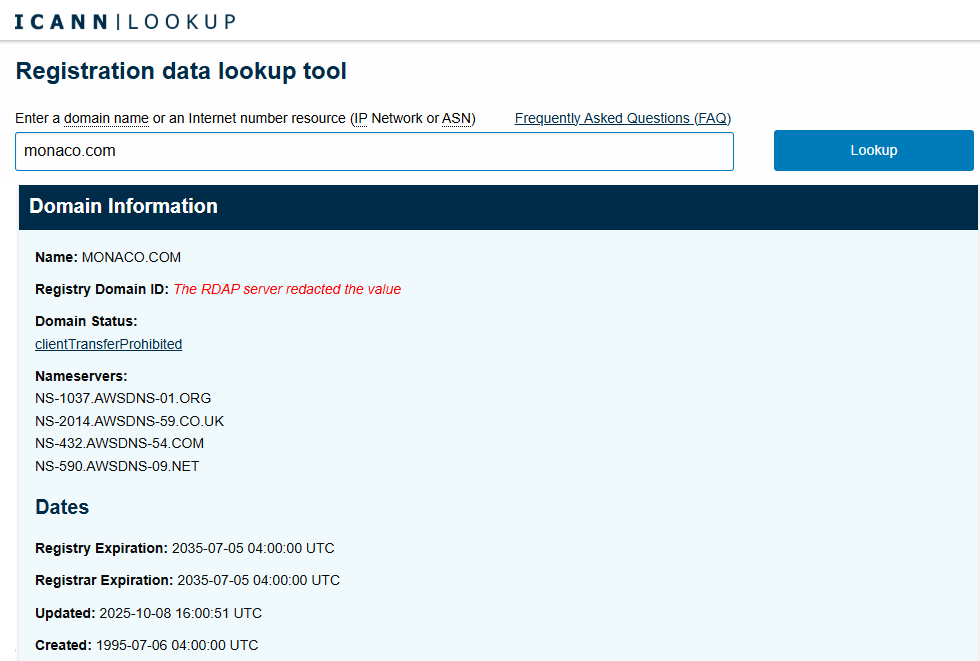
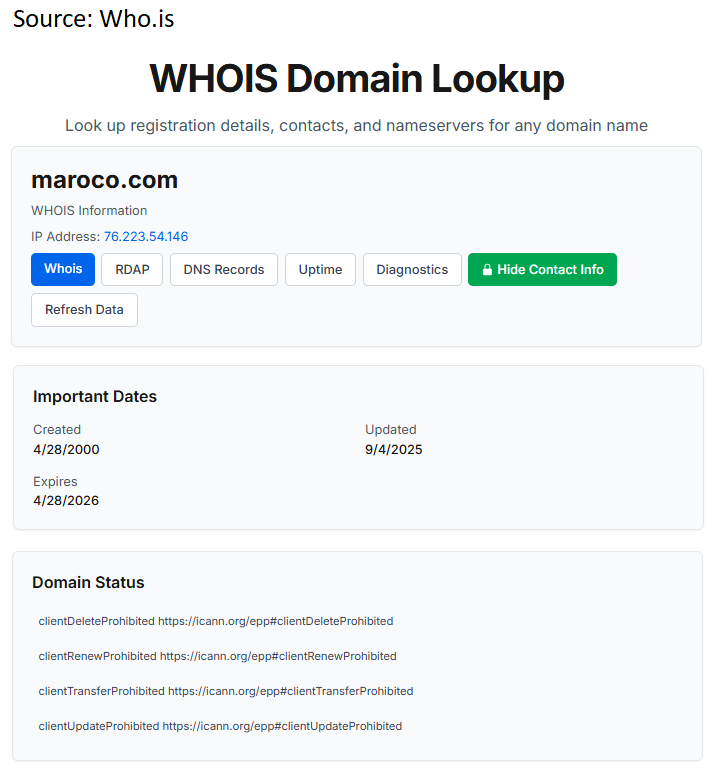
As for 02.02.2026 domain monaco.com is still blocked (in ICANN it has status clientTransferProhibited since 08.10.2025), and according to Whi.is domain status is blocked for all actions:
- clientDeleteProhibited,
- clientRenewProhibited,
- clientTransferProhibited,
- clientUpdateProhibited.
WIPO decision
The 3 WIPO representatives denied of Monaco claims and decided that:
No cybersquatting was found in this case and the WIPO panel decided that it is not the case of reverse domain name hijacking. The government’s arguments were fully rejected.
- the domain was not registered or used in bad faith,
- the person that used this domain had legitimate interests in the domain name,
- the fact that “Monaco” is a country name does not grant automatic rights in .com,
- Monaco’s trademark protections do not extend broadly outside its home jurisdiction, particularly in the United States (which could indicate where Client works.
Why this is not an isolated case
Till now, as far as we know, few governments have attempted to reclaim their exact country name in .com via UDRP and both lost:
- New Zealand (2002) – country was found guilty of reverse domain name hijacking.
- Monaco (2026) – country claims for Monaco.com were declined.
By contrast, Monaco has successfully won many UDRP cases earlier involving:
- “Casino de Monaco”,
- domains clearly tied to gambling or consumer confusion with “Monaco” included.
Bottom line
Monaco.com shows that hosting registrars must:
- freeze domain actions for months,
- handle customer confusion and support load,
- operate under ICANN constraints, not political pressure, if they are present in the country that is a part of a dispute.
This is why registrars often track legal domain disputes.
