
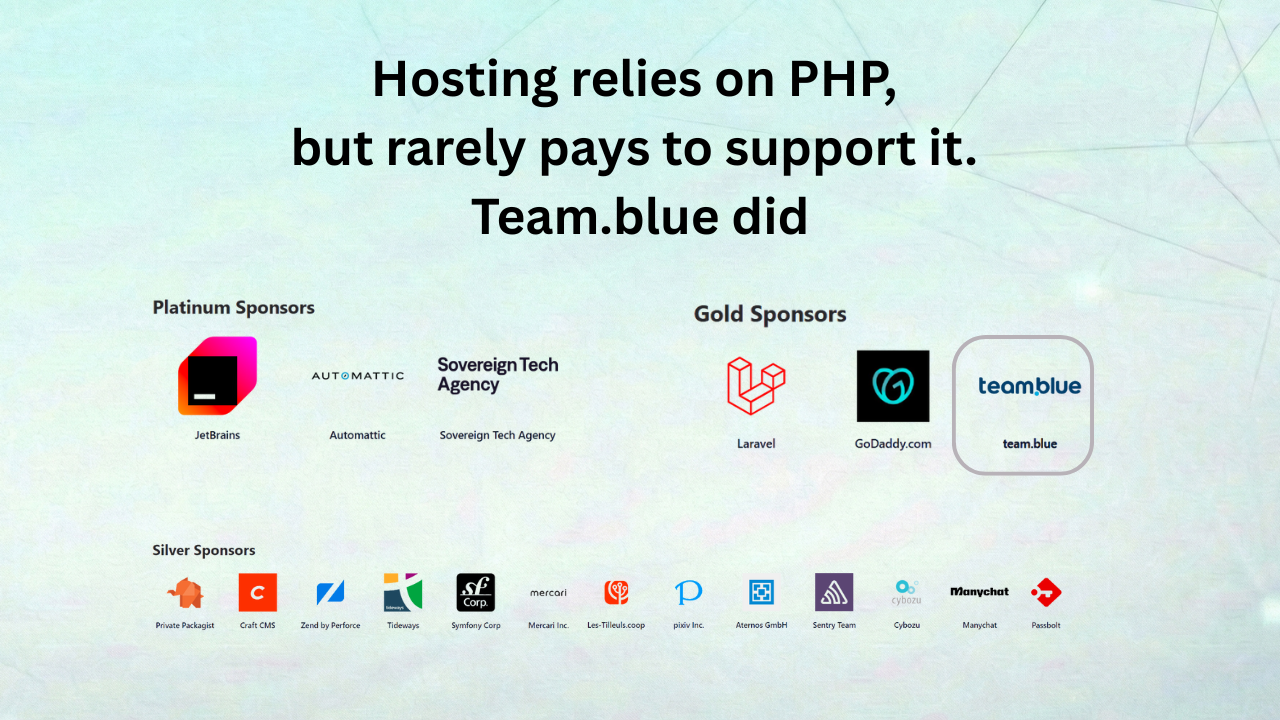
TL;DR – at the end of January 2026, team.blue, one of the largest hosting groups in Europe, announced that it would start financially supporting the PHP Foundation as a Gold Sponsor. On its own, this is a small, almost technical announcement. The contribution (12.000$/year) does not change PHP’s roadmap, nor does it materially alter the economics of the hosting market.
Why the hosting industry is so dependent from PHP
PHP is not an edge technology in hosting and for many providers, PHP workloads account for the majority of active sites, support tickets, and operational risk.
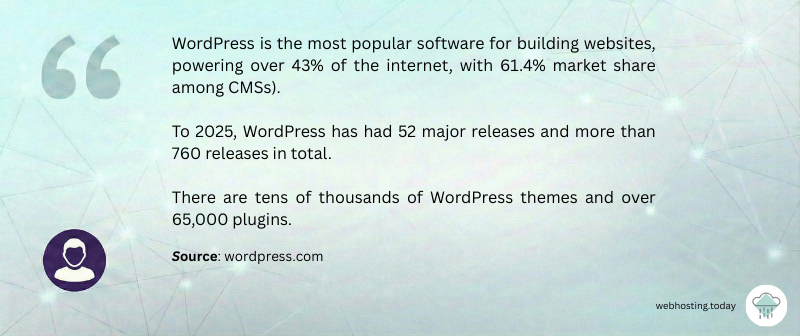
One of the main reasons why PHP needs to be maintained properly and not become another legacy burden is the scale of its adoption, because WordPress and a few other CRMs are built in PHP. According to a w3tech.com report, PHP powers nearly 75% of all websites globally.
Hosting companies operate on top of an unusually large and diverse stack of open-source software – a lot of the core infrastructure that hosting products depend on is not owned, licensed, or built in-house. Linux, MySQL, OpenSSL, web servers, mail servers, control panel components, automation tools – to name a few.
This dependency is inherited from open source ecosystems that evolved long before today’s hosting groups, such as team.blue reached their current scale.
Yet, this problem is rarely discussed, and even more rarely reflected in how hosting companies allocate capital.
Only a handful of operators actively support the upstream projects their businesses rely on.
Most do not.
But not because of negligence, only because the current model has worked for years without requiring conscious decisions.
Hosting companies on the sponsor list
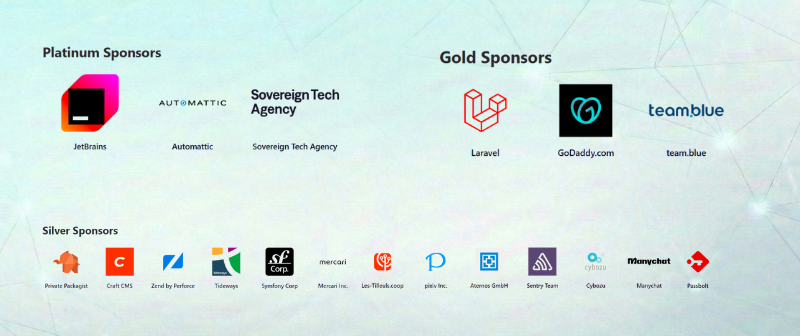
Among 19 active sponsors in 2026, as we mentioned, only three companies can be classified as hosting operators of any kind:
- Automattic/WordPress – with a minimal contribution of $100,000 per year on Platinium,
- and GoDaddy and team.blue – with a minimal contribution of $24,000 per year on Gold.
What team.blue’s move signals
team.blue becoming a Gold Sponsor does not change PHP’s funding dynamics overnight.
The contribution itself is small compared to the scale of hosting revenues.
What it does change is visibility. It makes clearer a relationship that is usually not so visible – that hosting companies depend on PHP not just as a runtime, but as maintained infrastructure that requires paid labor.
The important point is not uniqueness, but proportion. Three hosting companies (two of them shared hosting providers) support PHP financially, while dozens of large hosting brands do not.
We’ll see if now, with team.bluet joining as sponsor and its PR around it, the way that people think and talk about PHP might change.
How PHP Foundation uses donations
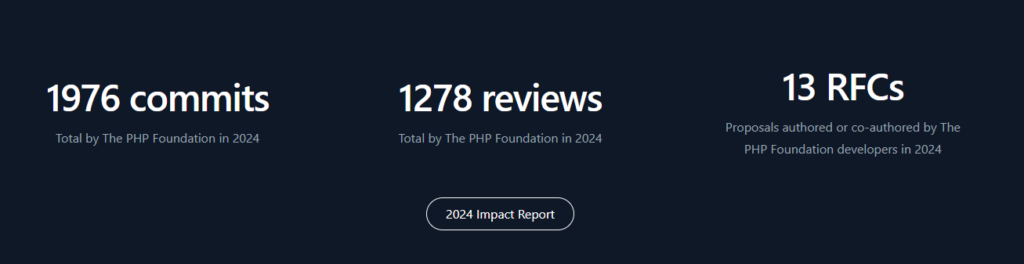
In 2024, the Foundation reported that it raised $685,350 and contracted 10 part-time and full-time developers responsible for a substantial share of PHP core work. They delivered 1,976 commits, 1,278 code reviews, and 13 implemented RFCs in a single year.
They also conducted the first external security audit of PHP core in more than a decade, which was mentioned in team.blue sponsorship announcement.
Bottom line
For hosting operators, PHP’s health directly affects security exposure, incident response costs, upgrade cycles, and long-term platform stability.
The PHP Foundation’s own reporting shows that its capacity is constrained by funding, not by a lack of work.
Decisions about how many developers are retained, how quickly audits are repeated, and how infrastructure evolves are all budget-dependent.
From that perspective, team.blue’s move is less a sign of community goodwill and more an operational risk mitigation strategy.

Damian Andruszkiewicz
Author of this post.