
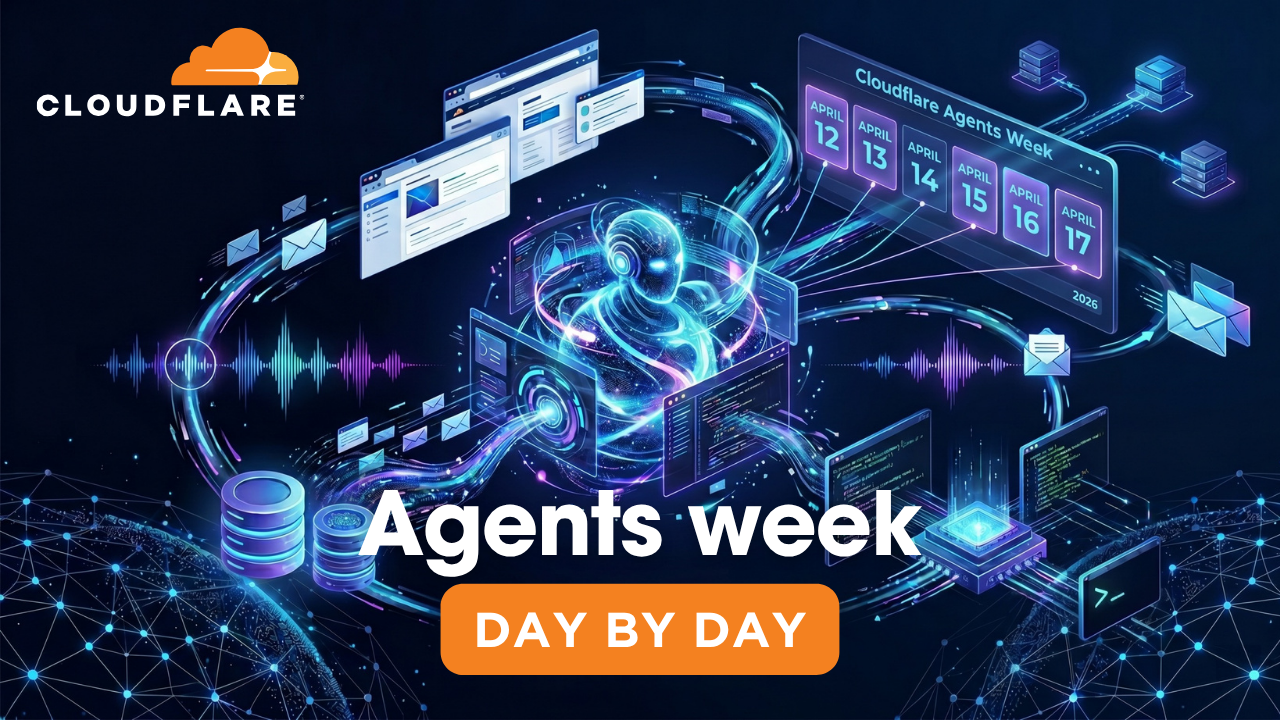
From April 12 to April 17, 2026, Cloudflare published more than 20 announcements covering new products, feature updates, and technical architectures under the banner of Agents Week. The week opened four days after Anthropic launched Claude Managed Agents on April 8, a hosted runtime that packages sandboxed execution, credential management, session checkpointing, and observability into a single API at $0.08 per session-hour. Cloudflare stock fell 11 percent on April 10 in intraday trading. Agents Week was the company’s structured response: not one counter-announcement, but a week of daily releases covering every layer of infrastructure an AI agent needs to run in production.
The competitive argument Cloudflare made throughout the week was explicit. Anthropic’s runtime runs only Claude. Cloudflare’s AI Platform, announced April 16, supports 70 or more models across 12 or more providers, including OpenAI and Anthropic. For organizations that need to run multiple models, avoid lock-in to a single vendor, or enforce their own data governance, the model-agnostic position is the structural difference. Cloudflare maintained its 2026 revenue guidance of 28 to 29 percent growth following the stock decline.
April 12: Opening
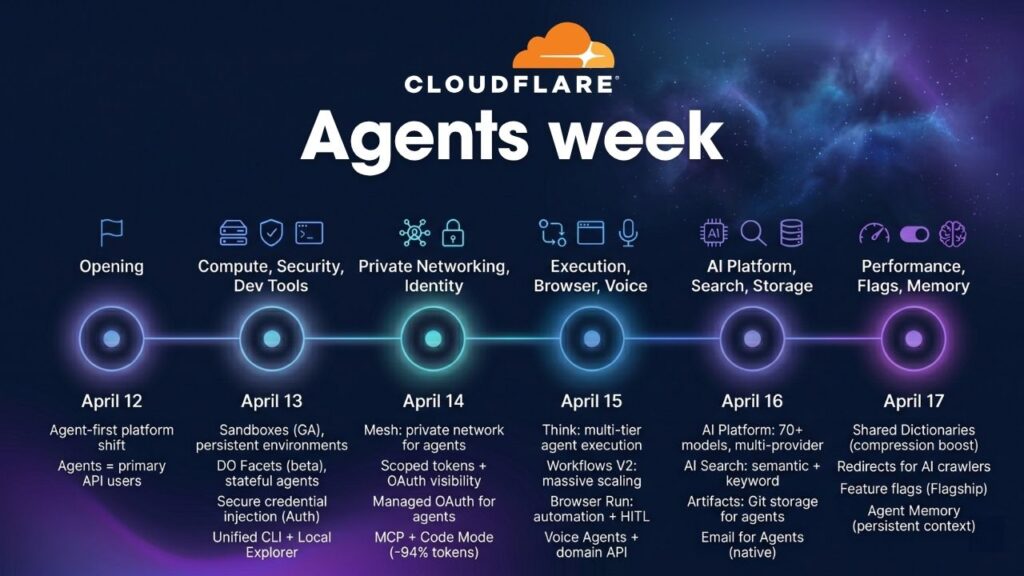
Cloudflare published the Agents Week introduction on April 12, framing the week as infrastructure for “what comes next” rather than a product launch event. No new products were announced on the first day. The post set the context: agents are now the primary users of Cloudflare’s APIs, and the platform is being rebuilt from that perspective.
April 13: Compute, Security, and Developer Tools
Sandboxes reached general availability nine months after their June 2025 beta. They provide persistent, isolated Linux environments with shell access, a filesystem, background processes, live preview URLs, and credential injection. Billing changed to active CPU cycles only, with no charge for idle time.
Sandbox Authentication is a companion security capability for Sandboxes. API keys and OAuth tokens for external services are injected at the network layer and never reach the code running inside the sandbox. Operators can restrict which external services a sandbox is allowed to contact.
Durable Object Facets entered beta on the Workers Paid plan. They allow AI-generated code to include its own persistent storage, not just logic that runs and disappears. Each instance gets an isolated database, so agents can build stateful applications programmatically.
A unified CLI named cf entered technical preview via npx cf. Cloudflare has nearly 3,000 HTTP API operations in total; the current preview covers a subset of products, with a version supporting the full API surface already in internal testing. The CLI is designed with agent-first defaults at the schema layer. A Local Explorer tool entered open beta alongside it, providing a local interface for inspecting Worker bindings and data across KV, R2, D1, Durable Objects, and Workflows, with SQL query support.
April 14: Private Networking, Identity, OAuth, and MCP Governance
Cloudflare Mesh was announced via press release on April 14. It is a private networking layer that connects AI agents, human users, and multi-cloud infrastructure into a single network isolated from the public internet. Each agent receives a distinct cryptographic identity. The service integrates with Workers, Workers VPC, and the Agents SDK.
Securing Non-Human Identities addressed API token security for agents: scannable API tokens, enhanced OAuth visibility, and general availability for resource-scoped permissions. The stated goal is a least-privilege architecture that prevents credential leakage from agent-driven workflows.
Scaling MCP Adoption published a reference architecture for enterprise deployments of the Model Context Protocol. The architecture layers Cloudflare Access for authentication, MCP server portals for centralized governance, AI Gateway for cost controls, and Cloudflare Gateway for detecting unauthorized MCP servers. The post includes Code Mode, a progressive tool disclosure mechanism: in testing with four internal MCP servers exposing 52 tools, the uncompressed context consumed approximately 9,400 tokens; with Code Mode enabled, those 52 tools collapsed into 2 portal tools consuming roughly 600 tokens, a 94 percent reduction.
Managed OAuth for Access entered open beta on April 14. It lets AI agents authenticate with Access-protected applications using standard OAuth 2.0 flows. The implementation uses RFC 9728 (OAuth 2.0 Protected Resource Metadata), which gives agents a standard way to discover where to authenticate before initiating the authorization sequence. The stated benefit is that existing internal applications protected by Cloudflare Access become reachable to agents without changes to those applications.
April 15: Execution, Browser, Voice, and Domain Registration
Project Think is a preview of a new Agents SDK formalizing five execution tiers: Tier 0 (workspace with SQLite and R2 storage), Tier 1 (sandboxed JavaScript without network access), Tier 2 (npm package resolution), Tier 3 (headless browser), and Tier 4 (full OS access with compilers and git). It includes durable execution with fibers, sub-agents with typed RPC, and persistent sessions. Available now as @cloudflare/think.
Workflows V2 is a rebuilt control plane for Cloudflare Workflows, migrated to all existing customers with no required action on their part. Concurrent instances increased from 4,500 to 50,000. Creation rate increased to 300 instances per second, up from 100. Queued instances increased from 1 million to 2 million per workflow. The architecture separates metadata management (SousChef) from instance leasing (Gatekeeper).
Browser Run is the new name for what was previously called Browser Rendering. The April 15 announcement added four capabilities: Live View (real-time visibility into page state, DOM, console, and network), Human in the Loop (handoff from agent to human for approval), Session Recordings, and WebMCP support for typed website functions. Concurrent sessions were quadrupled to 120. Available on Free and Paid plans.
Voice Agents were announced as experimental. The service enables real-time voice interactions over WebSocket with continuous speech-to-text and text-to-speech. The @cloudflare/voice package handles sentence-chunked audio streaming over 16 kHz mono PCM transport.
The Registrar API entered beta, allowing agents to search, check availability, and register domains at cost via the Cloudflare API. Post-registration management including transfers and renewals is planned for later in 2026.
Agent Lee received write operations and Generative UI. It can now update DNS records, modify SSL/TLS settings, configure Workers routes, and enable HTTPS, with every write operation requiring explicit user approval before execution. Generative UI renders inline charts and traffic visualizations from account telemetry. Available in beta for all Free plan users.
April 16: Storage, Search, Email, and AI Platform
Artifacts entered private beta, with public beta expected in early May 2026. It is a Git-compatible storage service for agent-generated code and data supporting millions of repositories, remote forking, and access from any Git client. A REST API and native Workers API handle programmatic creation and commits.
AI Search entered open beta as a built-in search service for agents that combines keyword matching and semantic understanding in a single query. Storage and search index are included. It is accessible from a Worker, the Agents SDK, or Wrangler CLI without separate setup.
Email for Agents graduated from private beta to public beta. Agents can send and receive email natively via Workers bindings without external API keys. Email Routing handles inbound and a transactional sending service handles outbound.
The AI Platform was announced as a unified inference layer connecting to 70 or more models across 12 or more providers, including OpenAI, Google, Anthropic, Alibaba Cloud, Bytedance, Runway, and others. It includes automatic failover across providers, buffered stream recovery, and multimodal model support. Custom model deployment is available via Replicate’s Cog.
April 17: Performance, Content Policy, and Feature Flags
Shared Dictionaries reduces the size of files sent over the network by sharing a reference dictionary between server and client, so only the difference from the previous version is transmitted. In lab testing, a 272KB JavaScript bundle compressed via standard gzip to 92KB; with shared dictionary compression, the same file dropped to 2.6KB, a 97 percent reduction over the already-compressed version. Download time on a cache miss improved 81 percent compared to gzip. Real-world results depend on how much the file changes between deployments.
Agent Readiness Score is a tool that lets site owners check how well their website supports AI agents, including compatibility with new standards tracked via Cloudflare Radar.
Redirects for AI Training was announced April 17 and is available on all paid Cloudflare plans. It converts existing canonical tags on a website into HTTP 301 redirects for verified AI training crawlers automatically, with one toggle and no origin changes. The feature affects only verified training bots such as GPTBot, ClaudeBot, and Bytespider. Human visitors are not redirected.
Flagship entered private beta as a native feature flag service built on Workers, Durable Objects, and KV. It evaluates flags at the edge without external API calls. Flag configurations support logical conditions nested up to five levels deep and percentage-based rollouts via consistent hashing. The stated use case is safely deploying AI-generated code to production by decoupling deployment from release.
Agent Memory was announced as a managed service in private beta. It gives agents persistent memory across sessions: what was discussed, what instructions were given, what tasks were completed. When retrieving context, the service runs multiple search methods in parallel and combines the results, so agents surface relevant information even when it is not described in exactly the same words as the query. The service is built on Cloudflare’s own infrastructure: Durable Objects for storage isolation, Vectorize for semantic search, and Workers AI for processing.
What This Means for Hosting Providers
Over six days, Cloudflare published announcements covering execution, storage, networking, identity, browser automation, email, voice, search, and developer tooling. The releases ranged from general availability graduations (Sandboxes) to infrastructure updates (Workflows V2), open and private betas (AI Search, Artifacts, Agent Memory), developer previews (Project Think), and experimental releases (Voice Agents).
For hosting providers, the competitive question depends on workload type. Cloudflare’s infrastructure is stateless and globally distributed, suited to task-based agents that run for minutes or hours on demand. Persistent, always-on agents that need continuous operation remain a better fit for dedicated VPS or managed server products. The OpenClaw market that traditional hosting providers have been building around over the past five months operates persistent agents. Cloudflare’s architecture does not replace that use case.
The model-agnostic position is the clearest structural difference from Anthropic’s offering. Running 12 or more providers through a single platform means organizations can choose models by task, price, or compliance requirement without rebuilding their infrastructure. Anthropic’s Claude Managed Agents does not offer that flexibility. For enterprises managing risk across multiple AI vendors, that constraint matters more than convenience.

Sources
- Welcome to Agents Week - Cloudflare Blog
- Sandboxes General Availability - Cloudflare Blog
- Sandbox Authentication - Cloudflare Blog
- Durable Object Facets and Dynamic Workers - Cloudflare Blog
- Unified CLI and Local Explorer - Cloudflare Blog
- Agent Lee - Cloudflare Blog
- Cloudflare Launches Mesh to Secure the AI Agent Lifecycle - Cloudflare Press
- Securing Non-Human Identities - Cloudflare Blog
- Scaling MCP Adoption - Cloudflare Blog
- Agent Memory - Cloudflare Blog
- Project Think - Cloudflare Blog
- Workflows V2 - Cloudflare Blog
- Browser Run for AI Agents - Cloudflare Blog
- Voice Agents - Cloudflare Blog
- Managed OAuth for Access - Cloudflare Blog
- Registrar API Beta - Cloudflare Blog
- Artifacts: Git for Agents Beta - Cloudflare Blog
- AI Search - Cloudflare Blog
- Email for Agents - Cloudflare Blog
- AI Platform - Cloudflare Blog
- Redirects for AI Training - Cloudflare Blog
- Shared Dictionaries - Cloudflare Blog
- Flagship: Native Feature Flags - Cloudflare Blog