
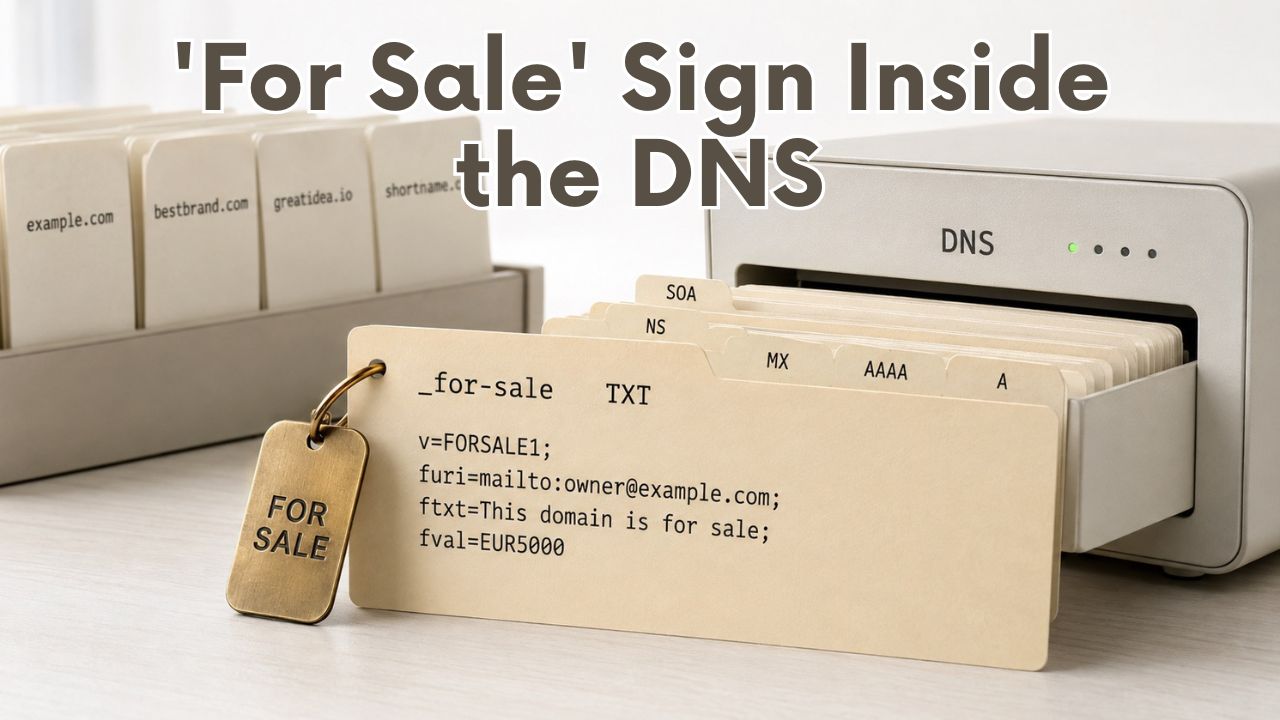
There has never been a standard way to ask a domain name whether its owner wants to sell it. You could guess, look up an often-hidden registration record, or pay a broker to make contact. As of July 2026 there is a simpler option: the owner can hang a sign on the domain itself. A new specification, RFC 10023, defines a plain DNS record that says the name is available and how to reach whoever holds it. The sign lives in the domain, not in a marketplace, and anyone can read it.
A Text Record That Says “Make Me an Offer”
The mechanism is deliberately small. RFC 10023 reserves a leaf node called _for-sale and puts a standard TXT record there. Every such record must open with the version tag v=FORSALE1;. What follows is optional, though the specification recommends including at least one tag so an interested party has something to act on:
furiis a contact route: anhttporhttpsaddress, amailtoaddress, even atelnumberftxtcarries concise, human-readable textfcodholds a code meaningful only to the systems processing itfvalstates an asking price, using ISO 4217 currency codes and, the RFC notes, other widely recognized abbreviations such as cryptocurrencies
Publishing the record does not touch the website, the mail, or anything else the domain does. It simply adds a readable flag beside them.
What the record does not do is as important as what it does. The sale itself stays human. RFC 10023 signals availability and a way to make contact, and stops there; the specification puts the negotiation and the transaction firmly out of scope. This is a discovery layer, a way for a buyer to find the seller directly, not a marketplace and not an automated checkout. The registrant is telling the world the door is open, and leaving the deal to be done the usual way.
SIDN’s Target Is the Middle of the Market
The author is Marco Davids of SIDN Labs, the research arm of the operator of the Dutch .nl registry, and the motivation is openly structural. SIDN says it wants “to make the domain name market more transparent and accessible, so that domain names can be traded more quickly, fairly and effectively”, and it is candid about who it thinks holds the advantage today. In its framing, good names sit idle or get snapped up by professional traders and drop-catchers who profit while the original owner is left out. A standard sign, readable by anyone, is meant to let a registrant signal willingness to sell without first handing the process to an intermediary.
Two choices show the ambition. SIDN took the specification through the IETF rather than bolting a feature onto .nl, precisely so it applies to every extension rather than one country’s names. And it has been piloting the idea with registrars, who expose it as a plain “Sell” button in the control panel: the customer clicks, the registrar hands SIDN a landing-page URL, and the DNS record is written for them. The registrant never edits a TXT record by hand, which is what any DNS-level feature needs if it is to reach owners who are not administrators.
The Catch: Registrars Have to Build It
That dependence is also the weakness. A sign nobody implements is invisible, and the parties who would have to build the button are registrars, many of which are plugged into the secondary market. A registrar whose business is tied to an aftermarket has less reason to surface a feature that lets a customer advertise a name without it. SIDN has said it will stay out of the commercial arrangements between registrars, sellers and buyers, which keeps it neutral but leaves adoption resting on the incentives of the layer it is asking to build the button.
The record itself is more neutral than SIDN’s framing suggests, and that may be its best chance. RFC 10023 explicitly counts brokers among the beneficiaries: such services, it observes, “are of limited value when the domain name is not available for purchase, but they may be beneficial for domain names that are explicitly marked as for sale“. A broker reading these records finds exactly the names worth approaching. The standard does not abolish the middle of the market; it makes the seller’s intent public, and leaves everyone free to act on it.
The specification is honest about its softer edges too. It is an Informational RFC, a convention rather than a mandate, and its security section reads as a list of ways a public, free-text record can be misused: a contact field can point to a malicious or improper URI, tools that follow those links automatically inherit the risk, and the record can be abused as a marketing lure. The scope is deliberately one-directional: the indicator is “only to be used for domain names that are available for purchase”, and the RFC rules that any text suggesting a domain is not for sale is invalid content. There is no negative signal here, and nothing in the convention validates that a published record reflects a real intention to sell. For hosts and registrars weighing whether to surface this, the sign is cheap to publish and cheap to read, but it is only as trustworthy as the party who planted it.
