
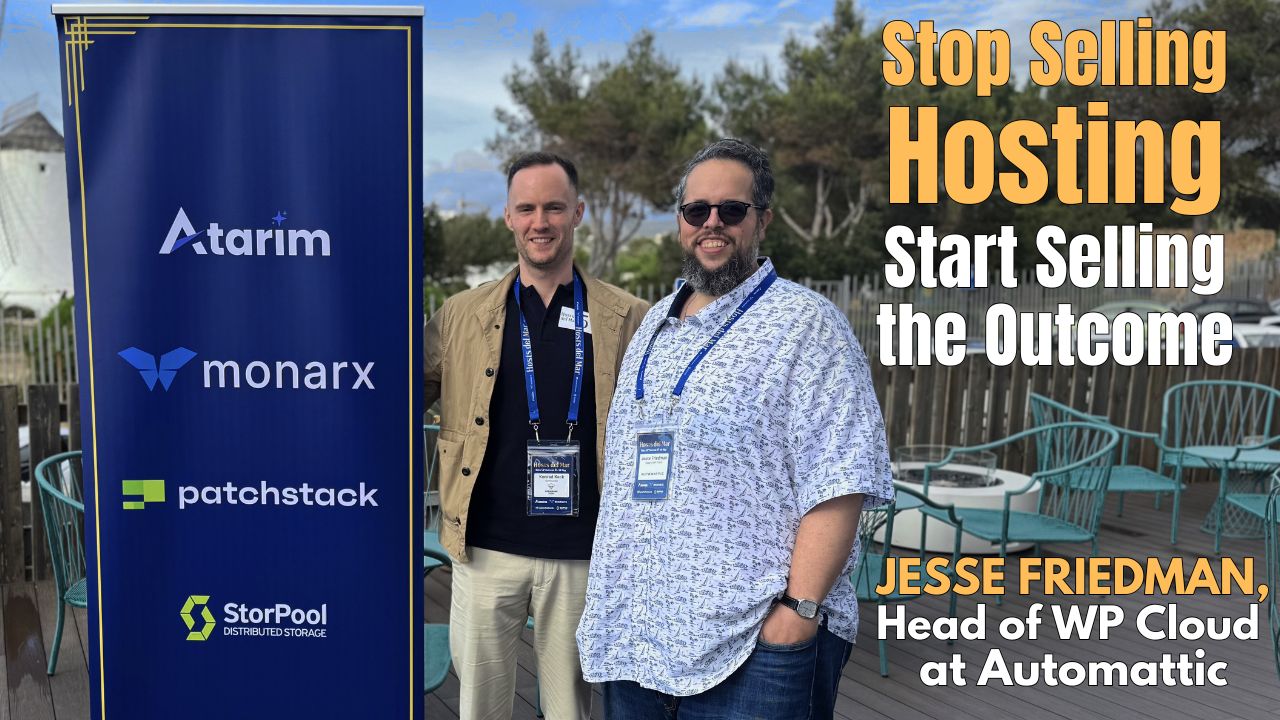
Sit in any pitch from Shopify or Squarespace and you will hear about outcomes – growth, conversions, working stores. Sit in most hosting pitches and you will hear about servers, data centers, and uptime. That gap is much of the story behind who is winning the website market in 2026, and it is what Jesse Friedman, Head of WP Cloud at Automattic, wants the hosting industry to close. We talked at Hosts Del Mar about why the “do it for me” market is pulling away from traditional hosting, how the Abilities API will let AI agents live inside WordPress, and what changes when agents become users in the admin. We finished with why WP Cloud’s next push is at domain registrars – to keep newly bought domains on the open web.
This interview is part of a series recorded at Hosts Del Mar – a private, invite-only hosting industry gathering on Ibiza, organized by Atarim, Monarx, Patchstack, and StorPool Storage.
All Hosts Del Mar interviews →
Konrad: You just came back from a three-month sabbatical. After that kind of break, what struck you about how fast AI has moved into hosting?
Jesse: Automattic gives a three-month paid sabbatical every five years. I spent most of it offline – libraries, cafes, reading, writing, almost no internet. Three months felt like five years away from the market. When I came back, the speed and the certainty had both changed. Last year people in the industry were still asking whether AI really mattered. Now there is no debate. It is reshaping the whole stack and the question is only how fast each piece responds.
Konrad: Where should the hosting industry actually pivot?
Jesse: The companies doing really well right now are in the “do it for me” market. The customer is running a business and wants a working website as a means to an end. They are not necessarily buying hosting. Look at Shopify – the merchant does not learn about servers, data centers, or uptime. They learn about the experience and how likely they are to succeed. As an industry, we are mostly still selling hosting. We can keep building great infrastructure for developers, but we also need to start solving for the outcome. AI helps here in a practical way. It is very hard for one hosting company to build separate offers for lawyer hosting, hair salon hosting, plumbing hosting, every niche. AI makes that achievable. You build a thousand landing pages, each solving a specific problem, all leading into one funnel, and you stop asking the customer what they want, because the niche they came in through already told you.
Konrad: I made a fairly provocative post recently arguing WordPress could become like Joomla in a few years. Where do you disagree?
Jesse: I would disagree. People get excited when they watch AI build a static one-page site in a few minutes, and for a brochure site, that is fine. AI does make that easier. But a real business outgrows the brochure stage. They need a framework that has worked for years, that they can keep building on without rebuilding everything from scratch when something changes. That is where WordPress wins. The other thing is that WordPress is not betting on one AI. You can integrate any AI you want. That means everything the AI knows about you and your business can flow into WordPress, and you get the handheld experience without being locked to a single provider.
Konrad: How does AI actually get into WordPress in a way that lasts beyond a single product?
Jesse: Matt has called WordPress the operating system of the web. Treat that seriously. On Windows or Mac you pick your own software – Claude, OpenAI, whatever – and the OS lets it run. WordPress should work the same. That is what the Abilities API is for. It surfaces to agents what your site can actually do. And it is not just vanilla WordPress – every plugin can extend the Abilities API. So the agent knows what is installed, what it can do, and over time it can read the goals of the site from the plugins themselves. A site with just a blog and photos reads as “I am writing for myself.” A site with SEO tools, marketing tools, analytics reads as “traffic matters here.” The agent does not need the owner to type any of that in.
Konrad: What changes when agents become users inside the WordPress admin?
Jesse: Real-time collaboration gets interesting at that point. Today you and a colleague can edit a post together. Soon a plugin can sit in that same view as an agent with a role and an avatar. Imagine writing an article and Rank Math or Yoast is in there with you, suggesting “use this keyword a few more times.” Jetpack helping you turn the post into a newsletter. Your host’s agent guiding you through an update. I think we will see mascots come back – the Jetpack rocketeer, the Yoast guy, characters with names. The user stops typing requests and starts approving suggestions. Yes or no, yes or no.
Konrad: Where is all of this right now? Is the end user feeling any of it yet?
Jesse: From the outside it can look like everyone is running hard on treadmills facing different directions. A lot of work is happening, the end user does not feel most of it yet. But if you drill into individual companies – Automattic, Bluehost, Rank Math – it is solidifying fast. The shape of it will become visible to users soon, and at that point the question is who does it well first. Whoever does it well first becomes the North Star that everyone else points at.
Konrad: What is WP Cloud trying to do for hosting companies?
Jesse: WP Cloud is a fully managed WordPress platform as a service. We built it for ourselves, saw how well it performed on speed and security, and opened it up. The pitch to a hosting company is simple – you keep your brand and your customer relationship, we take care of the infrastructure underneath. The mission depends on having many hosts selling WordPress in many different ways. There is no single right way to sell WordPress.
Konrad: Why does WP Cloud matter for registrars specifically?
Jesse: This is the part I get most excited about. Take a registrar with a million domains in their book of business who has never sold hosting. A turnkey WP Cloud solution lets them add hosting without building it. That is good for them commercially, but the bigger point is what happens to the domain. Once someone buys a domain, it can go anywhere – into a closed platform, into Shopify, into Squarespace. If the registrar can route it into managed WordPress with one click, the domain stays on the open web. Defending that path is a big part of why turnkey hosting matters for us.
Konrad: What is the next phase for WP Cloud as a product?
Jesse: The question for us is how to help more companies provide an amazing managed WordPress experience under their own brand. We have stayed out of telling partners how to go to market. What I care about is the experience the end customer has, because the first WordPress experience can be the last. People use the plumber as an example a lot – my own dad was actually a master plumber in New York. The plumber’s first WordPress site is the only chance you get. If it goes badly, they do not try WordPress with another host. They go to a completely different platform. Everything we build is in service of that first experience being good, regardless of which partner delivered it.
