
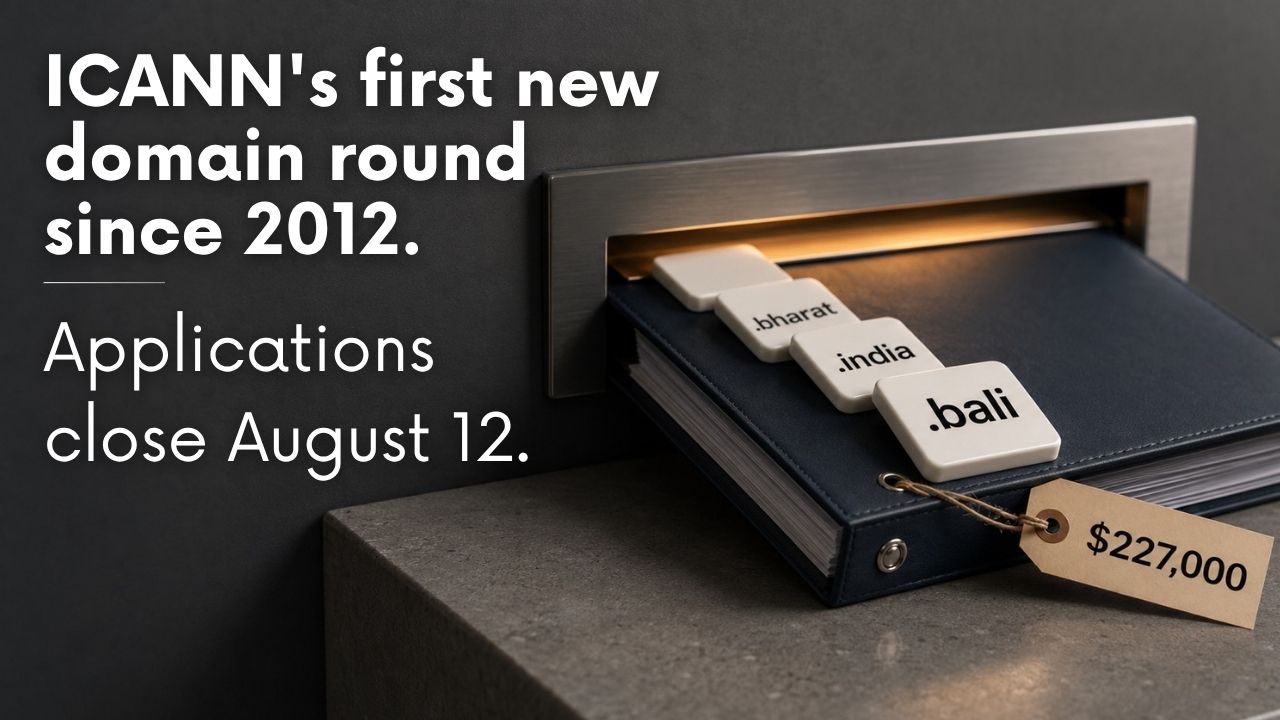
For the first time in fourteen years, anyone with a name, a plan and a serious budget can ask ICANN for their own ending to the internet. The application window for the 2026 New gTLD Program round opened on April 30 and closes on August 12, less than two weeks from now. Whoever is not in by then misses the round: the previous opportunity was the 2012 round, which produced the wave of new endings the web still runs on today. The quiet before the deadline is deceptive, because applications stay confidential until after the window shuts. The list of who asked for what will only surface once it is too late to join.
A 105-Day Window and a $227,000 Ticket
The rulebook for the round is the Applicant Guidebook published in December 2025, and the headline number in it is the price of entry: a gTLD evaluation fee of $227,000 per application. The fee covers one primary string plus up to four variant strings, and all required evaluations, including extended evaluation, through approximately June 30, 2030, a date that quietly signals how long the pipeline from application to a working domain ending can run. Payment is due promptly: ICANN must receive the full amount no later than seven days after the application window closes, or the application is canceled.
The program is not exclusively for deep pockets: an Applicant Support Program offers reduced fees to qualifying applicants. Additional fees apply for special cases, such as .Brand designations or voluntary registry commitments.
Country Names Are Banned, Cities Need a Letter
The geographic rules have real teeth, and early announcements are already colliding with them. Names of countries and territories are ineligible in any language, full stop. That puts the .india and .bharat endings announced by India’s national registry NIXI on a collision course with the guidebook. City and region names can be applied for, but require documented support or non-objection from the relevant public authorities, with a sample letter of governmental support included in the guidebook’s appendix and a separate Geographic Names Review on top of the standard evaluation.
Which brings the round its best story so far: .bali. The governor of the Indonesian island, Wayan Koster, has backed a bid for a Bali top-level domain, with a formal announcement expected at ICANN 87 in October. Note the calendar: the window closes on August 12, so if the bid is aimed at this round, the application has to be filed well before the announcement, not at it. Trade press reports leave open whether the regional government is the applicant or is endorsing a third party’s bid, a distinction the published application list will settle. The island has marketing on its side either way: in Balinese, “dot” means “want”, so “.bali” reads as “I want Bali” to locals, a fitting accident for an economy reportedly built about 80% on tourism.
The announcement will at least be made on home ground: ICANN 87 runs in Bali from October 17 to 22, after ICANN relocated its Annual General Meeting from Muscat, Oman over regional security concerns.
What August 12 Starts, Not Ends
The deadline is the beginning of the long part. After the window closes and fees clear, ICANN publishes the full list of applied-for strings, the moment the market learns which brands, cities and entrepreneurs put $227,000 on the table. Then come evaluations, objections and contention resolution between competing applicants for the same string. How long that takes is written into the price list: the evaluation fee alone is set to cover work through approximately mid-2030.
For hosting providers and registrars the round is worth watching from two sides. New endings are future shelf inventory: every TLD that survives evaluation will be looking for exactly the sales channels hosts and registrars own. And for customers, the published list doubles as an early warning system, showing which strings relevant to their brands or markets someone else has claimed. The chance to act on the first has, for anyone starting from scratch, in practice already passed, given the preparation an application takes. The second opens the day the list goes public.
About the Data
Window dates, the evaluation fee and its payment terms, the Applicant Support Program, and the geographic name rules come directly from ICANN’s New gTLD Program site and the 2026 Round Applicant Guidebook. The ICANN 87 venue and relocation are per ICANN’s official announcement. The .bali and .india details come from Domain Incite’s reporting, which itself notes it is unclear whether Bali’s government is the applicant or an endorser; we repeat that caveat here. No list of applications exists publicly until ICANN publishes one after the window closes.

Sources
- New gTLD Program: 2026 Round - ICANN (official)
- gTLD Evaluation Fee Frequently Asked Questions - ICANN (official)
- New gTLD Program: 2026 Round Applicant Guidebook - ICANN (official)
- ICANN87 Annual General Meeting to Be Held in Bali, Indonesia - ICANN (official)
- Bali to Apply for .bali, and the Dot Is Delightful - Domain Incite