
GoDaddy closed the second quarter of 2026 with numbers that read, at first glance, like a routine solid quarter: revenue up 6.6% to $1.298 billion, margins wider, full-year guidance intact. The line that explains the company sits further down the release. GoDaddy ended June with 20.5 million customers, just 22 thousand more than three months earlier, and 35 thousand more than in December. The world’s largest domain registrar has, for practical purposes, stopped adding customers. The release does not say why, and does not need to: whether the cause is a saturated SMB market, churn offsetting wins, or deliberate focus on higher-value accounts, the quarter’s economics did not depend on the answer. Its revenue grew anyway, by $80 million year over year, because the customers it already has are paying more.
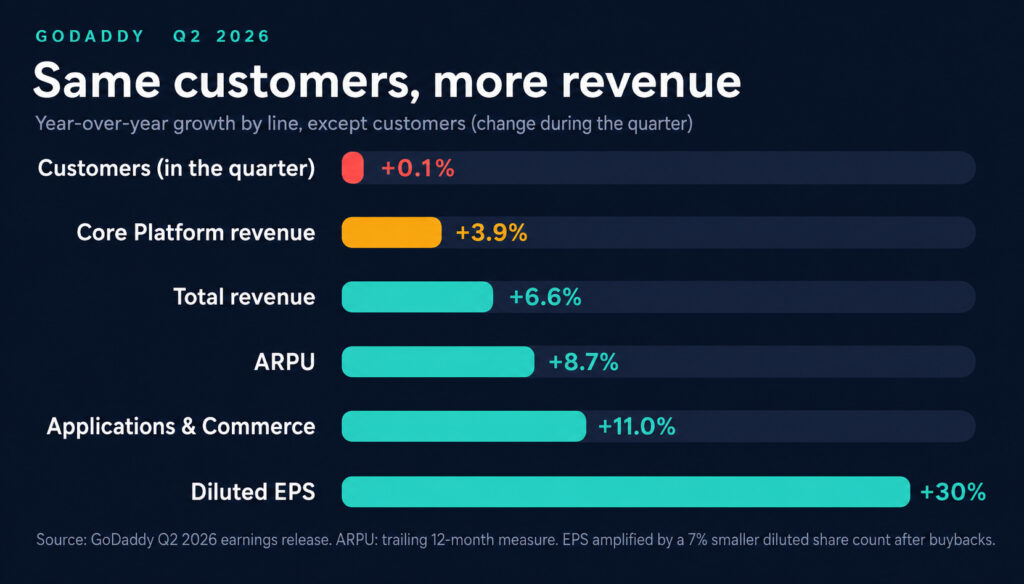
Customer count is the change during the quarter; all other lines are year over year. Source: GoDaddy Q2 2026 earnings release.
A $20 Raise Across 20 Million Customers
The mechanism is visible in a single metric. Average revenue per user reached $250 over the twelve months through June, up from $230 a year earlier, an 8.7% increase. With the customer count effectively flat, ARPU is not one growth driver among several. It is the growth. And the flat line is not an artifact of a narrow definition: GoDaddy counts as a customer anyone with a paid transaction in the trailing twelve months or an active paid subscription.
The spending pattern says the same thing. GoDaddy put $89.0 million into marketing and advertising in the quarter, down from $93.4 million a year ago. A company fighting to win new customers spends more to reach them; a company that earns its growth from the base it already owns can afford to spend less. Total bookings of $1.42 billion, up 5.7%, confirm the model is holding rather than accelerating.
The renewal machine shows up on the balance sheet too. GoDaddy is sitting on $3.5 billion of deferred revenue, money customers have already paid for services still to be delivered, up $193 million in the first half alone, and annualized recurring revenue stands at $4.4 billion. About half of the coming year’s revenue has, in effect, already been collected. The question each quarter is not whether the base shows up, but how much more it pays when it does.
Domains and Hosting Are the Slow Lane
Core Platform, the segment that holds domains, hosting and security, the products this industry is named after, grew 3.9% to $783.2 million. Inside it, domain revenue rose 5% to $470 million, with the aftermarket portion of that up 9% to $129 million, which leaves the rest of the segment, hosting and security among it, growing slower still. Applications and Commerce, the layer sold on top, website building, productivity tools and payments, grew 11.0% to $514.8 million and now brings in nearly 40% of revenue at a 46.8% segment EBITDA margin. The registrar’s future profit pool sits in what gets attached to the domain, not in the domain itself. One wrinkle is already visible in that layer: GoDaddy notes that A&C growth is moderating as customers consolidate several subscriptions into a single Airo plan, its AI product absorbing spend the attach layer used to book separately.
Seen from the hosting market’s side, this is the same shape our July Renewal Multiplier Index measured from the outside. In that survey, GoDaddy’s hosting plans renewed at 1.7x to 3.0x their advertised intro price on 36-month terms, with the entry plan stepping up harder than the top one, 2.4x against 1.7x. Hold the sticker price low, collect the difference at renewal, attach more products along the way: the quarter’s segment split now shows the same pattern from the inside, with the attach layer growing almost three times as fast as the core.
How 6.6% Growth Becomes 30% Per Share
The rest of the quarter is a lesson in multiplication. Operating income rose 28.6% to $342.5 million as the operating margin widened 4.5 points to 26.4%. Net income grew 20.1% to $240.1 million. Free cash flow reached $443.5 million. On top of that, GoDaddy has repurchased 9.8 million of its own shares for $851.8 million this year through July 29, a 7% gross reduction in its fully diluted share count since the start of the year. With the average diluted share count down 7% from a year ago, diluted earnings per share reached $1.83, up 30% from $1.41, on revenue growth of 6.6%.
The scale of the return programme is worth pausing on. In the first half, GoDaddy spent $824.4 million on repurchases against $917.1 million of free cash flow, handing back nearly every dollar the business generated, and Class A shares outstanding are down 8.7% in a year. Total stockholders’ equity, $215.1 million in December, now stands at $6.7 million, against $8.0 billion of assets. This is a company structured to convert a mature customer base into cash and pass it through, not to accumulate.
Guidance stays on the same track. GoDaddy narrowed its full-year revenue range to $5.215 to $5.255 billion, 6% growth at the midpoint, reaffirmed a normalized EBITDA margin target above 33%, and kept its $1.8 billion free cash flow target. For the third quarter it expects 5% growth, flagging its toughest comparison against last year’s strong domain Aftermarket. The market’s first read was cooler than the release: the stock fell more than 7% in after-hours trading, giving back part of a 17% run over the prior month.
GoDaddy’s Answer to a Flat Base: AI and Agents
If the paying human base has plateaued, the open question is where the next one comes from, and GoDaddy’s answer in this release is unambiguous: software agents. Airo reached an annualized bookings run rate of $50 million, five times the figure GoDaddy reported one quarter earlier. The company announced its intent to contribute its Agent Name Service to the Linux Foundation, is co-developing an agent discovery layer with partners including Google, Microsoft, Nvidia and Salesforce, and launched a Developer Platform whose APIs let AI systems search, buy and configure domains inside the tools where they run. Next to $5.2 billion in revenue these are small numbers. But in a company whose customer count barely moves, they are the only line growing at that speed.
About the Data
Figures come from GoDaddy’s second quarter 2026 earnings release, published July 30, 2026 on its investor relations site, including the consolidated statements and the company’s own operating metrics. The domain and aftermarket breakdown, the Airo consolidation commentary, and the after-hours share move are per Domain Name Wire’s reporting on the results. ARPU is GoDaddy’s trailing twelve-month measure; bookings, NEBITDA and free cash flow follow the company’s stated definitions; the Airo run rate comparison uses the figure GoDaddy disclosed in its first quarter release. Customer counts are company-reported. Comparisons are year over year unless noted. No analyst estimates or third-party projections are used.

Sources
- GoDaddy Reports Second Quarter 2026 Financial Results - GoDaddy Investor Relations (official)
- GoDaddy Inc. Reports Second Quarter 2026 Financial Results - PR Newswire
- GoDaddy Reports First Quarter 2026 Financial Results - GoDaddy Investor Relations (official)
- GoDaddy Aftermarket Revenue Up 9% Year Over Year, Shares Sink on Earnings - Domain Name Wire